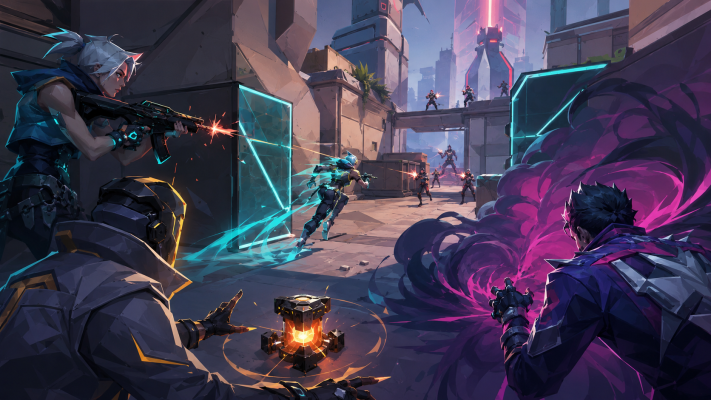
Valorant can feel intimidating during the first match. You load in, choose an agent because they look cool, buy a weapon you barely understand, walk around a corner, and suddenly someone removes you from the round before you even finish thinking, “Was that enemy already there?” That is a normal beginner experience. Valorant is not only about fast aim. It is a tactical shooter where patience, positioning, utility, economy, communication, and team decisions matter just as much as reaction speed.
This guide-course is made for new players who want to move from confused first matches to smarter aim, better agent choices, and more useful team play. You do not need to become a ranked monster overnight. You need to understand the basic rhythm of a round: buy correctly, move carefully, use abilities with purpose, take better fights, support teammates, and learn from every round instead of simply blaming aim.
We will go through 8 practical steps. Each step focuses on one part of Valorant that beginners often misunderstand: round structure, crosshair placement, agent roles, abilities, economy, map control, communication, and improvement habits. Valorant rewards players who think before they swing. It also rewards players who do not reload in the open like they are auditioning for a tragedy.
Step 1: Understand the Round Before You Chase Highlights
Valorant rounds are short, but they have structure. One team attacks, the other defends. Attackers usually try to plant the spike on a site. Defenders try to stop the plant, delay the push, or retake the site after the spike is planted. If you understand this basic rhythm, the game becomes much less random.
New players often treat each round like a deathmatch. They run forward, look for enemies, take the first fight available, and hope their aim solves everything. Sometimes it works. Most of the time, it creates early deaths that leave the team weaker. Valorant is about winning rounds, not just collecting fights. A smart player knows when to push, when to hold, when to wait, and when staying alive is more valuable than chasing one risky duel.
- As an attacker: your job is to help create space, reach a site, plant the spike, and defend it after planting.
- As a defender: your job is to delay, gather information, survive pressure, and help teammates rotate when needed.
- After the spike is planted: attackers should protect the spike, not wander around looking for unnecessary fights.
- During a retake: defenders should group, use utility, and enter together instead of arriving one by one.
A good beginner goal is simple: before each round begins, ask yourself what your job is. Are you holding a site? Watching a flank? Entering with the team? Supporting with utility? Playing for spike? That one question can stop you from drifting through the round without purpose.
Step 2: Improve Aim With Crosshair Placement First
Many beginners think better aim means moving the mouse faster. In Valorant, smarter aim usually starts with crosshair placement. This means keeping your crosshair where an enemy’s head is likely to appear before they appear. If your crosshair is already at head height and near the angle, you need less adjustment when the fight starts.
Poor crosshair placement makes every duel harder. If your crosshair is pointed at the floor, the wall, or someone’s knees, you must move farther before shooting. That extra movement takes time, and Valorant is not very forgiving with time. Good crosshair placement makes your aim feel faster without actually requiring superhuman reflexes.
- Keep your crosshair at head level. Practice this while walking around the map.
- Pre-aim common angles. Aim where enemies usually stand before you peek.
- Move your crosshair smoothly around corners. Do not stare at the ground while entering areas.
- Stop before shooting. Running accuracy is limited, so learn to pause before firing.
- Use short bursts. Spraying wildly often makes bullets climb away from the target.
Aim training can help, but do not ignore in-game habits. You can practice for hours in a range, then lose fights because your crosshair placement is lazy during real rounds. The best aim is not just mechanical. It is prepared. You want your crosshair to say, “I expected you,” not “Oh no, a person.”
Step 3: Choose Agents by Role, Not Only by Style
Valorant agents have different roles, and those roles shape how your team plays. Beginners often pick agents because they look cool, have flashy abilities, or appear in highlight clips. That is fine at first, but learning roles helps you become more useful to the team. A strong agent choice is not only about personal comfort. It is about what the team needs and what you can actually play well.
There are several main role types. Duelists are usually expected to create space and take aggressive fights. Initiators help reveal, flash, or disrupt enemies before the team enters. Controllers use smokes to block sightlines and shape the map. Sentinels protect areas, watch flanks, and slow enemy pushes. Each role teaches different habits, so beginners should try several before deciding what fits.
- Duelists: good for players who like entering first and taking space, but this role requires confidence and timing.
- Initiators: useful for players who want to help the team start fights with information or disruption.
- Controllers: important for blocking enemy vision and making site takes safer.
- Sentinels: strong for players who like holding areas, watching flanks, and playing patiently.
If you are new, do not feel forced to instalock the flashiest agent. Choose one or two agents and learn them properly. Understand what their abilities do, when to use them, and how they support the round plan. A simple agent played well is much better than a complicated agent played like a confused magician.
Step 4: Use Abilities With Purpose, Not Just Because They Are Available
Abilities are a huge part of Valorant, but beginners often use them randomly. They throw utility too early, too late, in the wrong direction, or after the fight is already over. Abilities should help create an advantage. They can block vision, gather information, force enemies out of positions, delay pushes, protect the spike, or make fights safer.
Before using an ability, ask what it is supposed to achieve. Are you clearing an angle? Helping a teammate enter? Stopping a rush? Blocking a sniper line? Delaying a defuse? If you do not know why you are using it, save it. Utility is limited, and wasting it can make the later part of the round much harder.
- Use information abilities before entering dangerous areas. Do not walk blind into every angle.
- Use smokes to block enemy sightlines. A good smoke makes a site take safer.
- Use flashes with timing. Flash for yourself or teammates, not into empty space.
- Use slowing utility to delay pushes. Defenders can win time without taking risky fights.
- Save post-plant utility. Some abilities are extremely useful after the spike is planted.
Good utility does not always create a highlight. Sometimes the best ability is one that prevents a teammate from being exposed, blocks a dangerous angle, or buys five seconds. Valorant rounds are often won by small advantages that do not look dramatic but quietly make the enemy’s life worse.
Step 5: Learn Economy Before Buying Like a Tourist
Valorant has an economy system, which means your money affects your weapons, shields, and abilities. Beginners often buy randomly every round. One round they buy a strong rifle with no shields. Next round they force a weak weapon while the team is saving. Then everyone has different money, different weapons, and no shared plan. This makes the game harder than it needs to be.
The basic idea is simple: teams should usually buy together or save together. A full buy means your team has enough money for strong weapons, shields, and useful abilities. A save round means you spend little so you can buy properly next round. A force buy means you spend despite limited money, usually because the round situation demands risk. The key is that the team should understand the plan.
- Full buy: buy proper weapons, shields, and abilities when the team can afford it.
- Save round: spend little so the team can have a stronger next round.
- Force buy: spend limited money when the team decides the risk is worth it.
- Do not buy alone. One expensive rifle on a team of weak pistols often creates imbalance.
- Check teammate money. Buying should be a team decision, not a personal shopping trip.
Economy is not the most exciting part of Valorant, but it wins matches. A team with coordinated buys has more consistent rounds. A team that buys randomly often feels strong one round and helpless the next. Good economy is like cleaning your room: not glamorous, but everything works better afterward.
Step 6: Play the Map Instead of Only Playing Your Crosshair
Map control is one of the biggest steps from beginner to smarter player. Valorant maps are built around sites, lanes, chokepoints, corners, mid areas, flanks, and rotation paths. If you understand the map, you understand where enemies might be, where your team is weak, and when to rotate. If you ignore the map, every enemy feels like they appeared by magic.
As an attacker, map control helps your team avoid being trapped in one predictable push. As a defender, map control helps you gather information and delay enemy plans. You do not need to memorize every advanced lineup or pro strategy immediately. Start by learning common paths, common hiding spots, and how long it takes players to rotate between sites.
- Learn common angles. Know where enemies usually hold from.
- Watch the minimap. It gives useful information from teammates’ vision and utility.
- Do not stack blindly. Defenders should avoid leaving sites open without information.
- Check flanks. Attackers often lose rounds because nobody watches behind.
- Rotate with information. Do not abandon a site just because one sound happened somewhere else.
Good map awareness makes you calmer. You start predicting where fights may happen. You rotate faster. You stop peeking angles that do not matter. You understand when the spike is safe and when it is not. Valorant becomes less about surprise and more about reading the round.
Step 7: Communicate Clearly Without Talking Too Much
Communication is powerful in Valorant, but only when it is useful. Beginners sometimes say nothing, which leaves teammates guessing. Other players talk constantly, which creates noise and stress. The best communication is clear, short, and relevant. Tell your team what you saw, heard, used, or need.
Good callouts do not need to be dramatic. “Two A main,” “Spike down mid,” “One flanking,” “No smoke left,” or “I can flash for you” are useful. Long speeches during fights are not. Your teammate does not need a full documentary while trying to clutch. Give information, then let them play.
- Call enemy locations. Say where and how many if you know.
- Call spike information. Spike location changes round decisions.
- Call utility plans. Tell teammates when you can smoke, flash, heal, or reveal.
- Avoid blame mid-round. It distracts the team and rarely helps.
- Be calm after death. Give useful information, then stop crowding the player still alive.
Team play improves when communication feels supportive. You do not have to be a leader every round. Sometimes the best thing you can do is make one useful callout at the right moment. Valorant is already stressful. Your voice should not become another enemy ability.
Step 8: Review Mistakes Like a Player Who Wants to Improve
Improvement in Valorant comes from noticing patterns. If you die once to a lucky shot, that happens. If you die five times because you peek the same angle alone, that is a lesson waving both hands. Beginners improve faster when they stop asking only “Was my aim bad?” and start asking better questions.
After a round, think about what actually caused the problem. Did you peek without utility? Did you stand in the open? Did you reload too early? Did you ignore the minimap? Did you buy when the team was saving? Did you use an ability with no purpose? Did you fight alone while teammates were far away? These questions create real improvement.
- Review one mistake at a time. Trying to fix everything at once is overwhelming.
- Focus on repeated deaths. Patterns matter more than one unlucky round.
- Practice crosshair placement daily. Small aim habits add up.
- Learn one agent deeply. Confidence grows when abilities become automatic.
- Stay calm during bad games. Tilt makes every decision worse.
Valorant is a game of small advantages. Better crosshair placement gives you milliseconds. Better utility gives you safer fights. Better communication gives your team clearer decisions. Better economy gives stronger rounds. Better patience keeps you alive when a beginner version of you would have swung into danger for no reason.
From your first match to smarter aim, agents, and team play, the path is not about becoming perfect. It is about becoming more intentional. Choose agents with a role in mind. Aim where enemies are likely to appear. Buy with your team. Use abilities for a reason. Watch the map. Communicate clearly. Learn from repeated mistakes. Do that, and Valorant starts feeling less like chaos and more like a tactical game you can actually understand — even when someone still one-taps you through a smoke and ruins the mood.






Leave a comment
Your comment is awaiting moderation. We save your draft here
0 Comments