
Review
Dino Game usually appears at the exact moment I am least interested in playing anything. My internet connection disappears, Chrome repl...

Dino Game: Reviving Retro Adventures for the Modern Gamer
Dino Game usually appears at the exact moment I am least interested in playing anything. My internet connection disappears, Chrome replaces the page I wanted with a small pixel dinosaur, and one press of the spacebar transforms a technical inconvenience into an endless desert run. There is no character selection, campaign introduction, equipment screen, or tutorial explaining the importance of survival. The dinosaur starts moving, the first cactus approaches, and the entire game becomes understandable before I have time to ask what the controls are.
That simplicity makes Dino Game look disposable, yet it has remained one of the most recognizable browser games for more than a decade. I can play for several seconds, close the page, and forget about it completely. I can also begin another run immediately because the previous failure felt avoidable by one tiny adjustment. The game occupies a strange space between a visual joke, a connectivity error feature, and an unexpectedly demanding score challenge.
The Offline Screen Is Part of the Game’s Identity
Dino Game was designed for a situation where the browser cannot reach the internet, and that context gives it more personality than an ordinary menu shortcut would provide. The desert represents a return to a prehistoric age without connectivity, while the lonely dinosaur becomes a playful response to a frustrating moment. Instead of presenting only an error message, Chrome offers a small activity requiring no download, account, or connection. The game feels like a reward hidden inside a problem.
I still associate it with waiting for a router to restart, travelling through an area with weak reception, or opening a laptop somewhere without reliable Wi-Fi. Those situations make every run feel temporary because the original task may suddenly become available again. A restored connection can end the session more effectively than any in-game obstacle. The browser and the game therefore compete gently for my attention.
Being playable through the dedicated Chrome address changes that relationship because I no longer need an actual connection problem. I can intentionally open the runner and treat it like a normal arcade game. It works perfectly well in that context, although part of its charm comes from appearing unexpectedly. Dino Game is strongest as something discovered rather than formally launched.
One Button Is Enough to Create a Complete Challenge
The dinosaur runs automatically, leaving me responsible primarily for jumping and ducking. The controls can be understood instantly through the keyboard, while touch devices reduce the interaction even further. This simplicity removes almost every barrier between opening the game and participating. A player does not need previous experience with platformers to understand that the cactus should not be touched.
Simple controls do not make success automatic. Jumping too early may place the dinosaur on the ground before a larger obstacle has passed, while jumping too late ends the run immediately. Holding the input can influence the jump differently from a quick press, creating more control than the visual simplicity suggests. Ducking also becomes useful once flying obstacles begin appearing at different heights.
I appreciate that the game never introduces another complicated command simply to create artificial depth. The challenge grows through speed, spacing, obstacle combinations, and the pressure of maintaining concentration. My hands always know what to do. The difficulty comes from deciding exactly when to do it.
The First Cactus Teaches Everything Without Text
The opening seconds are deliberately quiet. The dinosaur runs across empty ground before one cactus enters from the right side of the screen. Its shape, position, and movement make the danger obvious without an arrow or written warning. Jumping over it teaches the core rule through direct interaction.
The next obstacles appear with slightly different sizes and groupings, encouraging me to adjust timing rather than repeat one identical jump. A small cactus can be cleared late, while a group requires more distance and confidence. The game teaches variation by modifying familiar shapes. Each new arrangement feels understandable because it is built from information already learned.
This is excellent tutorial design precisely because it does not announce itself as a tutorial. There is no protected practice area or explanation that interrupts the first run. Failure is harmless and restarting takes almost no time. The game can teach through immediate consequences because the cost of misunderstanding is so low.
Speed Is the Real Opponent
The desert itself does not become dramatically more complex during a long run, but the scrolling speed gradually increases. Obstacles arrive sooner, safe reaction windows shrink, and decisions that once felt comfortable become automatic. I stop consciously thinking about each jump and begin responding to visual patterns. The game turns familiarity into pressure.
This acceleration is effective because it exposes hesitation. At lower speed, I can recover from reading an obstacle slightly late. Later, that same delay becomes enough to end the run. The controls have not changed, yet the meaning of every input becomes stricter.
The increasing speed also creates a satisfying sense of invisible progression. There are no levels or formal stages, but the game clearly feels different after surviving for a while. Early obstacles become warm-up material, while later sections demand continuous focus. Progress is communicated through rhythm rather than through a map or reward screen.
Cacti Create More Variety Than Their Simple Design Suggests
Cacti appear in different heights and combinations, forcing me to judge the required jump rather than respond to one universal shape. A single small cactus barely interrupts the rhythm, while a wide group occupies enough horizontal space to punish a short jump. Taller obstacles appear more intimidating even when their timing remains manageable. Visual variation creates practical differences without requiring complex art.
The most difficult cactus arrangements are often those that appear after another obstacle has already influenced my position. One jump may leave the dinosaur descending directly toward the next group. I need to consider the landing as well as the current obstacle. The game’s challenge therefore develops through sequences rather than isolated objects.
I occasionally fail because I react to the visual size instead of the spacing. A large obstacle encourages an early jump, yet jumping too early can be just as dangerous as waiting too long. Dino Game rewards timing over fear. The cactus looks threatening, but the correct response remains controlled and economical.
Pterodactyls Change the Meaning of Height
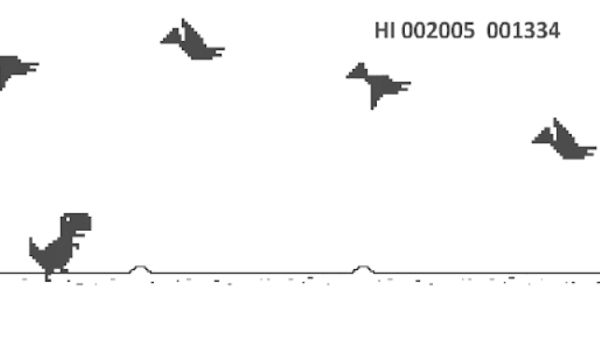
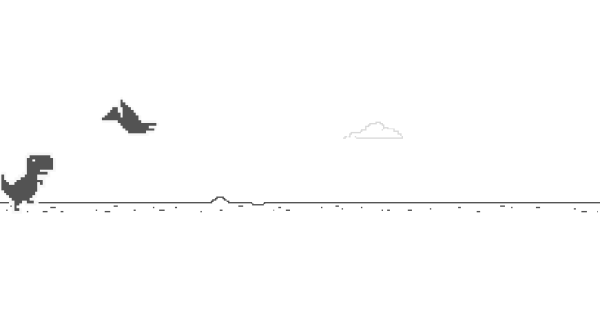
Flying obstacles eventually enter the run and prevent jumping from remaining the automatic answer to everything. Pterodactyls can approach at different heights, sometimes requiring a jump and sometimes rewarding a duck. Their arrival adds another decision without changing the central control system. I must identify both the obstacle type and its position before reacting.
Low-flying pterodactyls create the clearest use for ducking. The dinosaur lowers its body while continuing forward, allowing the obstacle to pass above. Higher versions may require no action or a carefully timed jump depending on the exact pattern. This uncertainty gives the later run more tension than an endless sequence of ground hazards could provide.
The visual animation makes them easy to distinguish from cacti, even at higher speed. Their wings create movement above the otherwise stable horizon. I can recognize the category instantly, though deciding the correct response becomes harder as reaction time decreases. The design remains readable without becoming predictable.
Ducking Is More Important Than It First Appears
Ducking is introduced later in the practical learning curve because early runs can be managed almost entirely through jumping. Once flying obstacles appear, the action becomes essential. It also changes the dinosaur’s silhouette enough to make the response visually satisfying. The character looks as though it is genuinely trying to avoid danger rather than simply switching collision states.
Holding down during a jump can also bring the dinosaur toward the ground faster, depending on the current version and input behavior. This gives me another way to control landing position after an early jump. A quick descent may prevent one obstacle from turning into a collision with the next. The mechanic adds subtle correction without introducing another dedicated button.
I find ducking more difficult than jumping because it feels less instinctive during panic. My first response to danger is usually to move away from the ground. The game deliberately exploits that habit by placing threats where jumping becomes the wrong choice. Mastery requires replacing reflex with recognition.
The Day and Night Changes Add Atmosphere Without Distraction
Longer runs eventually shift between light and dark presentation. The screen reverses its visual relationship, turning the pale daytime desert into a darker scene with bright foreground elements. This transition provides a small reward for surviving without interrupting the run. The same obstacles suddenly feel different because the contrast has changed.
I appreciate that night mode does not introduce a separate ruleset. The challenge remains focused on reading shapes and timing inputs. A dramatic visual transformation with new mechanics could break concentration or make failure feel arbitrary. Instead, the game uses presentation to acknowledge progress while preserving fairness.
The transition can still be momentarily distracting. My eyes need to adjust, especially when the change occurs near an approaching obstacle. That slight visual disruption becomes another concentration test. It feels intentional without becoming harsh.
The Score Is the Only Progression System the Game Needs
The score increases continuously according to distance survived. There are no coins, unlockable abilities, equipment upgrades, or permanent statistics improving future runs. Every attempt begins with the same dinosaur and the same basic controls. Improvement belongs entirely to the player.
This makes high scores unusually personal. A larger number means I maintained focus longer and handled faster patterns more reliably. Nothing can be purchased or equipped to explain the result. The score becomes a direct record of performance.
I enjoy comparing scores because the game is instantly understandable to anyone watching. There is no need to explain difficulty settings, character builds, or hidden multipliers. The person survived until the displayed number. That clarity gives even informal competition a strong foundation.
Milestone Signals Provide Tiny Moments of Celebration
Reaching certain score milestones produces a small audio and visual acknowledgment. The interruption is brief enough that it does not remove control from the player. It confirms that the current run has reached another meaningful distance. Inside such a minimal game, even a small signal feels rewarding.
These moments also create danger because celebration can break concentration. I may notice the score, feel satisfied, and immediately mistime the next obstacle. The game does not pause to protect the achievement. Every milestone is temporary until the run actually ends.
I like this lack of ceremony. A large reward screen would feel absurd inside the stripped-down design. Dino Game gives one quick signal and returns immediately to the desert. Survival remains more important than congratulation.
Restarting Is Almost Frictionless
After a collision, the game stops and displays the result. One input begins another attempt immediately. There is no loading screen, advertisement, confirmation box, or return to a main menu. Failure lasts only as long as I allow it to.
This is one of the main reasons the game becomes difficult to leave. Every mistake produces the belief that the next run can correct it. The restart occurs before frustration has enough time to become a rational reason to stop. I am already moving again while still thinking about the previous obstacle.
Many larger games weaken repetition through excessive transitions. Dino Game understands that a score challenge needs an almost invisible loop between failure and another attempt. The short restart respects the player’s time while also encouraging one more run. Its convenience is both generous and dangerously effective.
Failure Usually Feels Understandable
Most unsuccessful runs end because I jumped too early, reacted too slowly, misread a flying obstacle, or lost concentration. The cause is visible immediately. I rarely need a replay or damage report to understand what happened. This clarity makes improvement feel possible.
There are moments when browser performance, display refresh, or input delay can make timing feel less consistent. These problems are unusual during ordinary play but become more noticeable at high speed. A minimal game leaves technical irregularities nowhere to hide. When only one action matters, delayed response feels especially significant.
The overall fairness remains strong because obstacle shapes and movement are readable. The game does not depend on hidden attacks or complicated collision rules. I may dislike the result, but I usually recognize my own mistake. That relationship makes failure motivating rather than mysterious.
The Pixel Art Is Functional and Full of Personality
The dinosaur is built from a tiny number of monochrome pixels, yet its shape is immediately recognizable. Short legs animate during running, the body lowers while ducking, and the character’s rigid movement recalls early arcade games. The limited detail suits the error-page origin perfectly. A more elaborate model would make the empty browser screen feel unnecessarily theatrical.
Cacti, clouds, ground lines, stars, and flying creatures follow the same visual language. Every object can be identified quickly because the silhouettes are clean. The game avoids decorative clutter that might hide an obstacle. Art and readability support one another completely.
The dinosaur also appears strangely charming despite having almost no facial animation. Its large eye and compact body communicate enough personality for players to care about the run. I do not need a backstory to understand the tiny creature’s determination. It keeps moving because that is what the game asks it to do.
The Empty Desert Makes Concentration Easier
The background contains little beyond clouds, ground details, and occasional environmental changes. This emptiness directs attention toward incoming obstacles. There are no animated crowds, complex scenery layers, or bright effects competing for visual priority. The desert acts as a neutral stage for timing.
The minimal setting also supports the joke behind the game. A dinosaur running through a disconnected prehistoric landscape fits the idea of losing access to the modern internet. The world appears intentionally isolated. Nothing in the distance suggests a destination or explanation.
I like that the game never tries to expand the desert into a detailed narrative world. Its lack of context is part of the appeal. The dinosaur runs because the player pressed a button, and the horizon continues because the score has not ended. That is enough.
Sound Is Used Sparingly but Effectively
Dino Game does not rely on a continuous soundtrack. Jumping, scoring milestones, and collisions receive simple arcade-style audio cues. The silence between them keeps the experience suitable for a browser error page. I can begin playing without suddenly filling a quiet room with music.
The lack of soundtrack also makes each sound more noticeable. A successful milestone signal feels meaningful because the game is usually quiet. The collision sound provides an immediate final punctuation mark. Audio communicates events rather than atmosphere.
I sometimes imagine that music could make long runs more exciting, but it would probably weaken the game’s distinctive restraint. Repeated tracks would become tiring during score attempts. Silence allows me to create my own rhythm from footsteps, jumps, and visual movement. The game remains easy to play almost anywhere.
Mobile Play Changes Timing Without Changing the Game
On touch devices, tapping provides a direct way to begin and jump. The control is accessible enough that the game remains understandable without a keyboard. This broad compatibility helped the dinosaur become recognizable beyond desktop Chrome users. Almost anyone encountering the offline page can participate immediately.
Touch input feels different because the finger can cover part of the screen, and ducking may be less comfortable depending on the interface. Physical keys provide clearer separation between actions and stronger tactile feedback. Mobile play is excellent for short attempts but can feel less precise during higher-speed sections. The core design survives because it never requires many simultaneous commands.
I appreciate that the visual scale adapts to different screens without changing the fundamental obstacle language. A cactus remains readable, and the dinosaur remains expressive. Cross-platform simplicity was clearly considered during development. The game feels native to the browser rather than attached to one device category.
The Game Quietly Teaches Rhythm
Successful runs depend on reading the distance between the dinosaur and each obstacle as a repeating visual rhythm. I begin recognizing when to press based on movement speed rather than measuring exact space consciously. Groups of cacti create longer beats, while flying obstacles interrupt the pattern with another response. The game becomes almost musical despite lacking continuous music.
Losing rhythm is often more dangerous than facing one difficult obstacle. Looking at the score, thinking about the previous jump, or becoming distracted by another window can break the automatic timing. Once attention returns, the next object may already be too close. Concentration is therefore maintained through movement rather than through complex planning.
This rhythm explains why the game can feel calming during a strong run. Inputs become smooth and repeated, while the desert moves at a predictable pace. The same rhythm becomes stressful when speed increases beyond comfort. Dino Game moves gradually between relaxation and panic without changing its basic rules.
High Scores Depend on Endurance as Much as Reaction
Early obstacles require basic timing, but very long runs test whether I can maintain attention without becoming careless. The challenge is not only reacting quickly. It is continuing to react correctly after the actions have become repetitive. Boredom and confidence become hazards of their own.
I often fail shortly after thinking that the current run feels easy. That thought moves attention away from the obstacle pattern and toward the idea of success. One ordinary cactus then ends a run that survived much faster combinations. The game punishes mental drift more reliably than mechanical complexity.
Endurance makes serious score attempts surprisingly demanding. Sitting upright, watching the correct part of the screen, and avoiding distractions become practical strategies. The game can be played casually, but its highest challenge resembles a concentration exercise. The tiny dinosaur demands more discipline than its appearance suggests.
There Is No Random Reward to Hide Weak Performance
Dino Game does not give a cosmetic item because I completed several runs or return daily to maintain a streak. It does not place a bonus behind an advertisement or offer a temporary advantage. The only reward is the experience of playing and the number earned before failure. This feels unusually clean beside modern live-service design.
The absence of progression means some players will lose interest quickly. There is no collection to complete or story to reveal. Once the obstacle types are understood, the game offers refinement rather than discovery. Its longevity depends entirely on whether improving a personal score remains appealing.
I find that honesty refreshing. The game never pretends that repetition is producing a larger account value. One run matters because I am currently enjoying it or attempting to improve. When that motivation disappears, I can close the page without leaving unfinished obligations behind.
The Dinosaur Has Become Larger Than the Original Feature
The small T-Rex has become one of Chrome’s most recognizable visual symbols. It appears in references, merchandise, experiments, modified editions, and countless unofficial recreations. Players have transformed the simple runner into three-dimensional versions, themed variations, automated demonstrations, and coding projects. The original design is simple enough to invite reinterpretation.
This cultural reach comes partly from accessibility. Millions of people encountered the game without searching for it or purchasing anything. The same visual joke appeared across work computers, school devices, phones, and personal laptops. Shared recognition developed through ordinary technical failure.
I enjoy how the game became famous without behaving like a conventional product launch. It was hidden inside a browser condition and discovered through curiosity. The dinosaur did not need a marketing campaign explaining its personality. Running across the empty screen was enough.
Unofficial Versions Can Be Entertaining but Change the Point
Many websites and community projects reproduce Dino Game with alternate graphics, new characters, unusual powers, three-dimensional environments, or automated play. These versions can be funny and technically impressive. They demonstrate how flexible the basic endless-runner structure is. They also reveal why the original restraint matters.
Adding too many abilities or visual effects changes the experience from a concentration test into another feature-heavy browser game. This is not automatically worse, but it loses the elegance of the offline runner. The original requires almost no explanation, storage, or preparation. Every addition risks weakening that immediate clarity.
I prefer modified versions as brief experiments rather than replacements. They are most interesting when they reveal something about the familiar mechanics. Seeing the dinosaur in another style can be amusing, but I usually return to the monochrome desert. The original feels complete because it never tries to become large.
The Maximum Score Is Less Important Than the Next Personal Record
Dino Game can theoretically continue for an extremely long time, with scoring and speed behavior eventually reaching technical limits or repeating patterns. For ordinary players, those limits are irrelevant. The meaningful target is usually the highest number already displayed on my own screen. One additional milestone can provide enough motivation for several attempts.
This personal scale keeps competition approachable. I do not need to compare myself with automated systems or players who have practiced for years. Improving from a short run to a stable night cycle already feels significant. The game allows small success to remain satisfying.
I occasionally take a screenshot of a strong result because the browser does not build an elaborate achievement archive around it. That temporary record suits the game. The score belongs to one moment of concentration. Another failure can begin immediately afterward.
It Is an Excellent Waiting Game
Dino Game works particularly well during brief interruptions because it can begin and end without preparation. A router restart, delayed connection, or short break provides enough time for several runs. I do not need to remember a storyline or configure a character. The game occupies exactly the amount of attention I choose to give it.
The danger is that one short attempt can become many. Instant restarts remove the natural stopping points that a larger game provides through missions or menus. I may continue because the last result was poor, then continue because the next result was almost excellent. Waiting ends, but the dinosaur keeps running.
This makes the game both useful and mildly mischievous. It solves boredom so effectively that it can outlive the boredom-producing problem. The internet connection may return unnoticed while I focus on another cactus. Chrome accidentally competes with itself.
It Also Works as a Small Introduction to Game Design
Dino Game demonstrates several design principles in an unusually compact form. It teaches controls through play, increases difficulty gradually, communicates danger through silhouettes, and restarts immediately after failure. Score provides motivation without requiring a larger reward system. Every visible element supports the central action.
The game is also useful for programming and artificial-intelligence experiments because its state and actions are easy to describe. An agent needs to observe obstacles and decide whether to jump, duck, or continue running. That simplicity makes performance measurable. The runner becomes a convenient testing environment without losing its value as a human game.
I find it impressive that the design remains interesting after being reduced to such a small rule set. Many games depend on content volume to maintain attention. Dino Game depends on tuning. Jump physics, obstacle timing, speed progression, and restart flow carry the entire experience.
The Lack of Accessibility Settings Is a Visible Limitation
The minimalist design helps many players understand the game quickly, but it provides limited options for changing the experience. Speed, contrast, obstacle frequency, audio, and control behavior are not presented through a conventional settings menu. Players who struggle with rapid reaction or visual transitions receive few official adjustments. The game’s origin as a hidden feature explains this absence without eliminating the issue.
A practice mode with reduced speed could help more people enjoy the mechanics. Alternative contrast options might improve readability during visual transitions. Custom controls would also make ducking and jumping easier for some input needs. These additions could remain hidden behind optional settings without cluttering the main screen.
The challenge would be preserving the immediate start. Dino Game should not open with a configuration panel. Accessibility works best when defaults remain simple and additional controls are available only when needed. A tiny game can still support different players thoughtfully.
The Game Does Not Need a Story
It is easy to imagine a humorous explanation involving a dinosaur searching for connection, escaping extinction, or crossing the desert toward some destination. The game wisely avoids providing one. Narrative would create questions that the endless structure cannot answer. The dinosaur’s purpose is movement itself.
This absence allows players to interpret the character freely. The run can be a survival challenge, a race, a reflex test, or simply something happening while Chrome waits. No official personality conflicts with those interpretations. The dinosaur remains a mascot rather than a protagonist requiring development.
I usually prefer games with memorable characters and worlds, but Dino Game demonstrates that context can be extremely small when mechanics are clear. One pixel creature, one horizontal line, and several obstacles create enough emotional investment for a short session. I still feel disappointed when the dinosaur stops. That reaction is the only story the game needs.
The Monochrome Style Helps It Age Gracefully
Dino Game does not depend on contemporary rendering technology or detailed textures. Its pixel art already references an older visual era, preventing it from becoming outdated in the usual way. A higher-resolution remake might look technically cleaner while losing the connection to Chrome’s simple error illustrations. The original presentation remains appropriate years later.
Browser and device changes also have limited effect on the core appearance. The game can scale while preserving its silhouettes. There are no complicated lighting systems or models requiring modernization. Technical simplicity becomes visual durability.
This is one reason the runner still feels natural inside Chrome rather than like an abandoned promotional feature. Its art was designed for the surrounding interface. The dinosaur belongs beside browser text and icons. A more elaborate game would have aged away from that environment.
One Mistake Ends Everything, but Nothing Valuable Is Lost
There is no health bar or collection of extra lives protecting a strong run. Contact with one obstacle ends the attempt immediately. This creates clear tension because every cactus remains capable of removing all current progress. The rule never becomes less important simply because the score is high.
At the same time, failure removes nothing permanent. The next run begins from the same condition, and no resource has been spent. This combination allows the game to be severe without becoming discouraging. The current attempt matters greatly, while the larger experience remains forgiving.
I think this balance is central to Dino Game’s appeal. Multiple lives would weaken concentration, while permanent penalties would feel absurd for an offline browser feature. Immediate failure and immediate recovery create a perfect arcade loop. The game respects both tension and convenience.
A Tiny Game With Almost No Wasted Parts
Dino Game contains a running dinosaur, ground hazards, flying obstacles, score progression, changing speed, visual transitions, simple sounds, and an instant restart. Almost every element contributes directly to concentration and timing. There are no optional systems waiting to be explained. The design can be understood completely while still remaining difficult to master.
Its limitations are obvious. The visual and mechanical variety is small, there is no long-term progression, accessibility options are limited, and repeated play eventually depends more on endurance than discovery. Players searching for a substantial platformer or dinosaur adventure will find almost none of what those descriptions usually promise. Dino Game is a score challenge, not a miniature campaign.
I continue enjoying it because it never wastes time pretending to be something larger. One press begins the run, one mistake ends it, and one more press offers another opportunity. The game transforms a browser error into an immediate contest between attention and habit. Its design is so compact that improving one jump can feel like meaningful progress.
Dino Game remains memorable not because it contains an enormous world, but because it appears in a moment when the enormous online world has temporarily disappeared. The desert is empty, the dinosaur has nowhere visible to go, and the score is the only proof that movement matters. I may open it accidentally because the internet failed, yet I continue intentionally because the last cactus looked completely avoidable. That transition from inconvenience to obsession is the game’s greatest achievement.
Pros:
- Engaging retro aesthetics combined with modern gameplay mechanics
- Easy to install with minimal system requirements
- Customizable mods and cheat options enhance user experience
- Active community support with regular updates and patches
- Lightweight design that does not demand high-end hardware
- Accessible to a wide range of players with free download and multi-platform support
Cons:
- Cheat options can sometimes detract from the challenge and fairness
- The simple mechanics might not satisfy players seeking a deep, strategic experience
- Limited complexity may lead to repetitive gameplay over time

RELATED APPS


Recent Reviews

Minecraft

Grand Theft Auto V

Toca Boca World

Roblox

Leave a comment
Your comment is awaiting moderation. We save your draft here
1 Comments
Your reply is awaiting moderation. We save your draft here