
Review
A Sudden Case of Christmas begins with a contradiction that immediately gives the film more personality than an ordinary seasonal comed...



Holiday Lights of Renewal and Redemption
A Sudden Case of Christmas begins with a contradiction that immediately gives the film more personality than an ordinary seasonal comedy. The story takes place during summer in the Italian Dolomites, yet ten-year-old Claire Randall suddenly insists that her family celebrate Christmas.
She is not confused about the calendar. She has discovered that her parents, Jacob and Abbie, intend to separate, and she believes one final perfect family Christmas may convince them to remain together.
As a critic, I found the premise both charming and emotionally dangerous. A child attempting to repair a marriage through decorations, gifts, food, and ritual creates obvious opportunities for comedy. It also places an enormous responsibility on someone too young to understand why adult relationships sometimes end.
Claire does not see two people who have reached a painful decision after years of private conflict. She sees the destruction of the family structure that has made her feel safe.
Christmas becomes her emergency procedure. If the holiday once produced closeness, laughter, and familiar traditions, perhaps recreating it outside its natural season can restore what is disappearing.
The film’s central question is therefore not whether Christmas magic is real. It is whether a family can remain loving after admitting that one version of itself no longer works.
The Dolomites Give the Film Beauty It Does Not Always Earn
The Italian mountain setting is one of the film’s strongest assets. The landscapes are wide, bright, green, and dramatically different from the snowy streets usually associated with Christmas cinema.
Lawrence Armanetti’s hotel stands inside this summer environment like a place capable of hosting several genres at once. It can be a family retreat, romantic destination, comic workplace, and improvised Christmas headquarters.
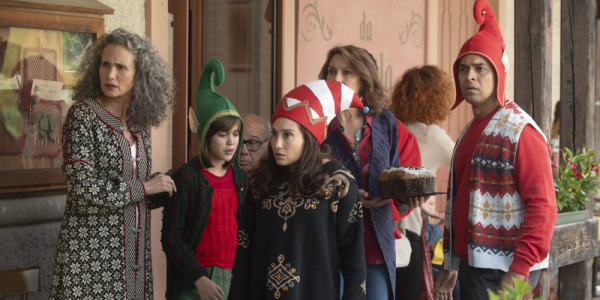
I enjoyed the visual contradiction created when festive decorations begin appearing beneath warm skies. Artificial snow, Christmas trees, lights, costumes, and seasonal food look slightly incorrect in August, which matches the emotional condition of the family.
Everyone is trying to perform a familiar celebration while knowing that something fundamental has changed.
The location occasionally does too much work for the film. A quiet conversation becomes attractive because mountains fill the background, even when the dialogue offers limited depth.
Still, the setting gives A Sudden Case of Christmas a distinct identity. It does not resemble another holiday movie filmed on the same decorated suburban street.
Claire Is Trying to Save More Than Her Parents’ Marriage
Antonella Rose plays Claire as intelligent, observant, determined, and emotionally less prepared than she believes.
She understands enough to know that her parents are hiding something. Once the truth becomes visible, she responds by creating a plan rather than admitting helplessness.
I found that reaction believable. Children often assume that family conflict must have a solution if they can only identify the correct behavior. They become quieter, more helpful, more successful, or more entertaining because doing something feels safer than accepting that the decision belongs to adults.
Claire chooses Christmas because it represents the family at its most complete. The annual visit to her grandfather’s hotel has become part of her personal mythology.
Her campaign is funny when she recruits adults, organizes decorations, and treats August as a minor logistical inconvenience. It becomes painful when she begins interpreting every moment of parental cooperation as proof that the marriage can still be restored.
Rose gives Claire enough confidence to lead the story without making her sound like a tiny adult. Her plans remain emotionally logical and practically unrealistic.
The film occasionally gives her dialogue that explains the theme too clearly. She is more convincing when her fear appears through urgency rather than speeches.
Danny DeVito Makes Lawrence a Grandfather Who Prefers Action to Explanation
Danny DeVito plays Lawrence Armanetti, Claire’s grandfather and the owner of the hotel where the family usually celebrates Christmas.
Lawrence understands immediately that Claire’s plan is impossible in the literal sense. A holiday celebration cannot erase the reasons Jacob and Abbie want to separate.
He also understands that dismissing her idea would make her feel abandoned by another adult.
DeVito gives Lawrence warmth, impatience, comic authority, and the energy of someone accustomed to solving hotel problems before guests notice them. He does not behave like a mystical Christmas figure. He behaves like a grandfather willing to create chaos because his granddaughter needs time.
I enjoyed his relationship with Claire because he does not pretend her plan will certainly succeed. He helps partly because the celebration may create a safer environment for the family to speak honestly.
Lawrence also has his own emotional interests. The possible separation affects his access to Claire and changes the family gatherings that have structured his later life.
The film could have explored that fear more deeply. DeVito receives comic scenes, practical tasks, and moments of affection, but the character’s loneliness often remains beneath the surface.
Lawrence’s Hotel Is a Family Home Disguised as a Business
The hotel is not merely a scenic location. It is the place where family memories, employment, hospitality, and personal history overlap.
Lawrence moves through it as both owner and patriarch. Staff members know his habits, guests enter his emotional space, and every public event can become part of the family crisis.
Turning the hotel into a Christmas venue requires cooperation from people who have no reason to accept Claire’s private logic. Decorations must be located, food prepared, costumes arranged, and guests persuaded to participate.
I liked how this process expands the celebration beyond one family. Claire believes she is reconstructing a private tradition, but the hotel transforms it into a communal performance.
The result also exposes the difference between hospitality and family life. Lawrence can organize an event for guests more easily than he can repair the people he loves.
Jacob and Abbie Do Not Separate Because One of Them Is a Villain
Wilmer Valderrama and Lucy DeVito play Jacob and Abbie as parents who still care about one another but no longer believe affection is enough to preserve their marriage.
This is one of the film’s better decisions. There is no simple affair, secret cruelty, or obvious character whom Claire can remove from the situation.
Their conflict is built from distance, frustration, changed priorities, and the exhaustion of repeating arguments that no longer produce movement.
I appreciated that the screenplay allows them to laugh together. Separation does not mean every positive part of a relationship was false.
Those moments also make Claire’s misunderstanding more painful. Whenever her parents cooperate, she sees evidence that the decision can be reversed. The adults may simply be demonstrating that love can survive in a different form.
The film occasionally keeps their problems too vague. Avoiding one clear villain is admirable, but the marriage would feel more specific if I understood more about how they reached this point.
Without that detail, several conversations rely on general statements about growing apart rather than the habits, disappointments, and choices that usually give such conflict emotional texture.
Lucy DeVito Gives Abbie Frustration Without Making Her Cold
Abbie carries much of the story’s emotional burden because Claire interprets parental separation through the fear of losing daily stability.
Lucy DeVito plays her as a mother who wants to protect her daughter while recognizing that pretending the marriage is healthy would create another kind of damage.
Abbie is not enthusiastic about the Christmas plan. She understands that encouraging Claire may strengthen the belief that a perfect celebration can force the adults back together.
At the same time, refusing completely would make Claire experience the separation as an immediate disappearance of family tradition.
I found Abbie most compelling when she tried to maintain two truths: the marriage may need to end, and Claire still deserves a meaningful relationship with both parents.
Her scenes with Lawrence also contain a believable generational tension. He wants to help, but his enthusiasm can cross into interference.
The film gives Abbie several moments of emotional honesty, though it sometimes moves away just as the conversation becomes uncomfortable.
Jacob Uses Calmness to Avoid Admitting How Afraid He Is
Wilmer Valderrama’s Jacob initially appears more willing to follow Claire’s plan, but his cooperation is not necessarily confidence.
He uses charm, flexibility, and gentle humor to keep the situation manageable. Those qualities make him sympathetic while also allowing him to postpone direct confrontation.
I noticed that Jacob often responds to emotional pressure by becoming agreeable. He wants to be a supportive father and avoid appearing responsible for Claire’s pain.
This creates a different problem. If he participates too enthusiastically, he may reinforce the idea that reconciliation is approaching.
Valderrama gives Jacob warmth and visible affection for both Claire and Abbie. The performance suggests that leaving the marriage does not feel like freedom to him.
I wanted the screenplay to challenge him more directly. Abbie frequently appears responsible for articulating the difficult reality, while Jacob receives more opportunities to be charming.
One Last Christmas Is an Impossible Promise
Claire describes the celebration as one final family Christmas, but that phrase contains an emotional trap.
If the event is wonderful, she will ask why the family cannot remain together. If it fails, she may believe the failure confirms that the family has already disappeared.
The adults accept the plan because they want to comfort her, yet participation risks transforming a complicated transition into a test.
I found this tension more interesting than the question of whether the decorations would be completed on time.
A holiday can preserve connection, but it cannot determine whether two adults should remain married.
The film gradually moves toward this understanding. Claire needs reassurance that Christmas, family, and love will continue even if her parents stop living as a couple.
That reassurance is more honest than a sudden romantic reunion created by festive music.
Rose Brings a Different Kind of History Into Lawrence’s Life
Andie MacDowell plays Rose, a woman connected to Lawrence’s past and capable of disrupting the routines he has built around the hotel and his family.
Their relationship adds an older romantic perspective to a story dominated by separation.
Lawrence may be encouraging Jacob and Abbie to confront their feelings while avoiding his own emotional unfinished business.
MacDowell brings warmth and calm to the film, offering a useful contrast with DeVito’s more restless comic energy.
I liked the idea that Lawrence’s future should matter independently of his role as Claire’s grandfather. Older characters in family comedies are often treated as support systems without personal desire.
The film gives Rose and Lawrence a meaningful connection, though it does not always devote enough time to make every emotional development feel complete.
Their storyline occasionally appears designed to demonstrate that love can return unexpectedly, creating a convenient thematic contrast with Jacob and Abbie’s marriage.
Still, MacDowell and DeVito make their scenes gentle and credible.
Christmas Decorations Cannot Hide Summer Forever
The visual comedy depends on the family attempting to recreate winter traditions in August.
Christmas trees, lights, ornaments, warm clothing, seasonal songs, and artificial snow collide with sunlight and green mountain landscapes.
I enjoyed the strange appearance of it all. The celebration is intentionally artificial because Claire is attempting to recreate an emotional state rather than respond to the actual season.
The more convincing the decorations become, the more visible the underlying denial feels.
Everyone knows it is not Christmas. Everyone knows Jacob and Abbie have not solved their relationship simply because they stood near the same tree.
This gives the production design thematic value. The holiday looks attractive, but it never completely covers reality.
The Film Finds Comedy in Emergency Hospitality
Lawrence and the hotel staff must create a major seasonal event without preparation, appropriate weather, or a normal supply chain.
Ordinary hospitality problems become larger because every failure appears capable of damaging Claire’s hope.
The film uses missing decorations, improvised entertainment, confused guests, food preparation, and unexpected participants to maintain comic movement.
Danny DeVito is effective when Lawrence treats absurd requests as routine business problems. His confidence makes the surrounding chaos funnier.
Some sequences become broader than necessary. Characters shout, objects fall, and plans collapse according to familiar family-comedy timing.
I preferred the quieter jokes involving adults attempting to discuss divorce while dressed for an August Christmas celebration.
The Supporting Guests Make the Hotel Feel Busy but Not Always Alive
The hotel contains several eccentric visitors and staff members who become involved in Claire’s plan.
They provide reactions, misunderstandings, romantic complications, and practical help.
This broadens the film visually, preventing the story from becoming one family talking inside a few rooms.
The weakness is that several supporting characters feel designed around one recognizable trait. They enter, create a comic disruption, and disappear before developing enough emotional weight.
I could see the attempt to create the atmosphere of a European ensemble comedy where multiple stories overlap inside one hotel.
The central family remains much more important, so the secondary material sometimes feels like decoration surrounding the real conflict.
Claire’s Plan Becomes Less Innocent as It Grows
At first, arranging Christmas appears harmless. Claire wants decorations, music, presents, and family traditions.
As the plan develops, she begins manipulating situations to place her parents together and interpreting adult behavior according to her desired outcome.
I appreciated that the film allows some discomfort around this. Claire is not malicious, but her pain does not make every decision healthy.
Lawrence shares responsibility because he supports the plan despite understanding more than she does.
The adults eventually need to stop treating Claire as the director of their marriage and tell her clearly that she did not cause the separation and cannot repair it.
This is the emotional conversation the story has been approaching from the beginning.
The Movie Is Better When It Refuses a Simple Reunion
A conventional holiday comedy might use the improvised Christmas to remind Jacob and Abbie of their love, leading them to abandon the separation before the final credits.
A Sudden Case of Christmas is more thoughtful when it recognizes that one successful day cannot solve long-term incompatibility.
The family can laugh, cooperate, and share affection without using those moments as evidence that the marriage must continue.
I respected this distinction. Children’s films often treat divorce as a mistake created by adults forgetting how much they love each other.
That fantasy can place unfair responsibility on children who believe better behavior or one emotional event might restore the relationship.
The film’s more mature message is that a family can change structure without ending its emotional existence.
Danny DeVito Is the Main Reason the Comedy Remains Warm
DeVito can turn frustration into affection without softening his personality completely.
Lawrence complains, interferes, improvises, and makes decisions before everyone else has agreed. He is not a perfectly patient grandfather.
His devotion to Claire gives the behavior emotional grounding. He knows he cannot protect her from every disappointment, so he attempts to create one experience where she feels surrounded by people who remain committed to her.
DeVito’s smaller reactions are often more effective than the larger gags. A pause after Claire asks a difficult question reveals that Lawrence understands the emotional cost before deciding how much truth she can manage.
I wished the film trusted those quieter moments more often. DeVito does not require constant physical chaos to hold attention.
Antonella Rose Keeps Claire From Becoming a Plot Device
Claire could have existed only to force the adults into the same location. Antonella Rose gives her enough emotional specificity to keep the story centered on a child’s fear.
Her excitement around the Christmas preparations is genuine, but it carries urgency. Every successful detail appears to bring her closer to restoring the family.
When the plan begins failing, the disappointment is not about decorations. Claire believes the failure may confirm that she has lost control permanently.
Rose handles the shift from comedy to emotional confrontation convincingly.
The screenplay occasionally makes Claire unusually perceptive when an adult-level observation is required. At other times, it simplifies her understanding to preserve a misunderstanding.
The performance smooths over much of that inconsistency.
The Film’s View of Divorce Is Gentle Rather Than Detailed
A Sudden Case of Christmas deserves credit for refusing to portray separation as automatic family destruction.
Jacob and Abbie want to remain active parents. Lawrence and Rose remain connected to Claire. The family’s future may contain multiple homes and changed traditions, but not emotional abandonment.
The film avoids detailed discussion of custody, finances, schedules, or the practical consequences of living apart.
This keeps the tone suitable for a broad family audience, though it also makes the resolution easier than the real process would be.
I understood the choice. The movie is interested in emotional reassurance rather than legal or domestic realism.
Its central statement remains valuable: children need clarity that the end of a marriage is not the end of their family.
The Music Occasionally Creates Christmas More Successfully Than the Characters
The soundtrack introduces familiar seasonal sounds into the summer environment, helping decorations feel temporarily convincing.
Music also supports the film’s movement between comedy, romance, and family sadness.
At times, the score pushes too firmly toward warmth. A scene may still contain unresolved conflict while the music signals that emotional healing is already underway.
I preferred moments when ambient hotel sounds and mountain quiet allowed the awkwardness to remain.
The contrast between Christmas music and summer imagery is still one of the film’s most memorable stylistic choices.
The Pacing Becomes Crowded Around the Middle
The opening establishes the family crisis clearly, and the final act delivers the necessary emotional conversation.
The middle section must manage Claire’s plan, hotel guests, Lawrence’s history with Rose, Jacob and Abbie’s conflict, multiple comic incidents, and the practical creation of Christmas.
Not every storyline receives enough space.
I occasionally felt that the film was adding another eccentric character or complication because the central relationship remained too painful to address directly.
The comedy keeps the movie moving, but it delays the conversation Claire actually needs.
A more focused version could have removed several secondary incidents and spent additional time showing Jacob and Abbie attempting to explain their decision honestly.
The Humor Is Pleasant but Rarely Surprising
The film finds comedy in cultural misunderstandings, hotel emergencies, unusual guests, family interference, improvised decorations, and the basic absurdity of celebrating Christmas during summer.
The cast delivers the material with energy, especially Danny DeVito.
I laughed occasionally, but many jokes arrive through familiar rhythms. A plan is announced confidently, one practical detail is ignored, and the resulting chaos becomes larger than expected.
The dialogue is warmer than it is sharp. This suits the family tone but limits the film’s comic personality.
The best humor comes directly from character: Lawrence’s confidence, Claire’s absolute commitment, and Jacob and Abbie attempting to remain civil while everyone behaves as though they are starring in a romantic reunion.
The Film Nearly Confuses Christmas Spirit With Emotional Pressure
The central celebration is created because Claire cannot accept her parents’ separation.
This means every cheerful activity contains an implicit demand: prove that the family can still remain exactly as it was.
The film eventually challenges that demand, but it spends much of the running time treating the plan as a charming mission.
I wanted Lawrence to establish firmer emotional boundaries earlier. Supporting Claire should not require suggesting that her parents’ decision remains available for negotiation.
The story recovers by shifting the meaning of Christmas. The holiday stops being a tool for restoring marriage and becomes a way to demonstrate continued family connection.
That change is essential to the final emotional success.
Rose and Lawrence Offer a Different Argument About Timing
Jacob and Abbie may need to accept that their relationship has reached an ending. Lawrence and Rose must consider whether their own emotional story ended too early.
The contrast gives the film balance. Not every separation should be reversed, and not every lost connection should remain buried.
Older romance is treated with warmth rather than as a comic side issue.
I liked seeing Lawrence confronted with the same uncertainty he asks younger family members to face. He cannot organize his way around vulnerability.
The film’s romantic symmetry is slightly convenient, but DeVito and MacDowell prevent it from feeling entirely mechanical.
The Final Celebration Works Because It Changes Purpose
Claire begins by wanting a Christmas capable of saving her parents’ marriage.
By the end, the celebration becomes evidence that family love can continue without producing the outcome she originally demanded.
This is a subtle but important change.
The decorations no longer need to prove that Jacob and Abbie belong together as a couple. They demonstrate that both remain willing to participate in Claire’s life.
I found this resolution more moving than a surprise reconciliation would have been.
Claire does not receive everything she wants. She receives a more durable promise: the adults will not require her to choose which part of the family remains real.
What Frustrated Me
The marriage conflict remains too general. Jacob and Abbie speak about distance and unhappiness without enough specific history to make their decision fully textured.
Several supporting hotel characters feel like comic functions rather than people.
The middle section becomes crowded, reducing time available for the central family conversations.
Lawrence encourages Claire’s reunion plan longer than I found emotionally responsible.
The humor is pleasant but frequently predictable.
Andie MacDowell brings warmth to Rose, though her storyline deserves more development before its later emotional turns.
The film occasionally uses the beautiful Dolomites to create emotional depth that the dialogue has not achieved independently.
What Stayed With Me
I remembered Claire treating decorations as tools capable of repairing adult pain.
I remembered Lawrence helping because refusing would have felt like another loss.
I remembered Jacob and Abbie laughing together without allowing one pleasant moment to erase years of difficulty.
Most of all, I remembered the film’s recognition that children often believe divorce divides love into smaller pieces.
A Sudden Case of Christmas offers a gentler possibility. The structure can change while love remains present in several places at once.
Who Should Watch A Sudden Case of Christmas?
I recommend A Sudden Case of Christmas to families who enjoy gentle holiday comedies, European settings, stories about grandparents and grandchildren, and seasonal films willing to discuss parental separation without creating a simple villain.
Danny DeVito and Andie MacDowell fans may enjoy seeing them bring warmth and comic experience to a smaller family production.
Younger viewers can respond to Claire’s plan, hotel chaos, decorations, artificial snow, and the unusual Christmas-in-August premise.
Adults may connect more strongly with the difficulty of explaining divorce to a child and the pressure to preserve family rituals during change.
Viewers seeking rapid comedy or a highly detailed family drama may find the film too soft and predictable.
My Final Verdict
A Sudden Case of Christmas is a warm, visually attractive, and uneven family comedy that uses an artificial August Christmas to examine a real childhood fear.
Danny DeVito gives the film its strongest comic and emotional presence. Antonella Rose makes Claire’s plan feel rooted in panic rather than simple mischief, while Lucy DeVito and Wilmer Valderrama create parents who still care about one another without pretending that care automatically repairs a marriage.
Andie MacDowell adds grace to Lawrence’s personal storyline, although the supporting material and hotel ensemble sometimes distract from the more compelling family conflict.
The movie struggles with predictable humor, vague marital history, and an overcrowded middle. Its emotional resolution is more mature than its broad comedy initially suggests.
I rate A Sudden Case of Christmas 7.4/10. It is not destined to become an essential holiday classic, but it offers a sincere message without using Christmas as a magical excuse to restore every relationship to its previous form.
Claire believes Christmas can keep her family from changing.
The adults eventually give her something more honest.
They show her that change does not have to mean disappearance.









Movie Reviews

Minecraft

Grand Theft Auto V

Toca Boca World

Roblox

Leave a comment
Your comment is awaiting moderation. We save your draft here
0 Comments