
Review
Dust Bunny made me feel as though I had entered a children’s bedroom designed by someone who understood exactly why darkness beneath a...

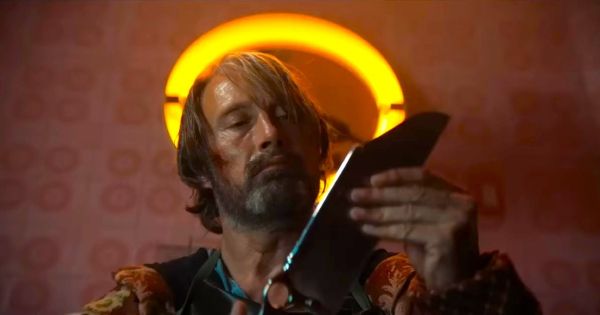

Dust Bunny: A Surreal Odyssey Through Human Consciousness
Dust Bunny made me feel as though I had entered a children’s bedroom designed by someone who understood exactly why darkness beneath a bed can feel larger than the entire room. The film surrounds that childhood fear with colorful interiors, eccentric neighbors, criminal danger, and a strange alliance between a young girl and a professional hitman. The result is neither a conventional monster movie nor a straightforward action comedy. It plays like a dark fairy tale in which an adult who deals with real-world violence is forced to consider that a child’s impossible story may be true.
Bryan Fuller’s feature directorial debut follows Aurora, a ten-year-old girl who asks the mysterious man living next door to destroy the creature she believes has eaten her family. Her neighbor initially understands monsters in a much more human sense, but their journey gradually brings physical and emotional threats together. Mads Mikkelsen and Sophie Sloan carry the central relationship, while Sigourney Weaver, Sheila Atim, and David Dastmalchian help populate the film’s dangerous, theatrical world.
The Apartment Building Felt Like a Vertical Game Map
The building immediately captured my attention because every floor seemed capable of hiding a different genre. Aurora’s home contains childhood objects, family tension, and the darkness beneath her bed. The neighboring apartment belongs to a man whose careful routines suggest a life built around secrecy. Corridors, elevators, staircases, doors, and ventilation spaces transform an ordinary residential structure into a layered environment filled with possible routes and concealed threats.
I began viewing the building like a compact stealth-game map. A closed door might protect someone or trap them. A hallway could provide a clear route until another resident appeared. The elevator offered quick movement but placed characters inside a confined metal box with no alternate exit.
The production design gives each room a strong personality. Aurora’s surroundings are imaginative and visually busy, while her neighbor’s space feels more controlled. One environment reflects a child who turns fear into stories. The other belongs to an adult who survives by reducing every situation to preparation and procedure.
When these spaces begin overlapping, the contrast becomes part of the comedy and tension. Aurora brings emotional chaos into a life organized around calculated risk.
Aurora Never Needed an Adult to Confirm Her Fear
Aurora is compelling because she does not behave as though she is asking permission to believe in the monster. She already knows what she has experienced. Her challenge is convincing someone capable of doing something about it.
She approaches her neighbor with an unusual combination of fear and confidence. The situation terrifies her, but she has moved beyond waiting for adults to provide reassurance. She identifies a person who appears qualified to handle dangerous problems and presents him with a mission.
I liked that her intelligence did not make her sound like a miniature adult. She remains imaginative, impatient, emotionally direct, and willing to interpret the world through the logic available to her. Her plan makes sense because a child who believes a creature has consumed her family would not necessarily contact the police. She would search for someone who destroys monsters.
Aurora also understands that adults frequently rename children’s fears instead of confronting them. A monster becomes a nightmare, trauma, misunderstanding, or attention-seeking behavior. Those explanations may sound reasonable, but they do not help when the child still believes something is waiting beneath the bed.
The Neighbor Treated the Request Like a Contract
Mads Mikkelsen’s character fascinated me because he initially reacts to Aurora’s request using the emotional distance of someone accustomed to dangerous assignments. He listens, evaluates, and searches for the practical explanation hidden beneath her language.
To him, “monster” may mean an abusive person, a criminal, or another threat that exists within the rules he already understands. His professional experience allows him to accept terrible human behavior without accepting the supernatural.
This creates an effective reversal. Aurora is frightened by the impossible creature, while he is more comfortable with violence that would terrify most people. Each character begins with a different definition of danger.
His apartment, clothing, posture, and precise movements suggest a man who survives through control. He notices exits, studies behavior, and rarely wastes motion. Aurora disrupts that system because her problem cannot be solved through a simple target profile.
From my gamer’s perspective, he resembles a highly upgraded character entering a mission whose enemies do not follow the mechanics he has mastered. His aim, planning, and experience remain valuable, but the rule set has changed.
The Film Made Professional Violence Look Almost Domestic
One of the stranger tonal pleasures of Dust Bunny is watching a dangerous man complete ordinary tasks with the same concentration he applies to his work. Preparing food, organizing a room, inspecting an object, or listening to a child can feel like part of a tactical routine.
The film does not need to explain his entire history immediately. Competence is visible in how he interacts with the environment. He rarely appears surprised by human threats because he has already imagined several ways a situation could become violent.
Aurora creates the surprise by treating him less like a feared criminal and more like a useful neighbor. She is interested in whether he can complete the job, not whether his profession should make her uncomfortable.
This gives their early conversations a dry humor. He attempts to preserve professional boundaries while speaking with someone who has no reason to respect them.
The Monster Under the Bed Worked Better as a Possibility
The film’s suspense was strongest for me when I could not determine whether Aurora’s creature was literal, symbolic, or some combination of both. The darkness beneath the bed is visually simple, yet it contains enough uncertainty for my imagination to create movement before the film reveals anything clearly.
A monster under a bed is one of the oldest childhood fears because the space is close, hidden, and difficult to inspect safely. Looking beneath it requires placing the face near the exact opening from which the threat might emerge.
Dust Bunny understands that geometry. The bed becomes both shelter and vulnerability. Aurora can climb onto it to escape the floor, but the creature is supposedly directly beneath her.
I appreciated how the film linked this fear to the larger apartment building. Once the possibility of a monster feels real, shadows, gaps, vents, closets, and adjoining rooms become extensions of the same hiding place.
Every Adult Brought a Different Type of Threat
The human antagonists are important because they prevent the story from becoming a simple question of whether one fantasy creature exists. Aurora and her neighbor are also surrounded by adults whose motives involve control, secrecy, money, survival, or revenge.
These characters may not have claws or live beneath furniture, but they understand how to frighten, manipulate, and remove obstacles. The film repeatedly asks which type of monster is easier to recognize.
A supernatural creature can be identified through appearance and behavior. A dangerous adult may look professional, charming, or completely ordinary until the moment they decide another person is disposable.
This overlap gives the story its darker edge. Aurora’s imagination may appear unusual, but her belief that adults can hide terrible intentions is not childish at all.
Sigourney Weaver Entered Like a Late-Game Opponent
Sigourney Weaver’s presence adds immediate authority. She can make stillness feel like a threat, and the film uses that quality effectively. Her character does not need to move quickly or speak loudly to change the balance of a scene.
I read her as someone who understands the neighbor’s professional world and therefore cannot be dismissed through the usual combination of skill and confidence. She knows enough to anticipate how an experienced operative might react.
Their confrontations feel less like simple exchanges of gunfire and more like two players recognizing one another’s preferred strategies. Position, timing, information, and emotional leverage matter as much as physical ability.
Her involvement also expands the story beyond Aurora’s apartment. The neighbor has a past, and that past contains people who do not accept retirement, disappearance, or disobedience easily.
Aurora Became the Least Predictable Variable
The adults around Aurora tend to underestimate her because she is young. They assume she will panic, follow instructions, remain hidden, or fail to understand what is happening.
She regularly disrupts those assumptions.
Aurora notices details, makes connections, and acts according to priorities that do not match adult expectations. Her decisions can create additional danger, but they can also expose information that more experienced characters overlook.
She is especially difficult for the neighbor to manage because he is accustomed to planning around trained adults. Aurora may obey one instruction and reinterpret the next. She asks direct questions at moments when silence would be professionally convenient.
In a cooperative game, she would be the companion character who refuses to remain in the safe zone but occasionally discovers the route needed to continue.
The Humor Came From Serious People Accepting Absurdity
Dust Bunny rarely treats its strange premise as a reason for every character to behave like a comedian. Much of the humor comes from serious reactions to increasingly absurd circumstances.
Aurora discusses monster behavior with practical confidence. Her neighbor evaluates impossible claims as though preparing for a difficult assignment. Dangerous adults enter visually extravagant spaces without acknowledging how unusual everything looks.
This restraint made the comedy work for me. The film does not constantly interrupt the story to announce that the situation is funny. It allows character personalities to collide naturally.
Mikkelsen’s controlled delivery is especially useful. A small expression or delayed response communicates that his character is reconsidering several life choices without needing a long joke.
The Color Palette Never Allowed Darkness to Become Plain
The film’s visual style is much brighter and more decorative than I expected from its central premise. Rooms contain saturated colors, patterned walls, carefully selected objects, and lighting that makes even threatening spaces look designed rather than merely dirty.
This creates a fairy-tale atmosphere. Beauty does not represent safety. In fact, some of the most dangerous situations are surrounded by visual elegance.
I liked how color helped separate emotional spaces. Aurora’s imagination feels vivid and expressive. The neighbor’s world has a more restrained precision. Other characters bring their own visual identities, making every encounter feel as though a different design language has entered the same building.
The result resembles a stylized adventure game in which each character faction has a recognizable palette and environmental theme.
The Camera Often Adopted a Child’s Perspective
Low angles and carefully framed interiors make furniture, adults, and doorways appear larger than they would from a typical adult viewpoint. This helps the film communicate Aurora’s vulnerability without making her passive.
An adult standing in a hallway can occupy most of the frame. A bed can become an elevated platform. A dark opening near the floor feels more significant because the camera treats it as a possible entrance rather than empty space.
The approach reminded me that children and adults do not move through the same physical world in exactly the same way. Handles are higher, rooms are larger, and dangerous people possess a scale advantage before any confrontation begins.
Aurora compensates through knowledge of the building and a willingness to use spaces adults overlook.
The Neighbor’s Rules Began Breaking One by One
At the beginning, the neighbor appears to live according to a strict personal code. Avoid unnecessary attachments. Keep professional problems separate from private life. Understand the target before acting. Never allow emotion to interfere with survival.
Aurora’s request challenges each rule.
Helping her creates attachment. The danger enters his home. The target may not fit any professional category. Emotional responsibility becomes impossible to separate from the assignment.
I enjoyed watching him resist this change because the film does not transform him instantly into a warm parental figure. His care emerges through practical actions before it appears in language.
He checks risks, creates safety plans, and places himself between Aurora and danger. These are the forms of affection his experience has prepared him to express.
Aurora Was Not Looking for a Replacement Parent
The relationship works because Aurora does not approach the neighbor with sentimental expectations. She hires him for a specific purpose. She needs the monster removed.
That practical beginning gives their emotional connection room to develop without feeling forced. She respects his ability before she trusts his intentions.
He, in turn, does not help because he believes he would be good at raising a child. He helps because the situation gradually becomes impossible for him to ignore.
Their bond forms through shared danger, arguments, small acts of protection, and the realization that each person takes the other more seriously than most adults do.
Aurora treats his dangerous profession as real. He eventually treats her monster as real enough to investigate.
The Creature Design Balanced Childhood Imagination and Physical Danger
When the monster becomes more tangible, the film needs to preserve the exaggerated quality of childhood fear without making the creature feel harmless. I thought the design achieved that balance through scale, texture, movement, and partial concealment.
The creature does not feel like a realistic animal. It belongs to the logic of bedtime stories, drawings, nightmares, and shapes imagined in darkness.
At the same time, it interacts with physical spaces in a way that gives it weight. Objects move, structures respond, and characters must treat its body as a genuine environmental threat.
This was important because the film’s emotional argument depends on the possibility that Aurora was not merely inventing a metaphor. Her reality may contain something adults have trained themselves not to see.
The Action Was Clearest When It Stayed Inside the Building
I enjoyed the action most when characters used apartments, corridors, doors, furniture, and elevation as part of the encounter. The limited space forced every movement to have a consequence.
A missed shot could enter another room. A blocked doorway changed the available route. Protecting Aurora required attention to where she could move, not only where the enemy stood.
The neighbor’s competence remained visible through his awareness of these details. He does not simply fire accurately. He reads the environment and attempts to control how danger moves through it.
The building becomes a maze shared by criminals, a child, an experienced operative, and something that may not follow human rules.
Gunfire and Fairy-Tale Logic Created an Unusual Balance
Combining professional assassins with a child’s monster story could easily have produced two disconnected films. Dust Bunny holds them together by treating both worlds with equal seriousness.
The weapons have consequences. Human threats remain capable of causing real harm. The supernatural elements do not erase the danger created by bullets, knives, and physical force.
At the same time, tactical realism never completely controls the story. A perfect plan can fail because the characters are dealing with forces that do not respect normal expectations.
I liked that tension. The neighbor brings the equipment and mindset of an action thriller into a fairy tale, only to discover that experience does not make him the author of the rules.
Monsters Became a Shared Language
Aurora and her neighbor begin with different definitions of the word “monster.” She means the creature beneath her bed. He thinks in terms of dangerous human beings.
Their journey gradually connects those definitions.
Human cruelty can feel supernatural to a child because it appears powerful, hidden, and impossible to reason with. A fantasy creature can represent fear while also existing as a genuine threat within the film’s world.
The word allows Aurora to communicate something larger than a physical description. A monster is anything that enters a supposedly safe place and makes the person inside feel powerless.
The neighbor understands that experience even before he accepts her literal explanation.
The Film Did Not Make Protection Look Simple
Protecting Aurora requires more than removing one enemy. She needs information, stability, trust, and someone willing to remain present after the immediate danger changes form.
The neighbor is skilled at ending threats. Remaining afterward is more difficult.
This distinction gives the relationship emotional depth. A professional can complete a contract and leave. A caretaker must accept that safety is an ongoing responsibility.
I never felt that the film was arguing that violence alone could solve Aurora’s situation. Violence may stop one attacker, but it cannot automatically repair grief, fear, or the experience of being ignored.
The Story Was Strongest When It Refused Easy Explanations
Dust Bunny contains enough fantasy to encourage symbolic interpretation and enough physical action to insist that events have literal consequences. I enjoyed the film most when both readings remained possible at once.
The monster can represent childhood trauma, but that does not necessarily make it imaginary. The neighbor can become a protective figure without turning into a conventional father. Aurora can be brave while still being frightened.
The story loses some mystery whenever it explains too much. Its most effective moments allow production design, performance, and silence to carry meaning.
A dark gap beneath a bed is more unsettling before every rule has been defined. A dangerous adult is more interesting before their complete history is available.
The Supporting Characters Felt Like Visitors From Other Stories
Several supporting characters enter with such strong visual and behavioral identities that they seem capable of leading separate films. This gives the world a storybook quality, as though Aurora and her neighbor are moving through chapters populated by a new kind of threat each time.
One character brings professional authority, another physical danger, and another emotional ambiguity. Their costumes, entrances, and speech patterns make them immediately readable without reducing them to identical enemies.
I enjoyed this theatricality because it matched the film’s stylized environments. A completely naturalistic performance would feel out of place inside rooms that already look like carefully illustrated pages.
The Pacing Sometimes Preferred Decoration Over Urgency
The film is visually confident enough that it occasionally slows down to enjoy a room, costume, or character entrance. Most of the time, I appreciated this. The design is part of the experience rather than background decoration.
There were moments when I wanted the story to move more directly. Once the central threat became clear, additional detours could reduce urgency rather than increase mystery.
The balance worked best when a visually elaborate scene also changed the relationship between Aurora and her neighbor. Style became less effective when it repeated information I had already understood.
I Trusted Aurora More Than the Adults Did
As the story continued, I stopped asking whether Aurora had misunderstood the situation and began asking why the adults were so confident that their own explanations were complete.
Children may lack vocabulary, authority, and experience, but that does not mean their observations are automatically false. Aurora notices the danger because she is the person closest to it.
The neighbor becomes useful not because he immediately believes everything. He becomes useful because he eventually investigates instead of dismissing.
That distinction felt important. Respecting a child does not require accepting every interpretation without question. It requires treating the experience seriously enough to look.
The Final Confrontation Tested More Than Marksmanship
By the final act, the neighbor’s established abilities are no longer enough on their own. He must combine professional skill with the knowledge Aurora has provided.
This felt like a co-op boss encounter where each character possesses information the other lacks. He understands weapons, movement, and human attackers. Aurora understands the monster’s habits, emotional logic, and connection to the hidden spaces around them.
Their survival depends on cooperation rather than one character rescuing the other completely.
I appreciated that Aurora remained active. The story does not reduce her to an object that must be carried away from danger. Her understanding contributes directly to the solution.
The Ending Worked Because Safety Was Not the Same as Normality
After everything Aurora and her neighbor experience, returning to an ordinary life would feel dishonest. Both characters have been changed by seeing the other’s world clearly.
Aurora cannot simply forget that monsters exist. The neighbor cannot return completely to a life built around isolation and professional detachment.
Their version of safety therefore does not depend on pretending nothing happened. It comes from no longer facing danger alone.
I found that more satisfying than an ending that explained away every supernatural element or transformed the apartment building into a permanently cheerful home.
The world remains strange. The difference is that Aurora now has someone willing to look beneath the bed.
Why Dust Bunny Stayed With Me
Dust Bunny worked for me because it understands that childhood fear can be visually fantastic and emotionally precise at the same time. A monster under the bed may sound irrational to an adult, but the fear of something entering the home, taking the family, and remaining hidden nearby is completely understandable.
The film pairs that fear with an adult who believes he already understands monsters because he has spent his life dealing with dangerous people. Aurora forces him to consider that expertise may have made his definition too narrow.
From my perspective as a gamer, the movie feels like a cooperative action adventure built around mismatched character classes. Aurora possesses imagination, environmental knowledge, and the ability to perceive the impossible. Her neighbor has tactical skill, discipline, and experience confronting human violence.
Neither can complete the mission alone.
The colorful production design, fairy-tale logic, dry humor, and sudden action give the film a distinctive personality. It can be playful without treating Aurora’s fear as a joke and violent without losing the emotional connection at its center.
What I remembered most was not a particular weapon or creature effect. It was the moment when an adult who survives by distrusting everyone decides that a child’s impossible story deserves his attention.
Dust Bunny turns that decision into its real act of heroism. Destroying a monster requires skill. Believing someone who has been ignored requires a different kind of courage.
Pros:
- Offers profound character development that resonates on an emotional level.
- Uses clever symbolism to enhance and deepen the thematic content.
- Encourages active interpretation through its ambiguous narrative structure.
- Accessible on multiple streaming platforms, ensuring a broad audience reach.
- Captivates viewers with a unique blend of surrealism and realistic elements.
- Features exceptional cinematography that creates vivid and atmospheric imagery.
Cons:
- Slow pacing in parts might reduce engagement for viewers who prefer faster narratives.
- Nonlinear narrative may confuse viewers seeking a clear storyline.
- Abstract symbolism can be overwhelming for some audiences.








Movie Reviews

Minecraft

Grand Theft Auto V

Toca Boca World

Roblox

Leave a comment
Your comment is awaiting moderation. We save your draft here
0 Comments