
Review
Marty Supreme understands that table tennis has an image problem. People hear the name and imagine a recreational table in a basement,...
Marty Supreme: A Cinematic Odyssey of Visual and Narrative Innovation
Marty Supreme understands that table tennis has an image problem. People hear the name and imagine a recreational table in a basement, a harmless office competition, or a casual holiday match played while someone holds a drink in the other hand. Marty Mauser sees something completely different. He sees speed, money, celebrity, control, humiliation, and a possible route toward becoming the most important person in any room he enters.
I entered the film expecting Josh Safdie to turn an underestimated sport into a source of nervous energy. He does that almost immediately. The ball moves too quickly for relaxed observation. A small adjustment in angle can reverse an exchange, and every rally becomes a conversation between confidence and panic. The table may be compact, but the emotional stakes surrounding it are enormous because Marty refuses to accept any version of his life in which he remains ordinary.
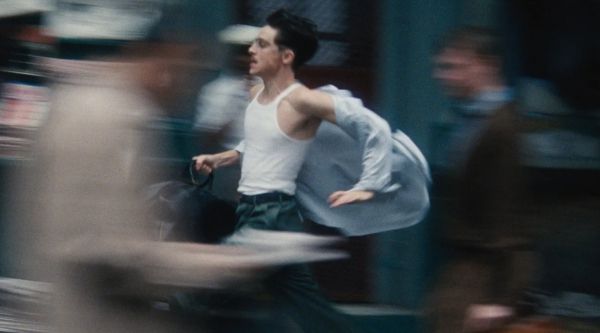
Timothée Chalamet plays him as though stillness might be fatal. Marty speaks quickly, changes tactics mid-sentence, enters spaces where he has not been invited, and assumes that any rejection is merely the beginning of a negotiation. His confidence is not peaceful self-belief. It is constant forward pressure designed to prevent anyone from examining the instability underneath it.
What surprised me was how little the film asks me to admire Marty in a conventional inspirational sense. He is talented, resourceful, charming, selfish, exhausting, and frequently willing to turn another person’s trust into temporary capital. I wanted him to succeed at the table while becoming increasingly uncertain that success would improve him.
Marty Treats Every Human Interaction Like a Rally
A table tennis player cannot remain attached to the previous shot. The ball returns immediately, and hesitation creates another weakness. Marty approaches conversation with the same logic.
When someone refuses him, he changes direction. When a lie becomes impossible to maintain, he replaces it with a partial truth. When charm stops working, he applies pressure. He rarely accepts the emotional meaning of another person’s answer because he is already preparing the next response.
This makes his dialogue thrilling to watch. Chalamet does not simply deliver lines quickly. He makes Marty appear to be editing reality while speaking. Each sentence tests whether the listener will accept a more favorable version of events.
I often found myself impressed by his improvisation and irritated by the fact that he needed to improvise only because he had created another avoidable problem. Marty does not escape chaos. He manufactures chaos, then uses his ability to survive it as proof of superiority.
That cycle is central to the film. A straightforward path toward improvement would require patience, humility, and repetitive work. Marty wants a larger story. He wants obstacles dramatic enough to confirm that his eventual victory was inevitable.
Timothée Chalamet Makes Arrogance Look Like Physical Hunger
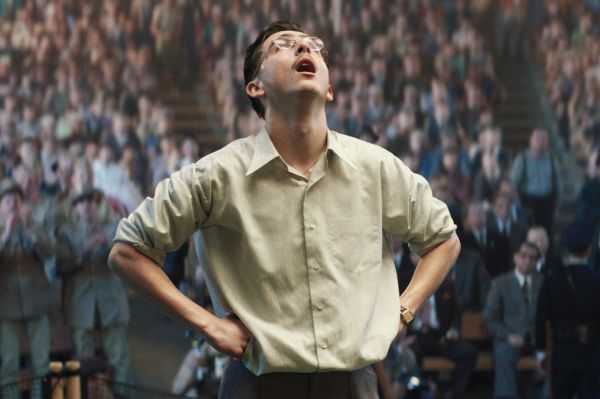
Chalamet gives one of his most restless performances as Marty. He changes posture depending on what he needs from a room. Around wealthy people, he becomes attentive and sophisticated. Around opponents, he expands physically and attempts to control the available space. Around people who know him too well, the performance begins to fracture.
His face is particularly effective during moments of public confidence. Marty smiles as if he has already received the answer he wants, yet his eyes continue measuring every reaction. He is always calculating whether admiration, desire, fear, or pity will become the most useful form of influence.
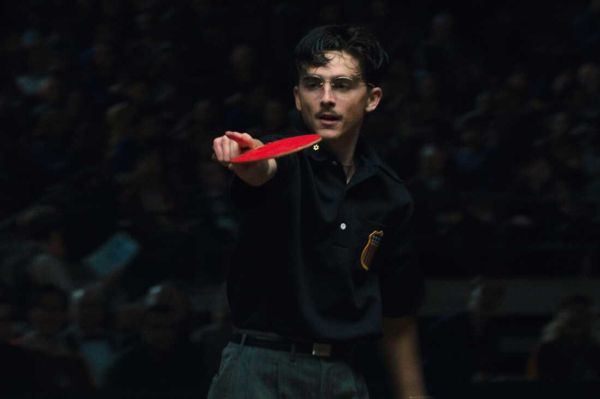
The athletic material is convincing because Chalamet does not play table tennis like a celebrity completing a few carefully edited movements. His stance, balance, preparation, and aggression suggest a character whose relationship with the sport is obsessive.
Marty does not merely want to win. He wants an opponent to understand that they have been beaten by someone more imaginative than themselves. The performance gives rallies a psychological quality. A point is not complete until Marty has turned it into part of his personal mythology.
I also appreciated that Chalamet allows him to appear ridiculous. His self-image is enormous, but his circumstances are often cheap, inconvenient, and humiliating. The distance between how Marty sees himself and how the room sees him creates much of the film’s comedy.
The 1950s Setting Does Not Feel Safe or Nostalgic
Marty Supreme is set in a postwar America filled with confidence about growth, competition, consumption, masculinity, and national possibility. Josh Safdie does not photograph this period as a comfortable collection of vintage cars and attractive suits.
The streets feel crowded, businesses feel transactional, and every social environment appears to contain someone searching for leverage. The country may be speaking about prosperity, but Marty experiences prosperity as something happening to other people behind doors he intends to enter.
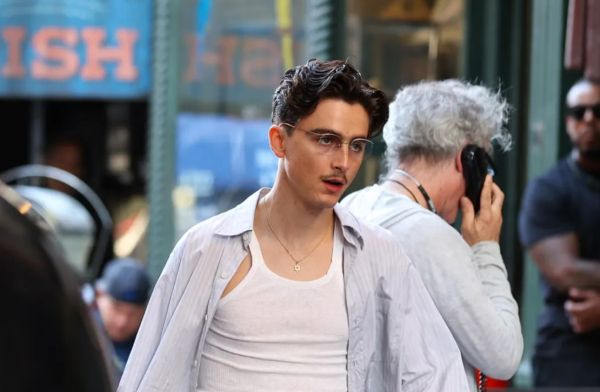
I liked how the period details support ambition rather than becoming museum decoration. Clothing signals status. Hotels separate those who belong from those pretending to belong. Shops, clubs, offices, tournaments, and restaurants create different versions of public respectability.
Marty is especially sensitive to these distinctions. He notices materials, manners, accents, and access. He understands that becoming a champion will not be enough if table tennis remains culturally insignificant. He needs to increase the value of the room around him.
The film’s use of later music over its 1950s world adds productive instability. It prevents me from settling into historical distance and makes Marty’s hunger feel contemporary. His desire to convert personality into a brand belongs just as easily to the present.
The Table Tennis Matches Are Directed Like Arguments
The matches are not filmed as identical sequences of rapid shots. Each important rally reflects a different power relationship.
When Marty feels superior, the game appears expansive. He has time to move, perform, provoke, and control the emotional rhythm. When he is threatened, the table becomes smaller and the ball seems faster. Space disappears as pressure increases.
I found the sound design essential. The repeated contact between paddle and ball creates a sharp mechanical pulse. Shoes move across the floor, spectators react, and breath becomes increasingly audible as the rally continues.
The editing does not always allow me to admire complete technique from a comfortable distance. Safdie places me inside Marty’s perception, where every return creates another urgent demand.
This approach may frustrate viewers wanting a clean technical record of each game. I rarely felt that the film wanted me to study table tennis objectively. It wanted me to feel why Marty experiences it as the only honest part of his life.
At the table, deception still exists through spin, placement, rhythm, and body language, but the result cannot be negotiated after the point ends. Someone reached the ball or did not. Marty is drawn to that clarity because everything outside the match is unstable.
Marty Wants the Respect Given to the Wrong Sports
One of the film’s most interesting tensions comes from Marty’s belief that he has chosen a sport too small for his ambition. He does not doubt the value of his skill. He doubts the world’s ability to recognize it.
A boxer, baseball player, or major team athlete can enter an established commercial structure. Marty must sell the importance of table tennis while also selling himself.
This turns him into athlete, promoter, negotiator, entertainer, and professional nuisance. He understands that athletic excellence without public fascination may leave him technically victorious and financially irrelevant.
I sympathized with this frustration. Cultural value is not distributed according to difficulty alone. Some disciplines receive enormous attention, while equally demanding activities remain invisible outside dedicated communities.
Marty’s response is less admirable. He begins believing that because recognition is unfair, nearly any method of obtaining it becomes justified. Exploitation can be renamed promotion, manipulation can become confidence, and betrayal can be treated as the temporary cost of a larger future.
Rachel Knows the Version of Marty That Public Performance Cannot Hide
Odessa A’zion’s Rachel provides the film with a perspective that does not depend on Marty’s charisma. She understands his habits, evasions, and emotional shortcuts because she has experienced their consequences directly.
Their relationship has physical attraction and genuine familiarity, but familiarity does not produce safety. Marty assumes that being known deeply will create forgiveness. Rachel recognizes that understanding why he behaves badly does not make the behavior less damaging.
I found A’zion especially strong during moments when Rachel listens to another promise. She does not need to interrupt immediately. Her expression communicates that she has heard several versions of this speech before.
Marty approaches her as someone who will remain available while he pursues a larger destiny. He treats emotional continuity as a resource he has already secured.
The film is sharpest when Rachel refuses that assumption. She is not simply the loyal woman waiting for the gifted man to become responsible. Her life continues while he is designing another escape.
I wanted even more time with her outside Marty’s orbit. The character is compelling enough that the consequences of his ambition become clearer whenever the film allows her independent choices to occupy the frame.
Kay Stone Understands That Desire Can Be a Transaction
Gwyneth Paltrow’s Kay Stone enters from a world of greater wealth, access, and social performance. Her relationship with Marty is charged partly because both characters understand that attraction does not exist separately from opportunity.
Marty sees Kay as a person and as an entrance. She represents money, influence, legitimacy, and environments where he wants to be recognized.
Kay appears aware of this almost immediately. That awareness gives her control. She is not easily deceived by Marty’s performance because she understands the structure of the exchange.
Paltrow gives the character an elegant emotional distance. Kay can appear interested without becoming available, generous without becoming selfless, and vulnerable without forgetting the social power she possesses.
I enjoyed their scenes because seduction becomes negotiation. Each person is attempting to determine what the other genuinely wants and how much that desire can be used.
The relationship also exposes Marty’s fantasy that access will resolve insecurity. Entering a wealthy room does not make him belong there. It merely gives him another audience whose approval he must continue earning.
The Film Is Funny Because Marty Thinks Every Disaster Proves His Importance
Marty Supreme contains significant tension, but it is frequently hilarious. Much of the comedy comes from Marty interpreting consequences as evidence that his life has become appropriately dramatic.
A normal person might see debt, anger, missed obligations, or a damaged relationship as reasons to reconsider. Marty sees them as obstacles appearing because he is close to greatness.
Chalamet’s complete commitment makes the logic persuasive for several seconds at a time. He speaks as though anyone questioning him has simply failed to understand the scale of the opportunity.
The supporting performances resist him in different ways. Some characters become fascinated, others exhausted, and several seem briefly unsure whether confidence this extreme must contain hidden evidence.
I laughed most when Marty attempted to maintain status while the physical situation contradicted him. Clothing, transportation, money, location, or another person’s reaction could expose the cheap machinery behind the myth.
The film rarely pauses to announce a joke. Comedy and danger often occupy the same scene, which makes laughter feel slightly irresponsible and therefore more effective.
Kevin O’Leary Fits the Film’s View of Capital Almost Too Perfectly
Kevin O’Leary brings a recognizable language of investment, value, efficiency, and personal advantage to the film. His presence initially risks feeling like casting designed around public persona rather than character.
Josh Safdie uses that familiarity productively. O’Leary’s controlled confidence belongs naturally inside a story where every talent must be translated into market value before powerful people take it seriously.
Marty believes that conviction should attract capital. Investors understand that conviction is abundant and risk should be transferred whenever possible.
Their exchanges reveal that Marty is not the only person skilled at performance. Wealth has its own theatrical language, one designed to make extraction sound rational and refusal sound educational.
I found these scenes darkly funny because Marty finally encounters people who treat his dream with the same strategic detachment he applies to other people’s needs.
He wants investment without surrendering control. The financial world wants his potential without inheriting his instability. Neither side is interested in an equal relationship.
Tyler Okonma Brings a Different Kind of Confidence
Tyler Okonma’s presence gives the ensemble another rhythm. His performance feels less desperate than Marty’s, even when his character is participating in the same uncertain social world.
Marty’s confidence demands constant external confirmation. Tyler’s screen presence suggests someone more comfortable allowing silence to create attention.
This contrast benefits Chalamet. Marty becomes visibly busier beside a person who does not need to fill every available second.
The casting also fits the film’s interest in performers who understand branding, ambition, provocation, and the construction of public identity beyond traditional acting.
I occasionally became aware of Tyler as a contemporary cultural figure inside the 1950s setting, but that slight disruption matches the film’s intentionally unstable relationship with period authenticity.
Fran Drescher Gives Family Pressure a Recognizable Voice
Fran Drescher’s performance adds warmth, criticism, and a specific New York family energy to the film. Her character understands that Marty’s ambition did not emerge in isolation.
Families can encourage confidence while also creating the fear that ordinary success will never be enough. Marty has learned to treat attention as proof of existence.
Drescher can make a simple concern sound loving and accusatory at the same time. That balance suits a family attempting to support someone whose behavior repeatedly damages the stability they value.
I appreciated that domestic scenes do not become quiet moral lessons. Family members possess their own pride, frustrations, and understanding of what Marty’s success might mean for them.
His dream is personal, but the cost is distributed.
Darius Khondji Makes Sweat, Smoke, and Fabric Feel Physical
The 35-mm cinematography gives Marty Supreme a tactile visual quality. Faces, clothing, streets, clubs, tournament halls, and hotel interiors feel textured rather than polished into digital smoothness.
Darius Khondji’s lighting often makes ambition look slightly unhealthy. Rooms are attractive without becoming comfortable. Light falls across faces while shadows preserve the sense that another calculation is happening nearby.
I liked the physical detail surrounding Marty. His clothes attempt elegance, but the camera notices wear, moisture, pressure, and movement. The body cannot completely maintain the image.
Table tennis benefits from this texture. The paddle, ball, table surface, and movement of hands remain physical objects rather than abstract pieces inside a heavily processed sports montage.
The wider environments also communicate class. Space, light, furniture, and crowd density change depending on who controls the room.
Marty understands these visual differences immediately. He does not only want money. He wants to appear natural inside the spaces money creates.
Daniel Lopatin’s Music Makes the 1950s Feel Temporally Unstable
Daniel Lopatin’s score and the film’s use of music from later decades prevent the period setting from becoming sealed historical recreation.
The soundtrack creates a productive mismatch. Marty moves through postwar New York with music that suggests later forms of celebrity, consumer desire, electronic anxiety, and cultural memory.
I found this especially effective during sequences where his ambition becomes larger than the immediate location. The music seems to broadcast the future he imagines before the world around him has agreed to it.
The approach may distract viewers who prefer period-specific scoring. I rarely experienced the songs as accidental anachronism. They function as access to Marty’s emotional scale rather than as sound literally playing within every scene.
Lopatin also understands repetition. Table tennis is built from rapid returns, and the score frequently uses patterns that create momentum without providing emotional resolution.
The music pushes forward even when Marty should stop. In that sense, it behaves like the character.
Josh Safdie Creates Anxiety Through Competing Objectives
A typical scene does not contain one problem. Marty may need to reach a match, satisfy a financial demand, hide information from one person, persuade another person to help him, and maintain the appearance that everything is proceeding according to plan.
Safdie allows these objectives to collide rather than resolving them sequentially. A phone call interrupts a negotiation. A personal relationship enters a professional space. A practical problem arrives while Marty is attempting to perform confidence.
The result resembles the pressure of Uncut Gems without simply repeating that film’s structure. Marty is younger, more physically gifted, and convinced that the future remains open. His anxiety comes from expansion rather than collapse alone.
I occasionally felt exhausted by the constant escalation. The film runs for roughly two and a half hours, and Marty’s personality provides limited opportunities for calm reflection.
That exhaustion is partly the point. Spending time with him means entering a life where every quiet moment risks revealing doubt.
The Running Time Tests My Tolerance for Marty’s Self-Belief
At approximately 150 minutes, Marty Supreme is deliberately substantial. It wants enough time to show ambition transforming across sport, money, romance, family, travel, and public identity.
The length allows the supporting characters to challenge different parts of Marty’s performance. It also creates repetition because his basic strategy remains remarkably consistent: push forward, promise more, and treat consequences as temporary.
I admired many individual scenes while occasionally feeling that the film had already demonstrated the same character flaw. Marty’s persistence is compelling, but persistence without variation can become emotional noise.
The sports sequences restore focus whenever the surrounding schemes become too scattered. At the table, the movie can reduce itself to movement, timing, and competitive intelligence.
I would not remove the film’s scale entirely. A shorter version might make Marty appear more conventionally heroic by eliminating the accumulation of harm around him.
The long experience forces me to understand why other characters become tired of his brilliance.
This Is Not an Inspirational Sports Film in the Usual Sense
Marty trains, competes, struggles for recognition, and attempts to prove the value of an underestimated sport. Those elements belong naturally to inspirational sports cinema.
The film repeatedly refuses the expected moral comfort. Discipline does not automatically produce humility. Talent does not make Marty generous. Public success cannot repair every private betrayal.
I wanted to cheer during important matches, yet the film kept reminding me that victory would strengthen the same ego creating damage elsewhere.
This tension makes the sports material more interesting. The question is not simply whether Marty deserves to win according to his talent. It is what he believes winning will permit him to become.
Many sports films present obsession as admirable because the final result validates every sacrifice. Marty Supreme examines the people who are described as sacrifices without agreeing to that role.
Marty Is Most Honest When He Is Competing
Outside the table, Marty constantly adjusts identity according to the audience. During a match, his ambition becomes visible without requiring explanation.
He wants control. He wants recognition. He wants to discover whether another person can resist the full pressure of his concentration.
The competitive arena gives his aggression a structure and an opponent capable of answering directly. Every return becomes a refusal to accept Marty’s version of superiority.
I found him easier to understand while playing than while speaking. His body expresses discipline that his conversation frequently hides beneath exaggeration.
This is the tragedy inside the character. He possesses a real ability worthy of attention. He remains convinced that talent alone is insufficient, so he surrounds it with manipulation until people cannot separate the achievement from the damage.
The Film Understands That Charisma Can Become a Form of Debt
Marty’s charm persuades people to invest money, time, access, affection, and credibility. Each successful interaction creates an obligation he assumes can be addressed later.
Eventually, his life becomes a collection of unpaid emotional and practical debts. One person needs honesty, another needs money, another needs recognition, and someone else needs him to arrive when promised.
Marty behaves as though future success will settle everything. Once he becomes sufficiently important, earlier harm can be reinterpreted as part of the difficult journey.
The film is deeply skeptical of this fantasy. Success may change public opinion, but it cannot retroactively turn exploitation into mutual agreement.
I thought about how often biographies of famous men describe abandoned relationships and broken promises as evidence of relentless focus. Marty Supreme refuses to make that language emotionally neutral.
What I Found Most Frustrating
Marty’s repeated avoidance of accountability is intentionally frustrating, but the pattern occasionally limits emotional variety. He can learn tactical lessons without accepting moral ones.
Several supporting characters are fascinating enough to deserve more independent development. Rachel and Kay are especially important, yet much of their screen time remains connected with what Marty wants from them.
The film’s tonal movement between comedy, sports excitement, romantic tension, and severe consequence is usually effective. A few transitions feel abrupt enough that emotional weight disappears beneath the next problem.
The long runtime intensifies these concerns. Some scenes add texture, while others appear to extend a pattern already clearly established.
The contemporary soundtrack is purposeful, though it may pull some viewers out of the period rather than creating the same emotional bridge it created for me.
The Ending Refuses to Make Victory Simple
Without reducing the final movement to a detailed plot summary, I found the ending effective because it does not treat sporting achievement as a complete moral resolution.
Marty reaches a point where the public version of his story and the private cost can no longer remain comfortably separated.
The film understands the seductive power of a winning image. A crowd can see talent, perseverance, and triumph while remaining unaware of the promises that made the moment possible.
I left uncertain whether Marty had changed or merely discovered a more sophisticated way to include responsibility inside his self-image.
That ambiguity suits him. A sudden transformation into a humble and emotionally transparent man would feel dishonest. Marty’s deepest habit is turning every event into proof that he is becoming the person he was always meant to be.
Who Should Watch Marty Supreme?
I recommend Marty Supreme to viewers who enjoy anxious character studies, unconventional sports films, morally difficult protagonists, period stories with modern music, and performances driven by physical and verbal momentum.
Fans of Uncut Gems and Good Time will recognize Josh Safdie and Ronald Bronstein’s interest in people who treat risk as a source of identity. This film has its own rhythm, but it shares their fascination with characters moving too quickly to confront themselves.
Timothée Chalamet delivers an intense central performance that does not depend on easy likability. Viewers interested in seeing him play charm as a dangerous survival skill will find a great deal to examine.
Anyone expecting a calm historical sports biography may be surprised. The story is fictionalized, the music deliberately crosses periods, and the emotional focus extends far beyond competition results.
Viewers who need a sympathetic protagonist may find Marty exhausting. The film understands that reaction and does not rush to protect him from it.
My Final Verdict
Marty Supreme is a fast, funny, exhausting, and visually confident sports drama about a man who believes talent gives him permission to reorganize every room around his ambition.
Josh Safdie turns table tennis into a credible arena of speed, strategy, status, and psychological violence. The matches are exciting because Marty’s complete identity enters every rally.
Timothée Chalamet is excellent at making confidence attractive and unbearable within the same scene. Odessa A’zion and Gwyneth Paltrow give the personal relationships enough resistance to prevent the film from becoming a celebration of male genius. Darius Khondji’s tactile cinematography and Daniel Lopatin’s temporally disruptive music create a period world that feels physical without becoming comfortably nostalgic.
The film occasionally repeats Marty’s destructive cycle beyond the point of discovery, and its supporting women deserve more space beyond their relationship with him. Its length is purposeful but demanding.
I rate Marty Supreme 8.9/10. It gave me the excitement of a sports film without allowing victory to settle every argument. I admired Marty’s skill, laughed at his audacity, and spent much of the running time hoping somebody would finally refuse to finance the next version of his mythology.
The table is small. The ball weighs almost nothing. The distance between the players appears manageable.
Marty looks across it and sees the entire world waiting to be conquered.
Pros:
- Deep character development with multi-dimensional performances.
- Effective blending of classic and modern filmmaking techniques.
- A soundtrack that perfectly complements the film's mood and pace.
- Encourages multiple viewings to uncover hidden details and symbolism.
- Innovative narrative structure that challenges traditional storytelling.
- Visually striking cinematography that enhances the story.
Cons:
- Technical risks in the editing pace may not suit viewers preferring traditional storytelling.
- Occasionally fragmented narrative that may confuse some viewers.
- Non-linear storyline requires active engagement which might not appeal to all.








Movie Reviews

Minecraft

Grand Theft Auto V

Toca Boca World

Roblox

Leave a comment
Your comment is awaiting moderation. We save your draft here
0 Comments