Review
Frosty the Snowman lasts less than half an hour, tells a story most viewers can summarize in a few sentences, and makes almost no attem...

Frosty the Snowman: A Timeless Winter Journey Through Magic and Memory
Frosty the Snowman lasts less than half an hour, tells a story most viewers can summarize in a few sentences, and makes almost no attempt to disguise where its emotional journey is heading. Children build a snowman. A discarded magician’s hat brings him to life. Rising temperatures threaten his existence, and a young girl tries to help him reach a colder place before he melts.
That simplicity is precisely why the special remains effective. It does not bury its central idea beneath mythology, complicated rules, or excessive comic activity. Frosty is alive for only a short time, everyone understands that winter cannot last forever, and the joy of his existence is inseparable from the knowledge that it may end.
I find the special warmer and slightly sadder than its cheerful song initially suggests. The story is designed for children, but it introduces them to impermanence with remarkable directness. Frosty’s first day is also potentially his last. He experiences the world with complete enthusiasm while the audience gradually understands how fragile that experience is.
Jimmy Durante Makes the Story Feel Like a Memory
Jimmy Durante narrates the special as though he is recalling something that happened long ago and has become part of a shared seasonal tradition. His voice is immediately recognizable: rough, affectionate, and slightly amused by the simplicity of the tale.
The narration creates a comforting distance from the danger. Even when Frosty is melting or Karen is stranded in the cold, Durante’s presence suggests that the story is being remembered from a place of safety.
I appreciate that the narrator does not dominate the special. He guides transitions, comments on events, and connects the story to the familiar song without explaining every emotion. The characters are allowed to react for themselves.
Durante also gives the production a sense of oral storytelling. Frosty the Snowman feels less like a polished animated film than a winter story someone might tell children after hearing the song many times.
Frosty Becomes Lovable Because He Has No Time for Cynicism
Jackie Vernon voices Frosty with relaxed friendliness. The character does not awaken frightened or confused by the impossible fact of his existence. He immediately accepts life as an opportunity for fun.
His famous first words, “Happy birthday,” establish the central quality of the character. Frosty experiences consciousness as celebration. Every sensation is new, and every new experience appears valuable.
Vernon avoids making him excessively energetic. Frosty’s voice is slow, warm, and slightly sleepy, which gives the character an easygoing personality distinct from the excited children around him.
I find his innocence effective because it is never presented as stupidity. Frosty quickly understands that heat is dangerous and that he must reach the North Pole. He simply refuses to let danger erase the pleasure of being alive.
There is something quietly moving in the way he speaks about returning every year. Frosty accepts disappearance differently from the humans around him because seasonal change is part of his identity. He belongs to winter, not to permanence.
Karen Gives the Fantasy Its Emotional Perspective
Karen is the child who most strongly accepts responsibility for Frosty. She participates in creating him, recognizes the magic of the hat, and refuses to abandon him when his life becomes endangered.
June Foray gives Karen a voice that combines excitement with practical concern. She believes in the impossible without becoming passive inside it. Once the temperature rises, she helps organize the journey north.
The story depends on her friendship with Frosty developing almost instantly. There is little time for gradual attachment, yet the simplicity of their bond suits the special’s fairy-tale logic. Karen cares because Frosty is alive, kind, and vulnerable.
I also appreciate that she is not treated as merely a witness to magic. She makes decisions, follows Frosty into danger, and endures physical discomfort because she believes protecting him is more important than returning home immediately.
Her presence gives the story human stakes. Frosty may be threatened by warmth, but Karen is threatened by cold. The environment that saves one character endangers the other.
The Magical Hat Creates Life Without Requiring an Explanation
Professor Hinkle’s hat brings Frosty to life, yet the special never explains why it possesses magic. There is no elaborate origin story, ancient spell, or system governing its power.
I find this restraint refreshing. The hat works because the story needs one impossible object. Explaining it would not make Frosty’s life more meaningful.
The lack of explanation also suits childhood imagination. An abandoned hat lands on a snowman’s head, and suddenly the figure moves. The children accept the event more quickly than the magician does because they are not concerned with ownership or proof.
Hinkle sees the hat as property once he realizes its value. The children see Frosty as a person once he begins speaking. That contrast establishes the moral difference between them.
Professor Hinkle Is Petty Enough to Be Funny and Dangerous
Billy De Wolfe voices Professor Hinkle as a failed magician whose incompetence is matched only by his selfishness. He initially throws away the hat because he believes it is useless. Once it demonstrates real power, he immediately demands its return.
Hinkle is not a frightening antagonist in the traditional sense. He is vain, clumsy, impatient, and constantly undermined by his own bad decisions. Yet his selfishness creates genuine danger because he treats Frosty’s life as less important than possessing the hat.
I like that the character’s motivation remains small. He does not want world domination or revenge. He wants recognition as a successful magician and believes the hat can provide it.
This pettiness makes him an appropriate villain for such a short special. His greed is easy for children to understand, and his exaggerated behavior prevents the threat from becoming overwhelming.
De Wolfe gives every complaint a theatrical rhythm. Hinkle behaves as though the universe has personally insulted him whenever events fail to follow his plan.
The Animation Has the Texture of an Illustrated Storybook
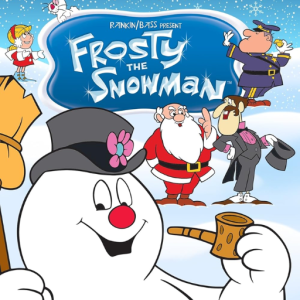
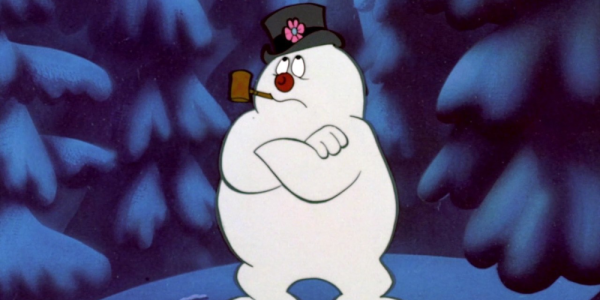
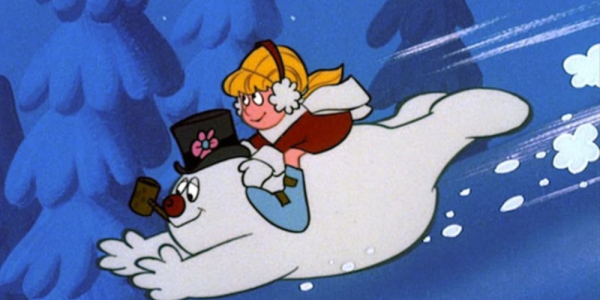
Unlike the stop-motion productions most strongly associated with Rankin/Bass, Frosty the Snowman uses traditional cel animation. The visual style resembles a children’s picture book brought gently into motion.
Characters have rounded forms, simple expressions, and clear silhouettes. Snow-covered streets and forests are created through broad shapes rather than detailed realism.
This simplicity supports the emotional clarity of the story. Frosty’s black hat, orange nose, and red scarf remain instantly readable against the white landscape. Professor Hinkle’s darker clothing and angular body distinguish him visually before he begins causing trouble.
The animation is limited compared with theatrical productions of the period. Movement can look stiff, backgrounds are reused, and facial expressions rely on a small range of changes.
Yet the limitations create charm rather than distraction. The special feels handmade, modest, and close to the television era in which it was produced.
The Parade Sequence Briefly Turns Frosty Into a Public Celebration
After coming to life, Frosty leads the children through town in a parade. The sequence expands the magic beyond the schoolyard and gives the familiar song its most natural place in the narrative.
The children follow him with complete confidence, while adults respond with surprise but little panic. The town seems willing to accept the impossible when it arrives in such a friendly form.
I enjoy the scene because it gives Frosty a moment of uncomplicated happiness before the temperature becomes a serious threat. He dances, greets people, and explores movement without yet understanding how limited his time may be.
The parade also establishes him as a communal figure. Frosty belongs partly to the children who built him, but his joy quickly spreads through the larger town.
The Train Station Introduces the Story’s Practical Problem
Frosty and Karen decide that the North Pole offers the safest climate, but reaching it requires transportation. At the train station, they discover that travel costs money, which Frosty obviously does not possess.
This small obstacle brings the fantasy into contact with ordinary systems. A magical snowman can come to life, but the railway still requires a ticket.
The children’s attempt to calculate the cost creates gentle humor, especially as the price increases according to Frosty’s unusual weight and condition.
The solution—hiding inside a refrigerated train car—is risky, but it follows the special’s simple logic. Frosty needs cold, Karen needs to stay with him, and conventional travel is unavailable.
I appreciate that the story allows practical details to shape the adventure without overwhelming it. The North Pole is not reached through instant magical transport. Frosty and Karen must begin an actual journey.
Hocus Pocus Is a Quietly Essential Companion
Professor Hinkle’s rabbit, Hocus Pocus, has no spoken dialogue, yet he repeatedly helps the children and undermines his owner. His loyalty shifts toward the characters who treat the magic responsibly.
The rabbit serves several functions. He guides characters, provides comic reactions, and eventually helps bring Santa into the story.
I find his presence especially useful because he connects Professor Hinkle’s failed performance with the real magic of Frosty. Hocus belongs to the magician’s act but recognizes that the genuine miracle should be protected rather than exploited.
His silent behavior also adds visual humor without requiring another song or extended explanation. A look or movement is enough to communicate what he thinks of Hinkle’s latest decision.
The Greenhouse Scene Gives the Special Its Darkest Turn
Professor Hinkle traps Frosty inside a greenhouse, where the warm air causes him to melt. Karen arrives too late to prevent the collapse and finds only a puddle, hat, coal, and clothing.
For a short children’s special, the scene is emotionally direct. Frosty does not gradually weaken while delivering a long farewell. He disappears, leaving behind the objects that once formed his body.
I find the image effective because the special does not completely soften Karen’s grief. She believes her friend is gone, and her reaction is treated seriously.
The greenhouse also represents the reversal of ordinary safety. A warm building would normally protect someone from winter. For Frosty, it becomes fatal.
Hinkle’s action crosses a moral boundary here. Until this point, his pursuit of the hat has been comic. Trapping Frosty reveals the real consequence of treating a living being as an obstacle.
Santa Arrives as an Interpreter of Christmas Magic
Santa enters relatively late, after Hocus Pocus brings him to Karen and the melted Frosty. His role is not to replace the central characters but to explain the nature of the magic.
Santa reveals that Frosty is made from Christmas snow and therefore cannot disappear permanently. As long as the season returns, Frosty can return with it.
This explanation transforms the apparent death into a seasonal cycle. Frosty melts, but he is not lost in the same way a human life would be lost. His existence follows winter.
I find this comforting without feeling entirely dishonest. The special acknowledges the pain of separation even while promising return. Karen still has to say goodbye, and another Christmas must arrive before Frosty can come back.
Santa also brings moral authority to the conflict with Hinkle. The magician responds to the possibility of exclusion from Christmas far more quickly than he responds to Karen’s grief.
The Promise of a Gift Forces Hinkle Toward Better Behavior
Santa tells Professor Hinkle that he must write an apology if he wants to receive a Christmas present. The punishment is gentle, especially considering what Hinkle has done, but it fits the special’s moral scale.
Hinkle is not defeated through violence or imprisonment. He is required to acknowledge wrongdoing and participate in the social expectations surrounding Christmas.
The speed of his transformation is comic rather than psychologically convincing. He immediately begins writing because the possibility of losing a gift matters to him.
This preserves the character’s selfishness even during correction. Hinkle behaves better because he wants a reward, not because he has suddenly developed deep empathy.
I enjoy that the special does not attempt a grand redemption speech. His apology is a first step, and Santa remains cautious about whether he has earned forgiveness.
The Song Functions as Narration, Memory, and Prediction
“Frosty the Snowman” is repeated throughout the special, but its function changes with the story. At first, it introduces the character before he exists. During the parade, it celebrates his life. At the end, it promises his return.
The familiar lyrics give the narrative a structure the screenplay does not need to invent from nothing. The special expands the song by asking what might happen between Frosty’s awakening and his departure.
Walter E. Rollins and Steve Nelson’s song already contains movement, danger, and farewell. The adaptation translates those elements into scenes while preserving the directness of the original.
I never feel that the production is merely illustrating lyrics. Karen, Hinkle, Hocus, the journey north, and Santa give the story additional emotional and comic shape.
The Special Understands the Emotional Power of Temporary Things
Frosty matters because he cannot remain. A permanent magical friend living beside the children throughout the year would create a different story.
His life depends on weather, and weather changes regardless of how strongly the children want winter to continue. This introduces loss through a natural cycle rather than cruelty alone.
I find the message especially effective because Frosty does not respond to impermanence with bitterness. He wants to reach safety, but he also accepts that departure belongs to his existence.
The children learn that loving something does not create ownership over it. They can celebrate Frosty, protect him, and remember him without preventing the seasons from changing.
This idea gives the final promise emotional value. “I’ll be back again someday” is comforting because someday is undefined. Return is possible, but waiting remains necessary.
Karen’s Safety Is Resolved More Quickly Than Her Risk Deserves
One weakness in the story is the way Karen’s exposure to cold is handled. She travels inside a refrigerated train car, walks through snow, and remains in conditions dangerous for a child.
Frosty recognizes the problem, but the special moves quickly between concern and the next plot event. The emotional focus remains primarily on saving him.
This imbalance is understandable within the fantasy, though it occasionally makes Frosty’s decisions appear less responsible than his friendly personality suggests.
Santa eventually returns Karen home safely, resolving the danger without consequence. A longer production might have explored Frosty’s realization that protecting himself could endanger his human friend.
The Short Running Time Protects the Story From Excess
Frosty the Snowman does not attempt to create an enormous mythology around its title character. It introduces the hat, establishes the threat of warm weather, begins the journey, and reaches an emotional farewell with remarkable efficiency.
Supporting figures appear only as long as necessary. The children outside Karen do not receive individual arcs. The town is not developed beyond a few festive streets. Santa does not take control until the story requires his particular knowledge.
This compact design keeps the special from becoming exhausting. There is no secondary villain, extended North Pole sequence, or complicated explanation of magical law.
The result resembles a short bedtime story more than a feature-length adventure. Its images and emotions remain clear because the production does not crowd them.
Why the Melting Scene Still Works
The audience knows that Frosty is a snowman. Melting is not a surprising possibility. The special announces the danger early and repeatedly reminds us of it.
What makes the greenhouse scene effective is the transition from movement to absence. Frosty has been speaking, dancing, worrying, and helping Karen. Suddenly, only inanimate pieces remain.
The scene creates grief through contrast rather than graphic detail. A puddle is enough.
Children watching may already understand that snowmen melt, but the story asks them to imagine the snowman as a friend before showing that ordinary seasonal change can feel like loss.
Santa’s later explanation does not erase the sadness. It reorganizes it into hope.
A Holiday Special That Finds Warmth Inside Cold Weather
Frosty the Snowman remains modest in almost every technical and narrative sense. The animation is limited, the characters are broadly drawn, and the magical rules exist only as far as the story requires them.
Yet its simplicity protects the emotional center. Jackie Vernon gives Frosty a calm and instantly likable personality. June Foray makes Karen active, compassionate, and brave. Billy De Wolfe turns Professor Hinkle into a comic antagonist whose selfishness creates real danger without overwhelming the gentle tone.
Jimmy Durante’s narration connects the adventure to the familiar song and gives the special the quality of a story passed from one generation to another. The visual style feels like a moving picture book, while the short running time leaves little space for unnecessary complication.
The special understands that winter is magical partly because it does not remain. Snow falls, children create something from it, and warmer weather eventually changes the landscape. Frosty gives that natural cycle a face, voice, and promise.
His return each year does not prevent the farewell from mattering. It makes the farewell part of the celebration.
Pros:
- Enchanting winter visuals that evoke nostalgia.
- Innovative blend of traditional animation and early digital effects.
- Timeless holiday magic that appeals to multiple generations.
- Engaging musical score that enhances the emotional impact.
- Universal, family-friendly appeal with a G age rating.
- Intricate narrative layers that encourage repeated viewings.
Cons:
- Familiar storyline may feel repetitive for some viewers.
- Limited depth in supporting characters compared to the protagonist.
- Some animation techniques may appear dated to modern audiences.







Movie Reviews

Minecraft

Grand Theft Auto V

Toca Boca World

Roblox

Leave a comment
Your comment is awaiting moderation. We save your draft here
0 Comments