
Review
A Christmas Carol felt like a supernatural morality campaign in which the main character receives one night to review an entire lifetim...
Cinematic Journey of Redemption: A Modern Tale of A Christmas Carol
A Christmas Carol felt like a supernatural morality campaign in which the main character receives one night to review an entire lifetime of poor decisions. Ebenezer Scrooge does not begin as an uncertain man waiting to discover the spirit of Christmas. He has already built a complete philosophy around money, emotional distance, and the belief that another person’s hardship is not his responsibility.
The three spirits do not simply frighten him into becoming more generous. They dismantle the story he tells about himself. Each visit reveals a different weakness in his worldview: the past shows what he lost, the present shows what he refuses to notice, and the future shows what remains when a life creates wealth but almost no affection.
From my perspective as a gamer, the film resembles a forced New Game Plus run. Scrooge is returned to earlier chapters with all his current knowledge intact, allowed to inspect locations he can no longer change directly, and shown how apparently minor dialogue choices developed into permanent character traits.
What makes the 2009 adaptation especially striking is its darkness. The film contains Christmas lights, snow, music, family gatherings, and moments of warmth, but it also leans heavily into the original story’s ghostly atmosphere. Scrooge’s transformation is presented as an emotional rescue, yet the route toward that rescue often feels like a nightmarish survival journey.
Initial Character Build: Maximum Wealth, Minimum Connection
Scrooge has spent years optimizing one resource. He understands money, contracts, payment, debt, and the practical value of almost every object around him.
His mistake is believing that every meaningful part of life can be evaluated using the same system.
Generosity appears inefficient because it provides no guaranteed financial return. Friendship creates expectations. Family gatherings consume time. Compassion may require him to acknowledge problems he cannot solve through accounting.
Jim Carrey gives Scrooge a physical sharpness that matches this mentality. His narrow body, rigid posture, suspicious eyes, and controlled movements make him look as though he has reduced himself to the minimum amount of space necessary to remain alive.
He does not simply refuse warmth. He appears to conserve it.
The Office Established the Rules of Scrooge’s World
Scrooge’s workplace is one of the clearest expressions of his personality. The room is functional but uncomfortable, and Bob Cratchit works under conditions determined entirely by his employer’s unwillingness to spend more than necessary.
The lack of sufficient heat is not only a visual sign of poverty. It reveals how Scrooge translates control into daily discomfort for another person.
Bob does not need extraordinary luxury. He wants enough warmth to perform his work without suffering. Scrooge interprets even that modest request as an attack on efficiency.
I viewed the office as a management simulation operated by someone who has reduced employee morale to an irrelevant statistic. Productivity matters. Human comfort does not.
The tragedy is that Scrooge is intelligent enough to understand every financial calculation and emotionally limited enough to believe those calculations contain the complete truth.
Fred Offered an Invitation With No Hidden Cost
Scrooge’s nephew Fred repeatedly invites him to Christmas dinner. The offer includes food, conversation, family connection, and a place where Scrooge would be welcomed despite his behavior.
Scrooge rejects it because he treats happiness without visible profit as foolishness.
I found Fred important because he disproves the idea that Scrooge has been completely abandoned. Scrooge still has access to family. He chooses isolation and then uses that isolation as evidence that emotional connection has little value.
Fred does not demand an apology before extending the invitation. He does not ask Scrooge to become charming or generous first. The door is already open.
In game terms, Fred represents a recurring optional quest that requires no payment and offers a significant relationship reward. Scrooge refuses it every year because the objective does not increase his inventory.
The Charity Collectors Exposed His Philosophy Directly
When two men request support for people experiencing hardship, Scrooge does not merely decline. He constructs an argument explaining why social institutions and death itself make private generosity unnecessary.
His response is frightening because it is calm. He is not reacting to a personal insult or immediate financial threat. He has converted human suffering into an administrative category.
This scene shows that Scrooge’s coldness is more than bad manners. It is a worldview designed to protect him from moral responsibility.
If poverty is the result of personal failure, he owes nothing. If institutions technically exist, he can ignore whether they provide dignity. If people disappear from the system, he can describe the result as improved efficiency.
The spirits later challenge this philosophy by forcing Scrooge to look at individual faces rather than abstract populations.
Marley’s Door Knocker Was the First System Warning
The appearance of Jacob Marley’s face in the door knocker begins the breakdown of Scrooge’s confidence.
Until that moment, his home represents control. He has locked the door, removed himself from other people, and entered a space where no employee, relative, or charity collector can demand anything from him.
The supernatural warning appears directly inside the object separating him from the outside world.
I liked how briefly the image remains. Scrooge sees enough to become unsettled but not enough to prove anything. He can still blame fatigue, imagination, or food.
This uncertainty is necessary because Scrooge’s first defense against the supernatural is the same defense he uses against emotion: reduce the experience to a physical explanation and continue as before.
Scrooge’s House Felt Like an Abandoned Level
The building is large enough to suggest former status, but its rooms feel empty, dark, and poorly inhabited. Scrooge possesses space without creating a home.
Long corridors, heavy doors, shadows, and isolated furniture make the environment feel larger than one person needs. The absence of other residents turns every sound into a possible threat.
From my perspective, the house resembles a once-important location that has lost its non-player characters. The architecture remains, but the social purpose has disappeared.
Scrooge has protected himself from interruption so successfully that the building now amplifies every sign of his loneliness.
Marley Entered Carrying His Entire Inventory
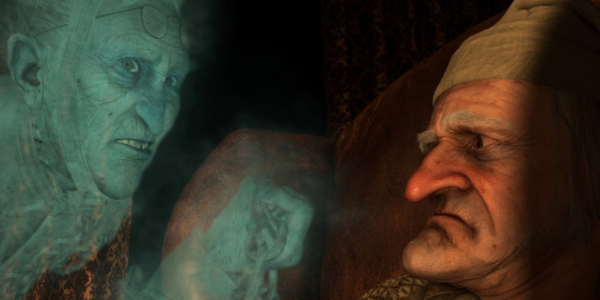
Jacob Marley’s ghost is one of the film’s strongest supernatural designs. He arrives wrapped in chains connected to money boxes, locks, records, and the material symbols of his business life.
The burden is not an arbitrary punishment assigned after death. Marley explains that he created it himself through years of selfish choices.
I interpreted the chain as a permanent inventory system where every object collected without compassion remains equipped forever. Wealth did not disappear when Marley died. It became weight.
His visit matters because Marley is not morally superior to Scrooge. He followed the same path and reached the destination first.
That makes him a credible warning. He understands every excuse Scrooge might use because he once relied on the same excuses.
The Ghost’s Jaw Made Death Physically Unstable
The film’s animation gives Marley’s body a disturbing lack of ordinary structure. His face can shift, his jaw becomes difficult to control, and his movements suggest that death has separated him from the rules governing a living body.
This visual choice pushes the movie toward horror more openly than many family adaptations.
Marley is not a transparent version of the man Scrooge remembers. He is a damaged spiritual consequence.
I found the design effective because it prevents Scrooge from treating the encounter as a sentimental reunion. Marley has not returned to exchange memories. He has returned because his former partner is approaching the same irreversible state.
The Chain Outside the Window Expanded the Scale
When Scrooge sees other spirits wandering beyond his room, Marley’s suffering stops looking unique.
The sky is filled with figures carrying chains, reaching toward people they can no longer help. They possess awareness without useful agency.
The scene demonstrates that regret is not the same as redemption. These spirits may finally understand compassion, but understanding has arrived after their ability to act has ended.
This becomes the central urgency of Scrooge’s night. He still has something Marley no longer possesses: time.
The Ghost of Christmas Past Was Memory Given a Body
The first spirit has a strange, shifting appearance that feels less physically stable than the later visitors. Its light is bright, its form can seem young and old at once, and its presence carries both gentleness and authority.
This design suits memory. The past remains fixed in one sense, yet the way a person experiences it changes with age.
Scrooge initially resists the light because the spirit does not show him unfamiliar information. It shows him information he has spent years refusing to examine.
From a gameplay perspective, the Ghost of Christmas Past does not unlock new lore. It restores deleted cutscenes.
The pain comes from realizing that Scrooge always possessed the evidence required to understand himself.
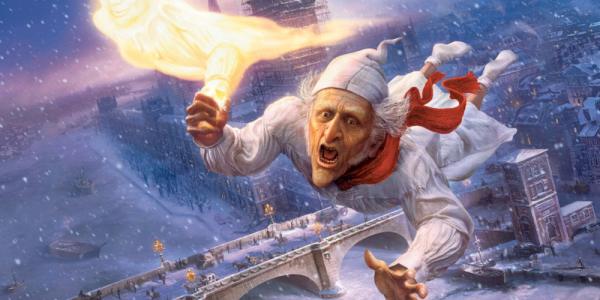
Flight Turned London Into a Memory Map
The journey through the night sky gives the spirit freedom to move across geography and time without respecting normal physical routes.
Scrooge is pulled away from the streets he controls and carried into landscapes associated with earlier versions of himself.
The camera movement is energetic, sometimes aggressively so. The film uses performance-capture animation to send Scrooge through the environment in ways a live-action adaptation would struggle to reproduce.
At its best, this movement makes memory feel uncontrollable. Scrooge cannot decide how quickly the past arrives or where the spirit places him.
At times, the visual ride becomes more important than the emotional destination. I preferred the quieter scenes where Scrooge had to remain still and watch.
The Lonely Schoolroom Revealed the First Wound
Young Scrooge sits alone while other children have gone home for the holiday. This is the first major challenge to the idea that he was always emotionally cold.
He understands loneliness because he experienced it before choosing it.
I found the scene effective because adult Scrooge does not observe the child neutrally. Recognition immediately changes his posture and expression.
The abandoned schoolroom becomes a place where his harshness looks less like natural strength and more like a defensive system developed over time.
This does not excuse the suffering he later causes. It explains why he learned to distrust dependence and celebration.
Scrooge’s Imagination Once Protected Him
The young Scrooge survives isolation partly through books and imagined companions. Stories create company where real people are absent.
This detail matters because the adult man later treats imagination as foolish and commercially useless.
He has rejected one of the abilities that helped him survive childhood.
From my gamer’s perspective, young Scrooge used narrative as an early support mechanic. Adult Scrooge removed it from the build because it reminded him of vulnerability.
Fan Brought the First Genuine Rescue
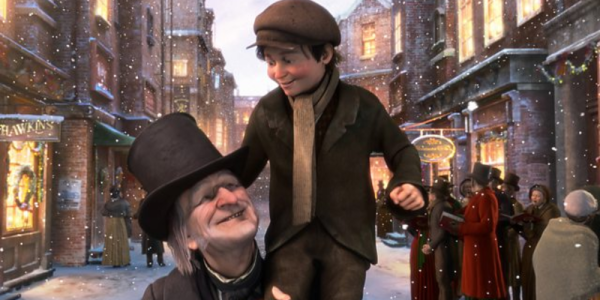
Scrooge’s sister Fan arrives to bring him home, offering affection without hesitation. Her presence changes the schoolroom from a place of abandonment into the beginning of reunion.
Scrooge remembers loving her deeply, and that memory complicates his rejection of Fred.
Fred is not simply an irritating relative inviting him to dinner. He is the son of the person who once rescued Scrooge from loneliness.
The film does not need to state this argument directly. The connection becomes visible through Scrooge’s reaction.
His refusal of Fred is therefore also a refusal of Fan’s memory.
Fezziwig Demonstrated Another Model of Business
Fezziwig’s workplace is transformed for Christmas through music, food, dancing, and community. He is still an employer, but he does not interpret generosity as a threat to authority.
Scrooge remembers the celebration with visible pleasure. He knows what it feels like to work for someone capable of creating warmth.
This scene undermines one of his central assumptions. Business discipline and human kindness are not mutually exclusive.
Fezziwig spends relatively little compared with the emotional value his actions create. A few hours of celebration produce memories that survive decades.
From a management-game perspective, Fezziwig understands that morale is not wasted capital. It changes how people experience the entire workplace.
Young Scrooge Looked Capable of Another Future
During the Fezziwig celebration, Scrooge is not yet the man introduced at the beginning. He can smile, dance, love, and participate without calculating the financial return of every interaction.
This is one of the most painful stages of the journey because it proves that his final personality was not inevitable.
The film is not showing a villain’s hidden origin as though one event permanently changed him. It is showing a gradual progression in which fear and ambition repeatedly received priority over connection.
Scrooge did not lose his humanity in one dramatic moment. He traded parts of it through a series of reasonable-sounding decisions.
Belle Recognized the New Master Before Scrooge Did
Belle’s separation from Scrooge reveals that money has stopped being a tool and become the central authority in his life.
She understands that he is no longer building security for their future together. He is using insecurity as a reason never to stop accumulating.
I appreciated that Belle does not demand wealth or dramatic sacrifice. She releases him because the person who originally made promises to her has changed.
Scrooge wants to believe that financial success will eventually make emotional life safe. Belle sees that the pursuit itself is destroying their shared future.
In game terms, Scrooge continues grinding after reaching the required resource level because the grind has replaced the quest it was meant to support.
The Later Vision of Belle Removed Scrooge From the Scene
Seeing Belle with a family of her own gives Scrooge access to a possible life that continued without him.
He is not shown a fantasy in which choosing differently would have guaranteed perfect happiness. He is shown that the capacity for warmth he once shared with Belle did not disappear from the world.
It disappeared from his life.
This distinction makes the vision more painful. Scrooge cannot blame fate for taking everything. He participated in the loss.
Scrooge Tried to Extinguish the Memory
When the past becomes unbearable, Scrooge attempts to cover the spirit’s light.
The action is symbolically direct. He cannot change the events, so he tries to suppress the awareness they create.
This is the strategy he has used for years. Painful memories are not processed; they are buried beneath work, money, and contempt.
The film turns that emotional habit into physical action. Scrooge attacks the source of illumination because darkness feels easier than accountability.
The Fall Through Time Was Visually Impressive but Excessive
The transition following the first spirit uses dramatic movement, rapid environmental changes, and physical danger.
I admired the technical ambition, but this was one of several moments where the movie seemed determined to remind me that it could behave like a theme-park ride.
The story’s emotional material is already powerful. Scrooge falling through memory does not always need literal high-speed spectacle to feel destabilizing.
Still, the sequence communicates that he has lost every illusion of control. The night is no longer a conversation he can end by closing a door.
The Ghost of Christmas Present Changed the Atmosphere
The second spirit arrives surrounded by light, food, greenery, and abundance. After the pale, unstable quality of the past, the room suddenly feels full.
Jim Carrey gives the Ghost of Christmas Present a booming warmth that can become intimidating when Scrooge reveals ignorance or hypocrisy.
This spirit is generous but not soft. He celebrates life while understanding how much suffering exists beyond Scrooge’s attention.
From my perspective, he functions like a guide who has unlocked the entire current map and can reveal every active event occurring during Christmas.
The Room of Food Was Abundance Without Hoarding
The feast surrounding the spirit visually contrasts with Scrooge’s relationship to wealth.
Scrooge accumulates money and removes it from circulation. The Ghost of Christmas Present is surrounded by resources intended to be shared.
The food has meaning because people will gather around it. Abundance becomes celebration rather than private possession.
I liked this contrast because the film does not argue that material things are unimportant. Food, warmth, gifts, and comfortable homes matter greatly.
The moral difference lies in whether resources create connection or merely reinforce control.
The Cratchit Home Reframed Poverty Through Attention
Bob Cratchit’s family has limited money, but the home contains care, preparation, humor, and a shared desire to make the holiday meaningful.
The film avoids pretending that love makes poverty harmless. The meal is modest, the family’s resources are strained, and Tiny Tim’s health creates real fear.
What the family possesses is emotional attention. They notice one another.
Scrooge has greater financial security and far less warmth. The contrast is not designed to romanticize hardship. It exposes how little his wealth has accomplished inside his own life.
Bob Cratchit’s Loyalty Was More Generous Than Scrooge Deserved
Bob still offers a Christmas toast connected to his employer, despite the conditions under which he works.
Mrs. Cratchit reacts with justified anger because she understands how Scrooge’s decisions affect the family directly.
I appreciated their disagreement. Bob’s kindness is admirable, but the film allows someone else to state that kindness should not require pretending exploitation is acceptable.
Scrooge hears himself discussed as a real force inside another family’s life. His low wages and refusal of warmth are not private business habits. They shape what the Cratchits can eat, afford, and hope for.
Tiny Tim Turned an Abstract Policy Into One Child
Scrooge can dismiss large groups of struggling people because numbers create distance.
Tiny Tim removes that distance.
The child is gentle, hopeful, and deeply loved. His physical vulnerability does not define his entire personality, but it makes the consequences of limited resources impossible for Scrooge to ignore.
When Scrooge asks about Tiny Tim’s future, the spirit uses Scrooge’s own earlier language against him.
This is one of the film’s most effective moral confrontations. Scrooge is forced to hear how his philosophy sounds when applied to someone whose face he has seen.
Fred’s Party Revealed That Scrooge Was Present Through Absence
Fred and his guests discuss Scrooge even though he refused the invitation. His absence has become part of the family ritual.
Some people laugh at him, but Fred continues defending the decision to invite him. He recognizes Scrooge’s behavior as sad rather than powerful.
I found this important because Scrooge imagines rejection as a form of control. He refuses before anyone can judge or disappoint him.
The party continues without him, and the people inside still possess the warmth he dismissed.
Isolation protects Scrooge from embarrassment while guaranteeing that he receives no connection.
The Game at Fred’s Party Became an Uncomfortable Character Description
When the guests describe an unpleasant creature during a guessing game, Scrooge initially participates with growing amusement.
The reveal that they are describing him changes the emotional meaning immediately.
The joke works because the group is not inventing a supernatural monster. They are describing the recognizable habits of a man who repeatedly chooses misery.
Scrooge receives an external character sheet. Other people see him as isolated, hostile, and almost inhumanly resistant to joy.
Christmas Present Revealed the World Beyond London
The spirit’s journey shows people celebrating in remote, difficult, and dangerous locations. Christmas is not limited to wealthy homes or crowded city streets.
Workers, sailors, and isolated communities create connection with whatever resources are available.
This expands Scrooge’s understanding of the holiday from a local inconvenience into a widespread human ritual.
Celebration survives distance and hardship because its purpose is not perfection. It is recognition that people are not alone.
Ignorance and Want Were the Film’s Darkest Living Symbols
The two children hidden beneath the spirit’s clothing are designed to disturb. Their thin bodies, hostile expressions, and animal-like reactions turn social problems into visible human consequences.
The spirit identifies them as Ignorance and Want, warning Scrooge that ignoring either creates danger.
I found the image effective because it refuses to make poverty look picturesque. These children have been denied enough care that desperation shapes how they respond to the world.
The film’s message becomes larger than personal charity. Scrooge’s transformation matters, but one generous man cannot repair every system represented by these figures.
The Spirit’s Aging Created a Visible Countdown
The Ghost of Christmas Present has only one day to exist. As the visit continues, he grows older.
This visual progression reinforces the temporary nature of the present. Every moment becomes the past immediately after it occurs.
Scrooge spent years postponing connection because he assumed another opportunity would always remain available.
The spirit’s life demonstrates the opposite. The present cannot be stored.
From a gameplay perspective, this entire chapter is a timed event, but the countdown is attached to existence rather than a visible clock.
The Ghost of Christmas Yet to Come Removed Dialogue Entirely
The final spirit is silent, enormous, and almost completely hidden inside dark fabric. Its lack of a visible face prevents Scrooge from negotiating emotionally.
The Ghost of Christmas Past explained. The Ghost of Christmas Present challenged. The final spirit points.
I found the silence threatening because Scrooge receives no reassurance that the future remains flexible. He must infer meaning from scenes whose characters do not know he is watching.
The spirit resembles a final boss that never attacks directly. It allows consequence to perform the confrontation.
The Future Was Built From Conversations Scrooge Could Not Control
Scrooge overhears businessmen discussing a death with casual indifference. He initially searches for clues about the person they mean.
The lack of grief becomes more frightening than open hatred.
The dead person appears to have created so little affection that the community treats his passing as an administrative update or an opportunity for profit.
Scrooge has spent his life attempting to become financially important. The future reveals that financial importance does not guarantee emotional significance.
The Thieves Turned a Life Into Loot
Objects taken from the dead man are sold by people who feel no loyalty to him.
The sequence resembles a post-mission looting screen stripped of triumph. Clothing, bed curtains, and personal items become inventory because the owner created no relationship strong enough to protect his dignity.
I found this scene especially harsh because Scrooge valued possessions as evidence of security. After death, those same possessions attract people who see him only as a source of items.
He controlled wealth while alive. He cannot control what it means after he is gone.
The Covered Body Became a Test Scrooge Could Not Complete
Scrooge is invited to reveal the dead man’s face but hesitates.
He already suspects the truth, yet direct confirmation remains emotionally unbearable.
This moment reflects his behavior throughout the night. He repeatedly asks for knowledge and resists the moment knowledge becomes personal.
The covered body is frightening because nothing supernatural needs to emerge from beneath the sheet. The identity itself is the threat.
The Cratchit Home Without Tiny Tim Lost Its Rhythm
The future version of the Cratchit household is quieter. The family remains loving, but grief has changed how every person moves and speaks.
Bob’s return is one of the story’s most painful scenes because he tries to remain composed for the family while carrying the full emotional weight of Tiny Tim’s absence.
The empty place inside the home communicates more than a dramatic vision could.
Scrooge finally sees the result of a future he previously discussed as though it were a population statistic.
Tiny Tim’s possible death is not an efficient reduction. It is a permanent wound inside a family.
The Graveyard Was the Final Objective Marker
The journey ends at a neglected grave carrying Scrooge’s name.
No family gathers there. No friend maintains the site with affection. The stone confirms that the dead man discussed throughout the future was Scrooge himself.
His fear is not only of death. It is of having created a life whose ending produces relief, indifference, or financial opportunity for others.
From my perspective, the grave acts as the campaign’s failure screen. It does not say that Scrooge lacked resources or intelligence. It says that he completed the wrong objective.
The Chase Sequence Made the Future More Physical Than Necessary
The film turns part of Scrooge’s final journey into an extended pursuit through London involving supernatural movement and changing scale.
The sequence is technically energetic, but I found it less powerful than the quieter visions.
Scrooge running from the future makes emotional sense. The exaggerated physical comedy and speed occasionally weaken the dread created by the silent spirit.
The grave and the Cratchit home already provide enough pressure. The story does not require constant motion to maintain fear.
Still, the chase communicates one important idea: Scrooge can no longer retreat into the controlled body and environment he trusted. The future has reduced him to panic.
Scrooge Finally Asked Whether the Future Could Change
At the grave, Scrooge stops defending himself. He does not argue that the visions are unfair or explain that his business decisions were rational.
He asks whether the events shown are shadows of what must happen or what may happen.
This question marks the beginning of genuine transformation. Scrooge accepts responsibility while still believing action might matter.
Redemption requires both parts. If the future is unavoidable, change has no practical meaning. If Scrooge bears no responsibility, change has no moral meaning.
Waking Up Was More Powerful Than Receiving a New World
Scrooge returns to his own room. The city remains the same, his wealth remains, and the people he treated poorly still remember his behavior.
The spirits do not move him into an alternate reality where every consequence has disappeared.
He receives one resource: another morning.
I liked this because the transformation must be expressed through choices made in the ordinary world. Feeling regret during a supernatural vision is not enough.
Scrooge’s Laughter Sounded Like a System Restart
His first reactions after waking are physically uncontrolled. He laughs, moves quickly, tests the window, and responds to ordinary objects with surprise.
Jim Carrey’s performance becomes broad, but the excess suits a man discovering that he is still alive after experiencing his own neglected grave.
Scrooge’s body appears different before his appearance changes. The rigid movements loosen. His voice carries excitement instead of suspicion.
From a gamer’s perspective, every emotional restriction has been removed at once, and the character is testing abilities he forgot were available.
The Boy Outside Became Scrooge’s First New Interaction
Scrooge speaks to a child in the street and initially has to convince him that the conversation is sincere.
The exchange is small, but it immediately demonstrates a new relationship with the world outside his house.
Scrooge uses money generously, yet the important change is not simply spending. He communicates with enthusiasm and trust.
The boy is no longer an anonymous part of the population. He becomes a person capable of helping Scrooge perform a generous act.
The Turkey Was a Material Gift With Emotional Purpose
Sending a large meal to the Cratchit family shows Scrooge redirecting wealth toward comfort and celebration.
Earlier, he believed resources mattered primarily when retained. Now he experiences pleasure through giving them away.
The gift is practical. It improves a real family meal rather than functioning only as a symbolic apology.
I appreciated that Scrooge sends it anonymously at first. He is not yet asking for praise. The action matters even before the family knows its source.
The Charity Donation Corrected More Than One Conversation
Scrooge encounters one of the men who previously requested support and offers a substantial contribution.
The moment is uncomfortable for him because generosity requires acknowledging the earlier cruelty directly.
He cannot erase the first interaction. He can respond differently when another opportunity appears.
This is one reason the ending works. Scrooge’s transformation is not presented only through cheerful language. He uses money, time, employment authority, and social access differently.
Fred’s Door Remained Open
Scrooge’s arrival at Fred’s Christmas gathering is emotionally risky. He has rejected and mocked the family repeatedly.
Fred accepts him.
The scene fulfills the invitation offered at the beginning, proving that Scrooge’s isolation was not permanent destiny.
I liked that he must enter awkwardly. Transformation does not immediately give him social confidence. He still has to face people who know the earlier version of him.
Forgiveness becomes another gift he cannot purchase.
Bob Cratchit Expected Punishment and Received Recognition
When Bob arrives late, Scrooge initially performs the familiar role of the severe employer.
The joke works because Bob has no reason to expect kindness. Years of experience have taught him that Scrooge uses authority through fear.
The promise of improved pay and support changes the entire working relationship.
I appreciated that Scrooge’s redemption includes workplace responsibility. He does not become generous only during private holiday celebrations. He changes how his power affects the person employed by him.
Tiny Tim’s Future Became Evidence of Sustained Change
The conclusion explains that Scrooge becomes an important supportive presence in Tiny Tim’s life.
This matters because one Christmas donation would not address the family’s continuing needs.
Scrooge’s transformation becomes credible through duration. He remains generous after the emotional intensity of the spirits’ visit has passed.
The story’s real victory is not that Scrooge feels Christmas joy for one morning. It is that he develops habits capable of changing another person’s future.
Jim Carrey Played Several Versions of Authority
Carrey’s multiple roles give the film an interesting internal connection. Scrooge and the spirits differ visually and emotionally, yet parts of the same performer remain inside them.
The Ghost of Christmas Past carries controlled strangeness. Christmas Present has expansive warmth and judgment. The final spirit communicates almost entirely through form and movement.
This casting choice makes the spirits feel partly connected to Scrooge’s own consciousness without reducing them to hallucinations.
They are external beings, but each one reveals a dimension of experience Scrooge has suppressed.
Gary Oldman Gave Several Characters Different Forms of Vulnerability
Bob Cratchit, Tiny Tim, and Marley serve very different functions, yet each is connected to Scrooge’s moral journey.
Bob reveals the human cost of Scrooge’s business practices. Tiny Tim represents a future that can still be altered. Marley shows the state awaiting a person who recognizes responsibility too late.
The performances help connect these figures without making the shared casting distracting.
The Performance-Capture Faces Remained Uneven
The film’s animation is ambitious, particularly in environments, clothing, movement, and supernatural transformation.
London feels textured, cold, crowded, and physically convincing. Snow, candlelight, fog, stone, wood, and fabric create a strong seasonal atmosphere.
Human faces are less consistent. Some expressions communicate remarkable detail, while others feel slightly artificial or emotionally distant.
This effect occasionally supports the ghost-story tone. Characters can look like figures inside an illustrated nightmare.
During intimate emotional scenes, however, the unusual facial quality can create distance at the exact moment I want greater warmth.
Victorian London Looked Beautiful and Unforgiving
The city contains decorated shops, crowded streets, food, music, and celebration. It also contains cold homes, hunger, dangerous alleys, and sharp differences between wealth and poverty.
I liked that Christmas does not transform London into a uniformly comfortable environment.
Scrooge’s wealth allows him to ignore many of the conditions surrounding him. The spirits remove that protection by carrying him into spaces he normally treats as irrelevant.
The city becomes a moral map. Every street contains lives affected by choices made in warmer rooms.
The Film Understood That Ghost Stories Belong at Christmas
Modern Christmas entertainment often emphasizes comfort so strongly that darkness feels inappropriate.
A Christmas Carol remembers that fear can serve a moral purpose. The spirits do not exist only to decorate the story with fantasy. They interrupt denial.
Scrooge has resisted ordinary persuasion. Family invitations, employee loyalty, and direct appeals for compassion have failed.
The ghost story reaches him because it makes emotional consequence physically unavoidable.
The Score Balanced Wonder and Threat
The music supports both the seasonal setting and the supernatural journey. Familiar warmth can shift into darker orchestral movement as Scrooge enters another vision.
I appreciated that the score rarely allows the film to become emotionally comfortable for too long.
Even beautiful memories contain the knowledge that Scrooge eventually abandoned them. Present celebrations exist beside poverty. Future silence waits beneath the music of the current holiday.
The Movie Was More Faithful Than Gentle
This adaptation preserves much of the original story’s structure, dialogue, social criticism, and supernatural severity.
That makes it compelling for viewers who want more than a loose holiday comedy inspired by Scrooge.
It also means the film may feel intense for younger viewers expecting a light Disney adventure. Marley, the wandering spirits, Ignorance and Want, and the final graveyard journey are deliberately disturbing.
I respected that commitment. Scrooge’s change should not feel effortless.
The Added Spectacle Sometimes Distracted From Dickens
The film occasionally turns transitions and supernatural encounters into extended rides, chases, or demonstrations of camera freedom.
These sequences show the possibilities of animation but can interrupt the emotional precision of the story.
I was most engaged when Scrooge watched people, listened, and understood. The moral transformation depends less on physical danger than on recognition.
The visual spectacle works best when it expresses his loss of control. It works less effectively when it appears added mainly to increase movement.
Scrooge’s Transformation Was Not a Personality Replacement
The ending makes Scrooge exuberant, generous, and socially open, but the change still grows from qualities visible earlier.
He was always intelligent, disciplined, observant, and capable of strong attachment. Those abilities became trapped inside fear and greed.
The spirits do not install a new personality. They reconnect Scrooge with the capacity for affection he abandoned.
This is why the past matters so much. Redemption is possible because the younger Scrooge proves that warmth was once part of him.
Money Was Never the Enemy
The story does not argue that financial knowledge or economic stability is immoral.
Fezziwig runs a business. The Cratchits need money. Food, fuel, medical care, and secure housing all matter.
Scrooge’s failure lies in treating money as the only resource with measurable value.
Time, attention, trust, memory, health, and affection also accumulate or disappear according to daily choices.
He becomes wealthy in one system while bankrupting himself in every other one.
The Three Spirits Functioned Like Different Review Modes
The Ghost of Christmas Past provides a replay system. Scrooge sees the decisions and experiences that shaped his build.
The Ghost of Christmas Present activates spectator mode. Scrooge can inspect how the current world operates beyond his limited route.
The Ghost of Christmas Yet to Come generates a projected ending based on existing choices.
Together, they create a complete character review. Origin, current impact, and likely outcome are placed beside one another until Scrooge can no longer pretend they are unrelated.
Why I Still Follow Scrooge Through the Night
I return to A Christmas Carol because it treats redemption as both possible and demanding.
Scrooge is not misunderstood. He has behaved cruelly, neglected relationships, exploited an employee, and created a life organized around private accumulation.
The story still refuses to declare him beyond repair.
From my perspective as a gamer, Scrooge has spent decades investing in the wrong progression tree. He has maximized wealth and control while allowing empathy, family connection, and social responsibility to remain almost undeveloped.
The spirits do not reset his history. They reveal the full consequences of the build.
Christmas Past shows that loneliness helped shape him but did not force every later choice. Christmas Present proves that joy and hardship exist outside the narrow route he follows. Christmas Yet to Come shows that his current path leads toward a grave surrounded by indifference.
The transformation works because Scrooge receives no guarantee that people will forgive him. He changes before knowing whether Fred will welcome him, Bob will trust him, or the charity collector will believe his promise.
He acts because the actions are finally right, not because the rewards are certain.
The 2009 film occasionally allows technical spectacle to overpower the quieter drama, and its performance-capture characters can look less natural than the environments surrounding them. Yet its willingness to preserve the story’s fear, social anger, and emotional severity gives the adaptation a distinctive force.
Scrooge’s greatest discovery is not that ghosts exist. It is that the world has continued containing warmth while he refused to participate in it.
He wakes on Christmas morning with the same city, the same money, the same family, and the same employee. Nothing has changed except the person choosing what those things mean.
That is enough to alter every future the final spirit showed him.







Movie Reviews

Minecraft

Grand Theft Auto V

Toca Boca World

Roblox

Leave a comment
Your comment is awaiting moderation. We save your draft here
0 Comments