Review
I was standing in Electrical, pretending that repairing wires was the most important job in the universe, when the door shut behind me....

Among Us Uncovered: The Art of Deception, Strategy, and Community Innovation
I was standing in Electrical, pretending that repairing wires was the most important job in the universe, when the door shut behind me. Another player was already inside. Neither of us moved for a second.
That pause contained everything I enjoy about Among Us. Maybe the other player was a harmless Crewmate wondering why I had stopped. Maybe they were an Impostor waiting for their cooldown. Maybe they suspected me for exactly the same reason I suspected them. The room contained almost no mechanical complexity, yet the uncertainty transformed one closed door into a complete psychological scene.
Among Us is a social deduction game about completing simple tasks while identifying hidden attackers among the crew. That description is accurate but incomplete. The real game happens in the distance between what I saw, what I think I saw, what another player claims happened, and what the lobby is willing to believe.
I have won matches by carefully tracking movement and presenting evidence. I have also been ejected because I entered a room at an unfortunate moment, typed too slowly, used the wrong color name, or sounded suspicious while defending myself. Among Us turns weak evidence, confidence, panic, memory, and personality into gameplay.
Its individual systems remain intentionally simple. Tasks rarely demand advanced skill, movement is easy, and combat for the Impostor requires little mechanical precision. The complexity comes from people. A strong lobby can make one familiar map feel endlessly unpredictable. A bad lobby can make the same game feel pointless within minutes.
My Favorite Matches Begin Before Anyone Is Eliminated
The opening moments of a round often reveal more than players realize. Crewmates move toward their first tasks. Impostors attempt to appear natural. Experienced players hesitate near common routes, watching who separates from the group.
I usually begin by creating a rough mental map. Which players travelled together? Who remained behind in Cafeteria? Who entered MedBay but left too quickly to complete a believable task? Did someone approach a panel without standing in the correct position?
None of these details proves guilt. That is what makes them useful. Among Us gives me incomplete information and encourages me to construct a theory before enough evidence exists.
When I am a Crewmate, I try to behave consistently. I complete tasks, avoid standing silently in doorways, and remember who saw me. Even innocent actions can become suspicious when another player witnesses only the final second.
When I am the Impostor, the same opening becomes a performance. I need to choose a believable route, pause at tasks for reasonable amounts of time, and avoid looking as though I am consciously trying to appear normal. The harder I perform innocence, the more suspicious I sometimes look.
The Crewmate Role Is More Active Than It First Appears
A new player may think being a Crewmate means following arrows and completing minigames. Tasks are important, but they are only one part of the role.
I also watch corridors, compare stories, remember pairings, respond to sabotage, and decide whether another player’s strange behavior deserves an emergency meeting. The strongest Crewmates are not always the fastest task workers. They are the players who gather information without becoming isolated.
Tasks create movement patterns that the Impostor must imitate. A real task has a location, duration, and sometimes a visible consequence. Understanding those patterns helps me notice when someone is pretending.
However, task knowledge can create false confidence. Different settings change task lists, and visual confirmation may be disabled. A player standing at an unusual angle may simply be using a different device or struggling with the interface.
I have caused innocent players to be ejected because I treated one odd movement as undeniable proof. Among Us repeatedly reminds me that observation and interpretation are different skills.
Being the Impostor Feels Like Acting in a Play With No Script
The Impostor role changes the meaning of every ordinary action. Walking through a corridor becomes positioning. Standing beside another player becomes risk assessment. Entering a room requires an exit plan.
I enjoy the role most when I resist the urge to act immediately. An early elimination may reduce the crew, but it also creates a trail of movement that is easier to reconstruct. Waiting can build trust.
Fake tasks require more attention than simply standing beside a panel. I need to know whether the task belongs to the current match, how long it normally takes, and whether another player is likely to watch the task bar.
Vents provide fast movement, but using them carelessly is one of the easiest ways to lose. A perfect elimination can become meaningless when I emerge in front of a player who happened to enter the room.
The most satisfying Impostor victories come from controlling interpretation rather than eliminating quickly. I can report a body, accuse someone who was nearby, defend a suspicious player to gain trust, or encourage the crew to skip when they lack certainty.
This freedom also makes the role stressful. One poorly chosen sentence can damage several minutes of careful deception. I have survived direct accusations because another player sounded more nervous. I have also been removed after making one joke that the lobby interpreted as confession.
Meetings Are the Actual Battlefield
Emergency meetings interrupt physical movement and replace it with communication. Everyone presents locations, suspicions, alibis, and accusations before voting.
A good meeting feels like a compressed detective scene. One player reports a body in Navigation. Another claims to have seen red leaving Weapons. Red says they were with yellow. Yellow confirms only part of the story. Someone remembers that the lights were off. Another player asks why blue has remained silent.
The information is incomplete, and the clock is moving.
I learned that confidence can be more persuasive than accuracy. A player who writes one clear sentence may control the meeting, while someone with better evidence loses attention by explaining it poorly.
Voice chat increases this effect. Tone, hesitation, laughter, interruption, and defensive reactions become part of the evidence, even when they should not be. A naturally nervous player may appear guilty in every round.
Text chat is slower but creates its own strategy. Short messages dominate because players have limited time. Complex reasoning becomes difficult, especially on mobile. A detailed explanation may arrive after several votes have already been placed.
The Most Dangerous Player Is Sometimes the Most Helpful One
I distrust players who follow me without explanation, but I also distrust players who appear too perfectly useful. A skilled Impostor can repair sabotage, report bodies, defend innocent players, and contribute accurate information.
Trust is valuable because it survives future contradictions. Once a lobby decides that someone is safe, later evidence may be interpreted in their favor.
I have watched an Impostor become the unofficial leader of a meeting. They asked sensible questions, organized locations, and encouraged cautious voting. By the final round, the remaining Crewmates trusted them more than each other.
This possibility prevents Among Us from becoming a basic process of finding the least cooperative person. Effective deception often looks like excellent teamwork.
It also creates memorable betrayals. Losing to a silent stranger is ordinary. Losing to the player who protected me for three meetings feels personal, even though I know deception is the entire point.
The Skeld Is Still the Best Place to Learn
The Skeld remains the map I associate most strongly with Among Us. Its layout is compact, readable, and filled with recognizable danger zones.
Cafeteria acts as the social center. Electrical is famous for isolation and poor escape options. Security attracts players who want information while creating an easy target. MedBay, Navigation, Reactor, and Admin all generate distinct movement patterns.
The vents create understandable connections between rooms, allowing experienced players to predict where an Impostor may reappear. Sabotages also divide attention effectively without making the map difficult to navigate.
I appreciate that The Skeld supports both casual and serious play. New players can learn the basic structure quickly, while experienced lobbies continue finding strategic value in timing, camera use, door control, and pathing.
Its familiarity can become a weakness. After many matches, common accusations and elimination locations feel predictable. Some players follow established routines so strictly that the map becomes more like a solved board than a living spaceship.
MIRA HQ Rewards Players Who Understand Movement
MIRA HQ feels more connected and less forgiving. Its corridors create frequent encounters, while the vent network gives Impostors powerful mobility.
The Doorlog system can reveal movement through sensors, but using it effectively requires attention and interpretation. I found it more demanding than ordinary cameras because the information arrives as records rather than direct visual proof.
The map encourages quick confrontations. Players cross paths often, making alibis easier to create but also easier to challenge.
I enjoy MIRA HQ when the lobby understands the map. With inexperienced players, meetings can become confused because locations and routes are less familiar than The Skeld.
The layout also makes certain sabotages especially dangerous. A coordinated Impostor team can divide the crew and exploit the limited routes between sections.
Polus Creates Suspicion Through Distance
Polus is larger, colder, and more open than the earlier maps. Exterior areas make players visible from a distance while still allowing them to disappear behind buildings and into rooms.
I like the contrast between indoor laboratories and outdoor paths. Movement becomes more deliberate because travelling between tasks can take longer.
The map contains several tools for gathering information, including vitals and security systems. Vitals can reveal that someone has been eliminated before a body is discovered, creating urgency and narrowing possible timelines.
Polus produces some of my favorite detective moments because distances matter. A player claiming to move between two locations may have an impossible timeline.
The size can slow weaker lobbies. Crewmates become separated, bodies remain undiscovered, and players may spend long periods completing tasks without meaningful interaction.
For organized groups, that isolation creates tension. For random public matches, it can create silence.
The Airship Is Impressive but Demands Patience
The Airship is the largest and most visually elaborate map. It contains ladders, moving platforms, multiple starting locations, distinctive rooms, and tasks that feel more physical than many earlier minigames.
I enjoyed selecting a starting room after meetings because it reduced predictable clustering. It also made tracking players more difficult, which benefited deception.
The size creates variety but weakens the social density that makes Among Us exciting. I can spend too long without encountering anyone, especially in smaller lobbies.
Learning the layout takes time. Early matches involved frequent map checking and wrong turns. This reduced my ability to monitor other players because I was too busy remembering how to reach the next room.
Once I understood the routes, the map became more satisfying. It supports elaborate alibis, longer pursuits, and unusual elimination opportunities.
I still prefer The Skeld for quick matches and Polus for serious deduction. The Airship feels best when I want a longer, less predictable round with a full lobby.
Tasks Are Simple Because My Attention Belongs Elsewhere
Most tasks involve connecting wires, entering codes, aligning shapes, moving objects, downloading data, cleaning areas, or completing short memory challenges.
They are not designed to test advanced reflexes. Their purpose is to occupy my attention and create believable movement.
This design works because I become vulnerable while focusing on a panel. The screen covers part of the environment, and I may not notice who enters the room behind me.
Some tasks are more enjoyable than others. I like activities that require a brief sequence without becoming repetitive. Long tasks become frustrating when an emergency meeting interrupts them near completion.
Downloading and uploading data can feel like intentional waiting. These tasks create danger, but repeated sessions make the waiting less interesting.
The best task settings balance duration and quantity. Too few tasks make the crew depend almost entirely on voting. Too many turn the match into maintenance work after the social mystery has already become clear.
Sabotage Changes the Shape of the Crew
Sabotage is more than a distraction. It forces players to move according to the Impostor’s plan.
Lights reduce information and create ideal conditions for confusion. Reactor or oxygen emergencies divide the crew between urgent locations. Communication failures disable useful systems and task information.
Door sabotage can isolate a target, delay witnesses, or make innocent movement appear suspicious. A player arriving late to an emergency may have been trapped rather than avoiding responsibility.
I find lights the most consistently effective sabotage because it changes how everyone interprets movement. A Crewmate may pass an Impostor without seeing them clearly, while several players enter a room with conflicting accounts.
Sabotages become predictable when used immediately after every cooldown. Stronger Impostors use them to support a specific story or position rather than creating noise without purpose.
Roles Add Variety but Can Damage Clear Deduction
Additional roles changed Among Us from a simple two-team structure into a more flexible social system. Crewmate, Impostor, and ghost abilities can alter information, movement, protection, and elimination.
I enjoy roles when they create new decisions without making every meeting incomprehensible. A protective or investigative ability can give a Crewmate useful responsibility. An Impostor ability can create uncertainty around what witnesses believe they saw.
The challenge is balance. Too many active roles make evidence unreliable. A strange movement might indicate an Impostor, a special Crewmate, a visual effect, or a misunderstanding of the settings.
Experienced groups enjoy that complexity because they know the possibilities. New players can feel completely lost when several characters break the rules they just learned.
I prefer introducing roles gradually. The classic format remains the clearest version of Among Us, while role-heavy lobbies work best as deliberate variations rather than the default for every group.
Hide n Seek Removes the Lie and Keeps the Panic
Hide n Seek changes the experience by making the Impostor known. There is no central mystery about identity. The tension comes from survival, route planning, task completion, and escaping a visible threat.
I initially assumed removing deception would remove the main appeal. Instead, the mode revealed how well the maps support pursuit.
Crewmates use room knowledge, vents or movement options depending on settings, and awareness of the danger indicator. The Impostor focuses on finding players before time expires.
The mode is faster and easier to understand for groups that do not enjoy arguing. It also works well when voice communication is unavailable.
I still prefer classic matches because meetings create the most memorable stories. Hide n Seek is a strong alternative when I want mechanical tension without social manipulation.
Public Lobbies Can Be Brilliant or Completely Unplayable
Among Us depends heavily on the people in the match. Public matchmaking gives me access to quick games, but quality varies dramatically.
A good public lobby contains players who understand the settings, communicate clearly, and remain after losing. Even without voice chat, these matches can produce clever deductions and unexpected alliances.
A bad lobby may contain players who leave when they are not selected as the Impostor, reveal teammates, spam meetings, ignore evidence, use offensive names, or vote randomly.
Leaving is especially damaging because a carefully configured 15-player game can lose several participants within seconds of starting. The remaining match becomes unbalanced before meaningful play begins.
Moderation tools and account systems help, but they cannot guarantee social quality. I often needed several attempts to find a lobby worth staying in.
The game’s reputation as a casual party title can hide how much respectful participation matters. One disruptive player can damage an entire round.
Playing With Friends Creates a Different Game
Among Us reaches its highest level with a consistent group using voice chat. Familiar personalities become part of the strategy.
I learn who becomes defensive when innocent, who talks too much when guilty, who always checks Security, and who forgets room names under pressure.
These patterns create both useful evidence and opportunities for manipulation. A skilled friend can imitate their innocent behavior while playing the Impostor.
Voice discussion is faster and more expressive than text chat. Accusations can be challenged immediately, and several players can reconstruct a timeline together.
The downside is emotional intensity. Repeated betrayal and confident lying can produce genuine frustration, especially when players take accusations personally.
Good groups separate the role from the person. I can distrust someone for ten minutes, vote them into space, and begin the next match without carrying resentment forward.
The Art Style Makes Betrayal Look Harmless
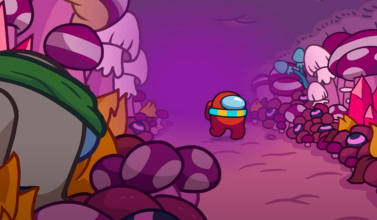
Among Us uses simple bean-shaped astronauts with small legs, large visors, and almost no facial expression. This design is immediately readable and easy to customize.
The contrast between cute characters and sudden elimination animations gives the game its comic tone. The violence is exaggerated, brief, and disconnected from realistic anatomy.
Colors function as identities during discussion. I rarely remember a stranger’s account name, but I remember that purple entered Security or green followed me through Storage.
Cosmetics complicate the silhouette without damaging readability. Hats, visors, skins, nameplates, and pets allow players to create recognizable appearances.
The visual simplicity also supports performance across phones, computers, and consoles. Among Us does not depend on high-end hardware to communicate its central information.
Cosmetics Are Fun Until the Menu Becomes the Main Event
Customization does not provide competitive advantages. I can select colors, hats, skins, visors, nameplates, and pets without changing my abilities.
Cosmicubes create progression paths filled with cosmetic rewards. Completing matches earns resources that unlock connected items inside the cube.
I enjoy this system when it gives me a reason to continue playing without affecting fairness. Collaboration cosmetics can also be entertaining, especially when they reference recognizable independent games.
The shop has become much larger than the early version of Among Us. New players may find currencies, bundles, Cosmicubes, and platform differences less immediately understandable.
I never felt that cosmetics were required, but the interface naturally draws attention toward them. The core game remains strongest when selecting an outfit takes less time than discussing the match settings.
The Sound of a Report Still Changes My Heart Rate
Among Us uses limited audio, but its key sounds are highly effective. Task confirmations, vent movement, sabotage alarms, and emergency reports communicate information instantly.
The report sound creates a sharp break in rhythm. One second I am completing a task; the next, every player is gathered for judgment.
Silence during ordinary movement supports suspicion. Footsteps and environmental noise are restrained, leaving space for my own expectations.
The music around major screens and certain modes is memorable without overwhelming communication. Voice-chat groups often reduce game volume, so essential effects need to remain clear.
Sound becomes tactical in Hide n Seek, where proximity and threat cues help determine whether I should continue a task or run.
Cross-Platform Play Is Essential and Occasionally Awkward
Among Us works across mobile devices, computers, and consoles, allowing groups to play without sharing one platform.
This accessibility is one reason the game became such a successful social space. Almost anyone in my group could join using hardware they already owned.
Input differences affect communication more than movement. Typing a detailed defense on a phone or console is slower than using a keyboard.
Quick Chat helps younger players and anyone without free typing, but it cannot express every complicated observation. Voice chat outside the game remains the smoothest solution for organized groups.
Cross-platform updates also require version compatibility. A player using an outdated build may be unable to join or may encounter features that no longer match the current game.
Technical Problems Are Small Until They Decide a Meeting
The game generally runs well because its graphics and controls are simple. I have still encountered disconnections, lobby errors, delayed actions, and occasional synchronization problems.
A brief delay can become important. A player may appear to move strangely, an elimination may seem to happen from an impossible distance, or a report may register differently across screens.
These moments create false evidence in a game built entirely around observation. Technical uncertainty can become indistinguishable from suspicious behavior.
Disconnections are equally disruptive. Losing one player may change voting balance, task completion, and the number of eliminations required for an Impostor victory.
Updates have expanded the game significantly, but every new role, platform, and cosmetic system adds complexity to a project that began with a much smaller scope.
Why the Game Survived Its Own Popularity
Among Us became a cultural phenomenon years after its original release. Memes, livestreams, animations, phrases, and character images spread far beyond active players.
That level of attention could have reduced the game to one temporary joke. The reason it survived is that the central design remains strong.
People naturally create stories when information is incomplete. We defend ourselves, form alliances, misremember details, follow confident speakers, and become emotionally attached to theories.
Among Us needs only a few rooms, simple tasks, hidden roles, and a voting screen to activate those behaviors.
Updates provide variety, but the social structure creates longevity. A new map can become familiar. A new group of people cannot be predicted as easily.
The Problem With Taking Every Match Seriously
Among Us can support careful deduction, but not every lobby wants that experience. Some players enjoy jokes, chaotic settings, unusual roles, or deliberately unreasonable accusations.
Conflict appears when one player expects a serious detective match and another treats the lobby as comedy.
I learned to read the group before becoming invested. A casual lobby can be enjoyable when I accept its tone. Trying to present a detailed timeline to players voting based on someone’s hat is a poor use of energy.
Competitive settings should be agreed upon before the match. Confirming roles, task counts, movement speed, discussion time, and visual-task rules prevents many arguments.
The game gives hosts enormous control, but extreme settings can damage balance. Excessive speed, too many roles, or very short discussions may produce funny rounds without preserving meaningful deduction.
The Lies I Remember More Than the Victories
I remember convincing a lobby that I had completed a task I had never approached. I remember defending another Impostor so strongly that my support caused both of us to become suspicious.
I remember finding a body beside a player who was genuinely innocent and refusing to believe their explanation. I remember following someone for protection, only to discover that they had been waiting for us to become isolated.
These stories remain memorable because no developer wrote them. The systems created the conditions, but the players produced the scene.
Among Us matches are short, yet one accusation can become a joke that continues inside a friend group for months.
Who Should Join the Crew?
I recommend Among Us to players who enjoy social deduction, party games, deception, teamwork, short online matches, and conversations that become more important than mechanical skill.
It works especially well for groups of friends who can communicate through voice chat and agree on a general level of seriousness.
Players uncomfortable with lying, direct accusation, social pressure, or conflict may find the experience stressful. Being falsely suspected is not an occasional accident; it is part of the game.
Anyone seeking a deep single-player experience should look elsewhere. Among Us depends on other people, and solo public matchmaking cannot provide consistent quality.
Parents should review chat settings, account protections, and online interactions before allowing younger players to enter public lobbies.
My Final Vote
Among Us is mechanically modest and socially enormous. Its tasks are simple, its movement is basic, and its maps can be learned quickly. The people inside those maps create nearly all of the complexity.
The game is brilliant when a lobby communicates, pays attention, and accepts that deception belongs to the experience. A closed door, a delayed report, or one inconsistent sentence can transform into a complete mystery.
It is frustrating when players leave, spam meetings, ignore the match, or attack one another personally. Public-lobby quality remains the largest weakness because no update can fully control how strangers choose to behave.
Roles, Hide n Seek, Cosmicubes, cross-platform support, and continued updates have expanded the original idea without replacing it. I can enjoy the additional systems, but the classic Crewmate-versus-Impostor structure remains the cleanest version.
I rate Among Us 9/10 when played with a good group and approximately 6/10 when I am trapped in a chaotic public lobby. The official rating I would settle on is 8.5/10.
I never learned whether the player beside me in Electrical was innocent. Before either of us acted, someone reported a body on the other side of the ship. During the meeting, we both accused each other.
Neither of us was the Impostor.
That was not a failure of the game. That was the game working perfectly.
Pros:
- Cross-platform support allows for a diverse gaming community
- Low system requirements facilitate play on various devices
- Engaging social dynamics that encourage strategic deception and teamwork
- Vibrant community and regular updates keep the game fresh
- Support for mods and creative modifications enhances replayability
- Simple and accessible gameplay, making it easy for new players to get started
Cons:
- Some versions or mods can upset the game balance
- Occasional connectivity issues may affect online sessions
- Gameplay can become repetitive over time

How much storage do you need?
 Among Us!








Recent Reviews

Minecraft

Grand Theft Auto V

Toca Boca World

Roblox

Leave a comment
Your comment is awaiting moderation. We save your draft here
0 Comments