
Review
I had known the reputation of It’s a Wonderful Life long before I watched it with full attention. It is regularly presented as one of t...
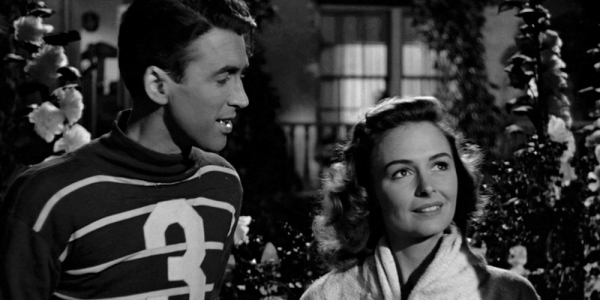
A Cinematic Odyssey of Hope and Redemption in Every Frame
I had known the reputation of It’s a Wonderful Life long before I watched it with full attention. It is regularly presented as one of the warmest Christmas films ever made, a reassuring story about family, community, and the value of an ordinary life. That description is accurate, but it is also incomplete. Frank Capra’s film earns its emotional comfort by spending an extraordinary amount of time exploring disappointment, financial pressure, loneliness, and the fear that a decent life may have amounted to very little.
What affected me most was not the supernatural intervention or the festive setting. It was the portrait of George Bailey as a man who repeatedly postpones his own ambitions for the benefit of others, then reaches a point where those sacrifices no longer feel noble to him. The film understands that generosity can exist alongside resentment. George loves his family and community, but he also mourns the life he never lived.
This emotional contradiction prevents the film from becoming a simple moral lesson. George is not rewarded immediately for every good decision. His patience is tested over decades, and the recognition he receives arrives only after he has become convinced that his absence would improve the lives of everyone around him.
George Bailey Is Introduced Through Other People’s Prayers
The opening is structurally unusual. Before George appears, I hear the voices of people asking for help on his behalf. Their words establish that he is loved, but they do not explain why he has reached a crisis. The film then moves into a celestial conversation in which Clarence, an inexperienced guardian angel, is shown George’s life.
This framing could have felt overly sentimental. Instead, it creates a useful distance. I am invited to examine George’s history as a collection of choices whose importance he can no longer see. The film does not begin by telling me he is a great man. It gradually demonstrates how his presence altered the direction of other lives.
Capra delays the central supernatural premise for much longer than many modern films would. Clarence does not immediately arrive to guide George through an alternative reality. The story first spends considerable time building Bedford Falls, George’s relationships, and the accumulated weight of his responsibilities.
That patience is essential. The later emotional turn works because the film has shown what George has given up and whom he has helped. Without that foundation, the vision of a world without him would be merely clever. With it, the sequence becomes devastating.
James Stewart Makes Goodness Look Exhausting
James Stewart’s performance is often remembered for its warmth, but I find its volatility equally important. His George Bailey is generous, charming, impatient, ambitious, and occasionally frightening in his frustration. Stewart never presents kindness as an effortless personality trait.
George frequently behaves well while wanting something else. He saves his brother, supports his family, protects the Building and Loan, and assists people who would otherwise remain trapped by Henry Potter’s control. Yet each act closes another possible door in his own life.
Stewart makes this tension visible in small physical details. George’s smile can remain in place while his eyes reveal disappointment. His posture changes when another obligation interrupts a personal plan. He speaks enthusiastically to reassure others, then briefly falls silent when he realizes what the decision will cost him.
The performance becomes especially powerful during George’s breakdown. His anger at home is uncomfortable because it is directed toward people who do not deserve it. Stewart does not soften the scene by making George’s pain automatically sympathetic. He allows the character to become unfair, desperate, and emotionally dangerous.
This is where the film’s humanity becomes clearest. George does not reach his darkest moment as an idealized hero. He reaches it as a man whose fear has distorted his behavior. The audience understands the pressure without being asked to excuse every consequence.
Bedford Falls Is Both a Community and a Constraint
Bedford Falls is usually remembered as an ideal American town, but the film presents it with greater complexity. It contains friendship, loyalty, and mutual aid, yet it is also the place George has spent his life trying to leave.
From childhood, he imagines travel, education, architecture, and a broader world beyond the familiar streets. He wants to build bridges and skyscrapers rather than manage the family business. Every time departure becomes possible, a crisis demands that he remain.
I found this repeated interruption emotionally painful because the film does not treat George’s dreams as immature. He is genuinely capable and curious. His desire to travel is not a rejection of his family; it is part of his identity.
Bedford Falls therefore becomes a place of belonging and limitation at the same time. George helps make it better, but he never completely stops wondering what he might have become elsewhere. The town’s affection cannot erase the fact that his life developed through obligation rather than free choice.
Capra uses this tension to complicate the idea of home. Home is not automatically the place where every desire is fulfilled. It may be the place where one’s actions matter most, even when remaining there involves sacrifice.
Mary Bailey Sees George More Clearly Than He Sees Himself
Donna Reed’s performance as Mary is central to the film’s emotional credibility. Mary is not simply the patient wife waiting for George to recognize the value of domestic life. She possesses determination, humor, and a strong understanding of what she wants.
Their early scenes together have a playful tension that distinguishes the relationship from the more solemn passages that follow. The dance sequence, the walk home, and the shared telephone call with Sam Wainwright reveal attraction through awkwardness rather than polished romance.
The telephone scene remains one of the film’s most intimate moments. George and Mary stand close together, attempting to focus on another conversation while their physical awareness of each other becomes impossible to ignore. Stewart and Reed convey desire, fear, frustration, and surrender without needing elaborate dialogue.
Mary also understands George’s emotional attachment to Bedford Falls before he does. She turns the abandoned house into a home, supports the Building and Loan during crisis, and mobilizes the community when George needs help. Her actions are practical rather than symbolic.
I do wish the film gave more attention to the private cost of her choices. Mary also reorganizes her life around George’s responsibilities, yet her disappointments are explored less directly. Still, Reed gives the character enough intelligence and emotional authority to prevent her from becoming merely supportive background.
Mr. Potter Is Powerful Because He Is Never Redeemed
Lionel Barrymore’s Henry Potter is one of the film’s most effective antagonists because he represents a complete economic philosophy rather than a temporary personal obstacle. Potter views vulnerability as opportunity. He prefers Bedford Falls when ordinary people remain dependent on him.
Unlike many seasonal antagonists, Potter does not experience a change of heart. The community’s generosity does not transform him, and the film does not require his approval for George’s life to have value.
This absence of redemption gives the ending greater integrity. George’s victory is not the destruction of Potter’s influence. The unequal structure of the town remains. Potter still possesses wealth, power, and the missing money that triggered George’s crisis.
What changes is George’s understanding of his own position. Potter tells him that he is worth more financially after death than alive. The alternative Bedford Falls reveals the social meaning that Potter’s calculation excludes.
The contrast between Bailey Park and Potter’s housing makes the argument visible. George helps people gain dignity and independence, while Potter’s system keeps them economically confined. The Building and Loan is not merely a family business; it is a fragile institution standing between community ownership and concentrated control.
The Financial Crisis Feels Disturbingly Immediate
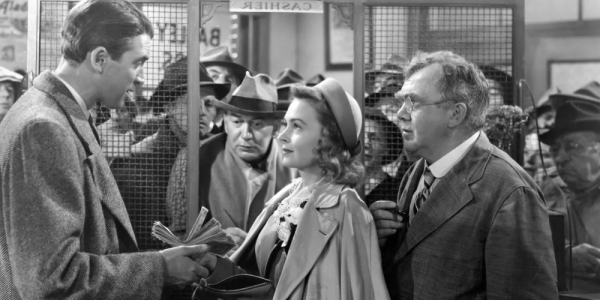
The sequence involving the bank panic is one of the strongest demonstrations of George’s value. On his wedding day, he is forced to choose between leaving for his honeymoon and protecting the Building and Loan from collapse.
George explains that the customers’ money is not sitting in a safe. It exists in their neighbors’ homes. His speech transforms finance from abstraction into a network of relationships. Deposits have become walls, roofs, and personal stability.
I was struck by how tense the scene remains despite its familiar resolution. The crowd is frightened, and fear makes Potter’s offer of immediate cash attractive. George cannot solve the problem through authority alone. He must persuade people to trust one another.
Mary’s decision to use their honeymoon money keeps the institution open, but the scene does not present sacrifice as painless. Their planned trip disappears. Another personal dream is exchanged for the survival of the community.
The sequence captures the film’s recurring structure: George responds to crisis, everyone benefits, and his own loss is quickly absorbed into the next responsibility.
The Film’s Middle Section Is a Record of Deferred Dreams
After George and Mary marry, the story moves through years with surprising speed. Children arrive, the house changes, the war reshapes the town, and George continues managing the Building and Loan.
These passages can initially feel less dramatic than the major crises, but they are essential. The film shows how a life becomes established through repetition. George does not make one grand sacrifice and receive permanent recognition. He makes many smaller choices whose significance becomes almost invisible through familiarity.
His brother Harry achieves public recognition, Sam Wainwright becomes financially successful, and friends move into broader lives. George remains in Bedford Falls, dealing with accounts, housing, and local problems.
I never felt that the film condemned the others for leaving or succeeding. The pain comes from George’s belief that their achievements confirm his own failure. He compares visible accomplishment with the quieter influence of his daily work.
This comparison becomes increasingly destructive because George uses standards that ignore the people around him. He can see skyscrapers he never built, but not the families whose homes exist because he stayed.
Uncle Billy Turns Human Error Into Catastrophe
Thomas Mitchell’s Uncle Billy is comic, affectionate, and dangerously absent-minded. When he accidentally loses the Building and Loan’s money, the mistake becomes the immediate trigger for George’s collapse.
The sequence is painful because the loss has no dramatic moral cause. Nobody intentionally betrays George. There is no elaborate criminal plan. A simple human error occurs at exactly the wrong moment, and Potter chooses to exploit it.
George’s reaction to Uncle Billy is one of his harshest moments. He understands that the business may collapse, that legal consequences are possible, and that every previous sacrifice could end in public disgrace. His fear becomes anger, and the person closest to the mistake receives the full force of it.
I found the scene difficult to watch precisely because Stewart does not protect George from ugliness. The film’s later affirmation would be weaker without this descent. George must become someone who can no longer recognize himself before Clarence can show him what his life means.
The Bridge Scene Rejects Easy Sentiment
George’s journey through Bedford Falls on Christmas Eve is visually and emotionally severe. He moves from panic to humiliation, asking Potter for help and receiving only contempt. The life insurance policy becomes part of Potter’s cruel calculation.
At the bridge, the film approaches despair without romanticizing it. Snow, darkness, and rushing water create an atmosphere of physical isolation. George is surrounded by the town he helped shape but feels completely separated from it.
Clarence’s arrival interrupts the moment through an unexpected act. Rather than offering immediate wisdom, he enters the water first, knowing George’s instinct will be to save another person. George’s compassion survives even when his desire to survive has weakened.
This detail is crucial. Clarence does not persuade George to value life through argument. He creates a situation in which George acts according to his deepest nature before he has time to think about himself.
Pottersville Is Frightening Because It Is Almost Familiar
The alternative reality is often described as a nightmare version of Bedford Falls, but its power comes from recognizable details. The streets, businesses, and people still exist, yet the social connections created by George are absent.
Pottersville is louder, harsher, and more commercially aggressive. The visual design replaces domestic warmth with crowded entertainment and economic desperation. The town has not become supernatural; it has developed according to Potter’s values without meaningful resistance.
The sequence involving George’s mother is particularly painful. She does not recognize him, and the familiar home no longer offers emotional safety. Stewart’s performance shifts from disbelief to panic as every relationship disappears.
Mary’s altered life has been criticized for presenting unmarried womanhood as inherently tragic. That element reflects the period’s limited imagination about female fulfillment and remains one of the film’s weaker choices. The emotional intention is clear, but the characterization depends on a narrow cultural assumption.
Even with that limitation, the alternative reality succeeds because it demonstrates cumulative influence. George did not merely save individual lives. His presence connected people, institutions, and opportunities in ways no single character fully understood.
Clarence Is Less a Teacher Than a Witness
Henry Travers plays Clarence with gentle eccentricity. He is not an imposing celestial figure. He is uncertain, curious, and occasionally comic, which prevents the supernatural material from becoming too solemn.
Clarence does not give George a detailed lecture about gratitude. He allows George to witness absence. The lesson emerges from experience rather than authority.
I appreciate that Clarence’s task is not to change George’s past or remove the financial crisis. He changes George’s perception. When George returns to his life, the missing money is still missing, the legal danger still exists, and Potter remains powerful.
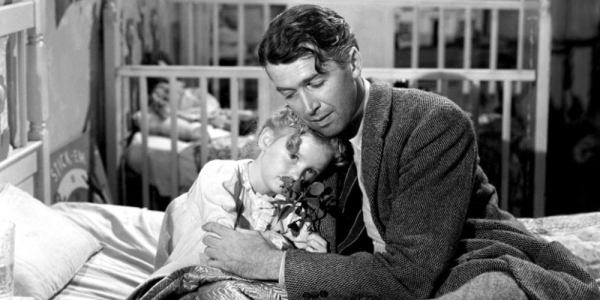
The transformation is internal but not passive. George returns home ready to face the consequences because existence itself has regained meaning. The external rescue follows only after he has already chosen life.
The Return Home Is Joyful Before the Problem Is Solved
George’s run through Bedford Falls is one of the film’s most famous passages, and it works because his circumstances have not yet improved. He celebrates the damaged car, the drafty house, the business, and even the threat of arrest.
The objects and places that previously represented entrapment now confirm that his life exists. His gratitude is not based on comfort. It is based on restored connection.
Stewart’s energy in these scenes is almost overwhelming. George moves through the town with the intensity of someone returning from emotional extinction. His greetings are excessive because ordinary recognition has become miraculous.
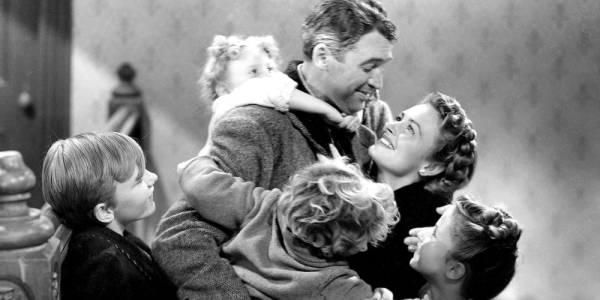
When he reaches home, the family’s presence matters before the community arrives with money. He is prepared to accept the consequences of failure because he no longer sees himself as financially equivalent to the missing funds.
The Final Gathering Earns Its Sentiment
The residents of Bedford Falls enter the Bailey home carrying whatever money they can offer. The sequence could easily feel manipulative, and it is certainly designed to produce a strong emotional response. Yet I find it earned because the film has spent so much time establishing George’s relationship with these people.
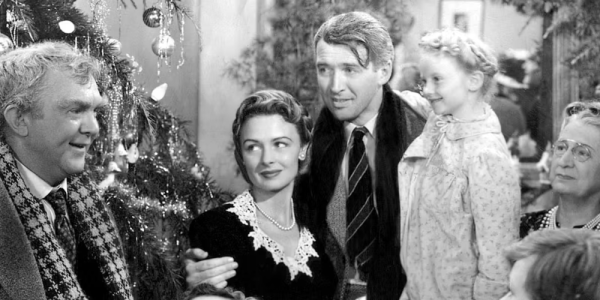
They are not anonymous citizens arriving to reward a hero. They are families who received housing, colleagues who witnessed his loyalty, and friends whose lives developed alongside his. Their contributions return the support George has extended for years.
Harry’s toast identifies George as the richest man in town, but the film is not pretending that financial pressure is irrelevant. Money remains necessary. The community’s affection becomes materially useful because they choose to act together.
This is why the ending does not reduce the story to the idea that love alone solves everything. Love produces cooperation, and cooperation addresses the immediate crisis. The distinction matters.
The Film’s Imperfections Remain Visible
It’s a Wonderful Life is emotionally powerful, but I do not consider every element equally successful. Some of the celestial framing feels overly explanatory, and several supporting characters are defined more by their relationship to George than by independent development.
The representation of Mary’s alternative life is especially dated. The film also moves quickly through the consequences of George’s anger toward his family. His return brings relief, but the people he frightened are not given much space to process what happened.
Potter’s possession of the missing money remains unresolved, which may frustrate viewers expecting conventional justice. I actually find this omission thematically appropriate, though dramatically abrupt. The film is not about proving that good people always defeat corrupt systems. It is about recognizing forms of value those systems cannot calculate.
Capra’s direction occasionally presses emotional points with unmistakable force, but the performances usually keep the sentiment grounded. Stewart, Reed, Mitchell, Barrymore, and Travers give the film enough human texture to prevent its moral structure from becoming purely schematic.
Why the Film Feels More Serious Each Time I Return
When I first encountered It’s a Wonderful Life, I primarily noticed the final celebration. On later viewings, the earlier disappointments became more prominent. George’s story now feels less like a simple affirmation and more like a study of how easily responsibility can consume a person’s sense of identity.
The film does not argue that personal dreams are selfish or that sacrifice automatically creates happiness. George’s despair comes partly from the fact that he never fully grieved the life he surrendered. His generosity remained meaningful, but meaning did not protect him from exhaustion.
What Clarence restores is not blind optimism. He gives George access to evidence that his daily actions mattered. The vision does not prove that every sacrifice was fair or that George should never have wanted more. It proves that his life cannot be measured only by unrealized ambition.
That is the idea I carry most strongly from the film. Human influence is often indirect. A conversation, loan, act of patience, or decision to remain can shape outcomes that the person responsible may never witness clearly.
It’s a Wonderful Life remains moving because it does not begin with a man who knows he is loved. It begins with a man whose years of service have become invisible to himself. The film then reconstructs the meaning of his life by showing the empty spaces his absence would leave behind.
Pros:
- The film offers a compelling narrative that intertwines hope and despair.
- Each character is dynamically developed to evoke deep emotional responses.
- The film expertly uses technical elements such as art direction and cinematography.
- Its timeless message of community, resilience, and interconnectedness resonates across generations.
- The G age rating makes it suitable for viewers of all ages, enhancing its family appeal.
- The film is widely accessible on multiple streaming and download platforms, ensuring ease of viewing.
Cons:
- The pacing may seem slow for viewers accustomed to modern, fast-moving narratives.
- Certain scenes and cinematic techniques might appear outdated to contemporary audiences.
- The film sometimes relies on heavy sentimentality, which may not appeal to all viewers.









Movie Reviews

Minecraft

Grand Theft Auto V

Toca Boca World

Roblox

Leave a comment
Your comment is awaiting moderation. We save your draft here
0 Comments