Review
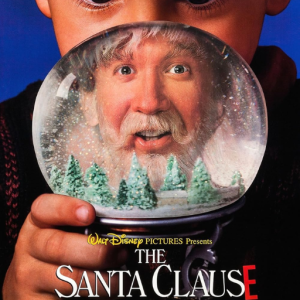
The Santa Clause begins with a premise that sounds almost aggressively cheerful. Scott Calvin accidentally causes Santa Claus to fall f...

Embracing Holiday Transformation: A Journey Through The Santa Clause
The Santa Clause begins with a premise that sounds almost aggressively cheerful. Scott Calvin accidentally causes Santa Claus to fall from his roof, puts on the red coat, and discovers that he has unknowingly accepted a supernatural employment contract. From that moment, his body, schedule, family relationships, and future no longer belong entirely to him.
When I returned to the film as a critic, I was surprised by how strange that idea remains beneath the familiar holiday decorations. Scott does not volunteer to become Santa. He is transformed by a system that provides almost no meaningful explanation and treats his confusion as an inconvenience. His weight changes, his beard returns after shaving, his hair turns white, and his appetite becomes impossible to control. Everyone around him interprets these physical changes through ordinary adult suspicion.
The comedy is broad, but the emotional center is serious. Scott is already struggling to remain important in his son Charlie’s life after divorce. Becoming Santa initially appears to give him the perfect way to impress the child. It eventually threatens to remove him from Charlie completely.
I found the film most effective when it stopped treating the transformation as a collection of body jokes and allowed Scott to recognize that accepting the role would require a different kind of fatherhood. He cannot preserve his old life exactly as it was. He must decide which parts of himself matter enough to carry into the new one.
Scott Calvin Begins as a Man Who Treats Christmas Like a Scheduling Problem
Scott is introduced as successful, sarcastic, impatient, and emotionally less prepared than he believes. He loves Charlie, but love does not automatically make him attentive. He approaches parenting through activities, jokes, gifts, and attempts to appear more entertaining than Charlie’s stepfather.
Tim Allen plays Scott with defensive confidence. He wants every room to agree that he is funny, capable, and in control. When something goes wrong, his first instinct is usually to make another joke before anyone notices that he is worried.
This personality makes him a useful candidate for transformation. Santa represents patience, generosity, ritual, and attention to children. Scott begins the film treating many of those qualities as sentimental performance.
I liked that the movie does not make him a terrible father. He remembers important occasions, wants time with Charlie, and becomes genuinely hurt when that time is threatened. His flaw is that he often treats being loved as something he can win through personality rather than maintain through reliability.
Becoming Santa forces him to confront a role that cannot be completed through charm alone. Children expect him to listen. The elves expect him to work. Charlie expects him to keep a promise that sounds impossible.
The Roof Scene Is Funny Because the Consequences Are Horrible
The original Santa falls from Scott’s roof after being startled. The moment is staged as slapstick, but the basic event is remarkably dark for a family comedy. A stranger appears dead or unconscious in the snow, then disappears and leaves behind clothing and instructions.
Scott responds with disbelief rather than grief because the movie quickly moves into magical logic. Charlie is fascinated by the sleigh and reindeer, while Scott wants to complete the immediate task and return to normal life.
The card explaining the Santa Clause is deliberately vague. Putting on the suit transfers the role, while the legal-sounding language hides the scale of what Scott has accepted.
I find this central joke stronger as an adult because it resembles the worst possible contract: the terms become clear only after agreement, resignation is apparently unavailable, and the employer operates outside ordinary law.
The North Pole treats this arrangement as established tradition. Scott’s objections sound reasonable to me, but the elves respond as though every new Santa has probably complained in exactly the same way.
Charlie Believes Before Scott Has Decided What Is Real
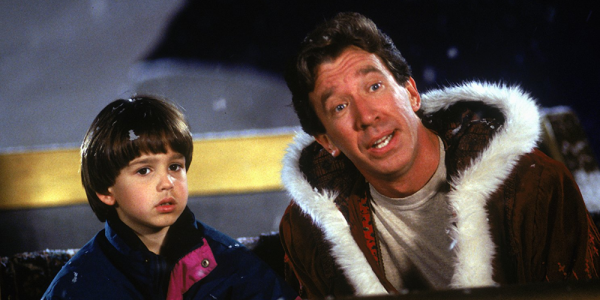
Charlie gives the film its emotional urgency. He sees the sleigh, reindeer, elves, and North Pole directly. For him, the question of whether Scott is becoming Santa is not theoretical.
Eric Lloyd plays Charlie with enough sincerity to prevent belief from becoming irritating. He is excited, but he is also frightened that adults will force him to deny what he experienced.
His relationship with Scott changes after the first Christmas journey. Charlie no longer sees his father only as a divorced parent competing for attention. He sees him as part of a larger magical world.
This creates a difficult imbalance. Scott wants Charlie to trust him, yet public agreement with the Santa story makes Scott appear unstable. Denying the story protects the custody arrangement but damages the private bond between father and son.
I found Charlie’s position more painful than the film always acknowledges. Every adult tells him that the truth he witnessed is fantasy. His loyalty to Scott is treated as a psychological concern rather than evidence that the adults may be missing information.
Laura and Neal Are More Reasonable Than the Film Wants Me to Admit
Laura, Scott’s former wife, and Neal, her new husband, are positioned as obstacles to the magical relationship between Scott and Charlie. Yet from their perspective, Scott’s behavior becomes increasingly alarming.
He gains a large amount of weight rapidly, grows an uncontrollable white beard, begins dressing as Santa, encourages Charlie to identify him as Santa, and eventually takes the child away under circumstances that look like abduction.
Wendy Crewson gives Laura understandable concern rather than simple hostility. She does not appear eager to remove Scott from Charlie’s life at the beginning. Her position hardens as the situation becomes less explainable.
Judge Reinhold makes Neal easy to mock because the character speaks in therapeutic language, wears carefully arranged sweaters, and analyzes Charlie’s belief through professional categories. Still, his concern is not entirely absurd.
I appreciated the film more when I stopped treating Laura and Neal as enemies of wonder. They are adults attempting to protect a child using the information available to them. The problem is that the magical world refuses to provide evidence until the final act.
Neal’s Childhood Story Gives Him More Depth Than a Typical Stepdad Rival
Neal explains that he stopped believing in Santa after failing to receive an important gift as a child. The memory is played partly for comedy, but it reveals that his skepticism began as disappointment.
He did not simply grow out of belief through maturity. He interpreted the missing gift as proof that the comforting story had failed him.
This makes his professional interest in Charlie more personal. Neal wants to protect the child from dependence on a fantasy that may eventually produce the same pain.
The film does not explore this idea deeply, but the detail prevents him from becoming a completely empty rival. He is attempting to replace uncertainty with explanation.
His eventual return to belief works because the final Christmas gives him the forgotten childhood gift. The moment is extremely neat, but emotionally satisfying. Santa does not defeat Neal through argument. He repairs the specific wound beneath the skepticism.
The North Pole Looks Like a Corporation Designed by Children
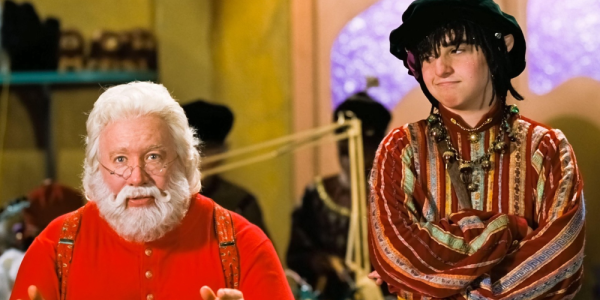
The North Pole combines magical architecture with industrial production. Elves operate workshops, monitor deliveries, prepare lists, and manage enormous logistical systems. It feels like a holiday fantasy organized through corporate efficiency.
I enjoyed the contrast between Scott’s confusion and the elves’ professionalism. To him, the environment is impossible. To them, he is the newly appointed executive who has arrived without reading the handbook.
The sets have a tactile quality that helps the film age well. Toys, shelves, machinery, costumes, snow, and interior spaces feel physical rather than completely digital.
The production design avoids creating a perfectly elegant fantasy. The North Pole is crowded, active, colorful, and slightly chaotic. It appears built for work rather than only for visual admiration.
I wanted more information about its social structure. The elves clearly possess advanced knowledge, long lifespans, and enormous responsibility, yet they remain completely dedicated to supporting Santa. The film treats that arrangement as part of the fairy tale rather than a subject for investigation.
Bernard Is the Only Person Willing to Tell Scott the Truth Directly
David Krumholtz gives Bernard, the head elf, an impatient authority that immediately distinguishes him from the cheerful workers around him.
Bernard does not behave as though meeting the new Santa is a sacred emotional event. He has procedures to explain, deadlines to meet, and limited patience for Scott’s refusal to accept obvious magical evidence.
I found him one of the film’s funniest characters because his frustration is practical. He understands exactly how much work Scott’s denial is creating.
Bernard also becomes important to Charlie. He gives the child a magical snow globe that allows communication with Scott, recognizing that the relationship will need support after the first visit.
The character has confidence beyond his physical appearance. Scott initially treats him like a child because the elf body resembles one. Bernard immediately establishes that age and authority operate differently at the North Pole.
His sharpness prevents the magical world from becoming completely sweet. Someone needs to explain that Christmas is also a demanding operation, and Bernard has clearly solved too many emergencies to remain endlessly patient.
Scott’s Physical Transformation Is Both Comic and Disturbing
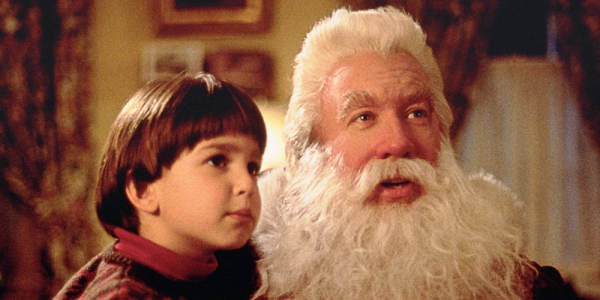
The film builds many jokes around Scott’s changing body. He becomes heavier despite exercising, develops an appetite for sweets, grows white facial hair, and loses control over his appearance.
Tim Allen reacts with increasing panic as doctors, coworkers, and family members interpret the changes through ordinary health concerns. He attempts diets, shaving, exercise, and denial, but the transformation continues.
As a child, I saw these scenes mainly as proof that magic was taking over. As an adult, I found the loss of bodily autonomy more unsettling.
Scott cannot consent to each stage. The role is rewriting him according to an external image of Santa. His body becomes evidence of a responsibility he still refuses to accept.
Some of the humor depends on fat stereotypes and exaggerated eating. Those jokes have aged less gracefully than the emotional concept beneath them.
The strongest interpretation is that Scott’s appearance changes as his identity changes. The weakness is that the film often treats size itself as the joke rather than the strange absence of choice.
The Office Party Shows Why Santa Cannot Remain a Private Problem
Scott’s professional life begins collapsing as the Santa transformation becomes visible. Coworkers react to his appearance, children approach him instinctively, and his authority as a businessman becomes harder to separate from the new identity.
The office sequence is effective because Scott initially attempts to maintain ordinary professional behavior. The children around him do not care about that performance. They recognize something before the adults do.
When he begins listening to their wishes, his manner changes. He becomes patient and attentive in a way that contrasts with his earlier sales-oriented confidence.
I saw this as the first moment when he performs the role naturally rather than through obligation. He stops trying to prove that he is not Santa and begins responding to what the children need.
The scene also exposes why his old life cannot continue unchanged. A toy-company executive resembling Santa may appear commercially useful, but Scott’s transformation is not another marketing opportunity.
The Film’s Custody Conflict Gives the Fantasy Real Consequences
The threat to Scott’s visitation rights gives the story stakes beyond completing Christmas deliveries. If the adults decide that he is unstable, he may lose regular access to Charlie.
I appreciated that the movie allows magic to create legal and emotional problems rather than functioning only as a gift.
Scott cannot explain his situation without sounding delusional. The evidence disappears, the North Pole remains inaccessible, and Charlie’s testimony is treated as part of the concern.
The courtroom and family discussions are simplified, but the emotional fear is clear. Scott began the film worried that Charlie preferred Neal. He now faces the possibility of being excluded through official decision.
The story also asks whether encouraging Charlie’s belief is responsible. Scott knows the experience was real, yet he cannot provide the kind of proof the adults require.
This is one of the film’s strongest conflicts because neither side is behaving irrationally inside its own understanding of reality.
Scott Becomes Santa Before He Admits It
The film does not mark one exact moment when Scott’s inner identity changes. Instead, small behaviors accumulate.
He becomes more patient with children. He understands names and wishes without being told. He accepts the North Pole’s routines. He begins responding to Christmas as responsibility rather than interruption.
His verbal denial continues after his actions have already changed. That gap is funny because everyone else can see the transformation before he accepts it.
I liked this gradual approach. A sudden declaration would feel less convincing. Scott has built his adult identity around independence and sarcasm, so admitting that he belongs to a role defined by generosity requires emotional surrender.
Acceptance does not mean becoming completely different. Tim Allen preserves Scott’s humor and occasional irritation. The new Santa is still recognizably the man Charlie knew.
The Sleigh Ride Works Because Scott Is Finally Good at Something Charlie Values
The first delivery journey gives Scott and Charlie a shared experience unavailable to the other adults. Charlie watches his father navigate rooftops, chimneys, reindeer, gifts, and the North Pole.
Scott begins awkwardly, but the journey allows competence to emerge. He discovers that the magical systems respond to him and that the role contains abilities he did not know he possessed.
For Charlie, this is more than proof of Santa. It is proof that his father belongs somewhere important.
The emotional danger is that Charlie may value Scott primarily through the magical role. The film gradually corrects this by emphasizing their relationship beyond spectacle.
Scott needs to become Santa without turning every visit with Charlie into a performance. Charlie needs to love his father without requiring constant proof that he is extraordinary.
The E.L.F.S. Rescue Sequence Feels Like a Different Movie
The final act introduces the E.L.F.S., a tactical team equipped to rescue Santa after police surround the house. The sequence uses ropes, gadgets, coordinated movement, and action-comedy energy.
As a child, I found this exciting. As a critic, I think it interrupts the stronger emotional material with a temporary parody of military rescue films.
The elves’ competence is entertaining, and the scene demonstrates that the North Pole has prepared for modern obstacles. Still, the tone shifts away from family conflict toward spectacle.
The central problem is not really whether Scott can escape custody. It is whether Laura and Neal can accept that Charlie’s belief contains truth.
The rescue gets Scott into the sky, but the emotional resolution comes when the adults finally see enough to reconsider their certainty.
Laura’s Belief Returns Through a Childhood Memory
Laura reveals that she stopped believing in Santa after not receiving a childhood gift she wanted. Like Neal, she connects skepticism with a specific disappointment.
Scott later provides that gift, demonstrating knowledge he should not possess through ordinary means.
The scene is sentimental and convenient, but it works because belief returns through personal memory rather than general spectacle.
Laura does not believe simply because a sleigh appears. The gift connects the impossible present with the child she once was.
I appreciated that the film treats adult skepticism as emotionally constructed. People do not always stop believing because they become more intelligent. Sometimes they protect themselves from earlier disappointment.
Charlie’s Gift Is Permission to Stop Carrying the Secret Alone
By the final Christmas, Charlie has spent much of the film defending an experience nobody else accepts. The burden of belief has isolated him.
When Scott reveals himself publicly and the adults witness the sleigh, Charlie no longer needs to argue constantly.
This is important because belief is joyful only while it does not become an exhausting responsibility. Charlie should not have needed to prove the magical world to every adult around him.
The resolution restores his trust in Scott and allows Laura and Neal to join the truth rather than remain outside it.
Scott also gives Charlie a way to call him when needed. The magical snow globe becomes a symbol of access across distance, which matters deeply in a divorced family structure.
The Divorce Story Is More Important Than the Santa Story
Beneath the North Pole, reindeer, gifts, and transformations, The Santa Clause is about a child moving between two households.
Charlie has a mother, biological father, and stepfather who all care about him but do not trust one another equally. Every adult decision risks becoming a competition over who understands the child best.
Scott initially treats Neal as a rival rather than another person involved in Charlie’s life. Neal approaches Scott as a psychological problem. Laura attempts to manage conflict while protecting stability.
The magical crisis forces them to reconsider these roles. Scott can remain important without removing Neal. Neal can care for Charlie without replacing Scott.
I liked that the film ultimately expands the family instead of restoring the original marriage. Laura and Scott do not reunite romantically. The solution is cooperation across a changed family structure.
The Christmas Atmosphere Remains One of the Film’s Greatest Strengths
The Santa Clause contains nearly every visual element expected from a holiday film: snow, rooftops, decorated homes, reindeer, toy workshops, fireplaces, lights, cookies, red clothing, crowded family rooms, and a magical sleigh.
The atmosphere works because these elements are tied to practical action. Cookies affect Santa’s body, chimneys become transportation problems, rooftops become workplaces, and gifts require enormous logistics.
The score supports wonder without making every scene excessively emotional. Familiar seasonal sounds blend with comic and adventurous music.
The film also uses suburban spaces effectively. Christmas exists not only at the North Pole but inside ordinary houses where adults are tired, families are reorganizing, and children are attempting to preserve excitement.
The Comedy Has Aged Unevenly
Tim Allen’s sarcasm remains effective when it reveals Scott’s discomfort. His reaction to impossible magical procedures gives the fantasy a grounded comic voice.
Bernard’s impatience, Neal’s therapeutic language, and the elves’ professional seriousness also hold up well.
Some jokes based on weight, appetite, appearance, and mental-health assumptions feel more dated. The film frequently uses Scott’s changing body as public humiliation.
The custody story occasionally invites the audience to laugh at professionals for interpreting impossible behavior through reasonable concerns. I can enjoy the misunderstanding while recognizing why the adults respond as they do.
The E.L.F.S. material is energetic but less timeless than the family and North Pole comedy.
What Frustrated Me
The Santa Clause never examines whether Scott has any genuine choice about accepting the role. The contract is presented as magical law, but the absence of consent is significant.
The previous Santa disappears without emotional consequence. The North Pole moves immediately to replacement procedures, suggesting a system more unsettling than the film wants to explore.
Laura and Neal are treated too often as obstacles even when their concerns are reasonable. The audience knows the magic is real, which makes it easy to judge characters denied that knowledge.
The body-transformation jokes sometimes reduce an interesting identity crisis to mockery about weight and eating.
The final rescue sequence is less emotionally engaging than the custody and family conflict leading to it.
Why the Film Still Works
The Santa Clause succeeds because Tim Allen makes Scott’s transformation feel resistant, comic, and eventually sincere. He does not begin as someone dreaming of becoming Santa. That reluctance gives acceptance meaning.
Charlie provides emotional clarity. He does not need the North Pole to prove that Christmas matters. He needs adults to stop treating his trust as a symptom.
The supporting cast gives the conflict balance. Wendy Crewson and Judge Reinhold make Laura and Neal more understandable than simple antagonists. David Krumholtz gives the magical world authority, while Eric Lloyd prevents Charlie’s belief from becoming artificial sweetness.
The practical production design also preserves the film’s charm. The North Pole looks physical, crowded, and connected with older holiday fantasy rather than temporary digital spectacle.
Who Should Watch The Santa Clause?
I recommend The Santa Clause to families, fans of 1990s holiday comedies, viewers who enjoy reluctant-hero stories, and anyone interested in a Christmas fantasy built around divorce, custody, and changing family identity.
Children can enjoy the elves, sleigh, reindeer, North Pole, magical transformations, and tactical rescue sequence.
Adults may connect more strongly with Scott’s fear of losing relevance in Charlie’s life, Laura’s concern about stability, and Neal’s attempt to protect the child through rational explanation.
Viewers uncomfortable with body-based comedy or simplified treatment of psychological concerns may find certain scenes dated.
Anyone seeking a completely logical magical system should accept that the film uses fairy-tale rules whenever detailed explanation would interfere with the holiday mood.
My Final Verdict
The Santa Clause remains an effective Christmas comedy because its impossible premise is attached to a recognizable fear: a parent worries that divorce, time, and another household will gradually make him less important to his child.
Scott Calvin becomes Santa physically before he understands what the role demands emotionally. The transformation gives him magical authority but also forces him to become more patient, reliable, and generous.
The film’s strongest elements are Tim Allen’s committed performance, Charlie’s sincere belief, Bernard’s sharp humor, the tactile North Pole design, and the decision to resolve the family story through cooperation rather than romantic reunion.
Its weaknesses are visible. Some jokes have aged poorly, Laura and Neal are judged too harshly for reasonable concerns, the magical contract raises questions the story avoids, and the action-heavy finale is less satisfying than the quieter emotional conflict.
I rate The Santa Clause 8.1/10. It is funny, strange, warm, and more psychologically interesting than its red suit initially suggests.
Scott begins the film afraid that another man is replacing him as Charlie’s father. By the end, he learns that love is not protected by winning a competition.
It is protected by showing up, even when showing up requires eight reindeer and a sleigh.
Pros:
- Captivating blend of humor and heartfelt emotion
- Excellent performance by the lead actor showcasing a believable transformation
- Visually stunning winter wonderland with meticulously crafted set design
- Engaging narrative that balances magic, personal growth, and family values
- Accessible for a broad audience with its PG rating
- Easy availability on multiple streaming platforms with download options
Cons:
- Plot may feel predictable to some viewers
- Occasional pacing issues in slower emotional segments
- Some secondary characters could benefit from deeper development









Movie Reviews

Minecraft

Grand Theft Auto V

Toca Boca World

Roblox

Leave a comment
Your comment is awaiting moderation. We save your draft here
0 Comments