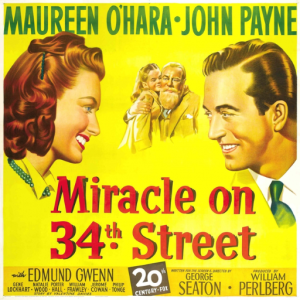
Review
Miracle on 34th Street begins with a familiar Christmas image: an elderly man with a white beard insists that he is Santa Claus. The fi...
Embracing the Magic: The Timeless Legacy of Miracle on 34th Street
Miracle on 34th Street begins with a familiar Christmas image: an elderly man with a white beard insists that he is Santa Claus. The film’s more unusual decision is to take that claim seriously enough to place it inside department stores, family disputes, psychiatric examinations, newspaper headlines, and eventually a courtroom.
When I returned to the film as a critic, I was struck by how little it depends on visual spectacle. There are no enormous digital landscapes, flying action sequences, or elaborate explanations of North Pole mythology. The central miracle is carried through conversation, performance, legal reasoning, and the gradual transformation of people who have trained themselves not to expect anything extraordinary.
Kris Kringle enters New York as though the city has misunderstood Christmas. Stores treat the holiday as a commercial campaign. Adults treat belief as a childish weakness. Children are encouraged to ask for gifts while being quietly prepared for disappointment.
Kris challenges this system without appearing angry. He does not attempt to defeat commercialism through speeches. He simply behaves according to a different set of values. He listens carefully, tells the truth when dishonesty would be easier, and treats each child as though the conversation matters.
The film asks whether such behavior is evidence of delusion or evidence that everyone else has accepted too little from ordinary life. I never needed a definitive supernatural answer. The more important question was whether the characters became better by acting as though Kris might be telling the truth.
Kris Kringle Looks More Comfortable as Santa Than Anyone Else Looks as Themselves
Edmund Gwenn’s performance is the reason the film’s central ambiguity survives. Kris does not appear to be a performer attempting to convince people that he is Santa Claus. He appears mildly surprised that anyone would need convincing.
Gwenn gives him warmth without making him excessively sweet. Kris can be amused, offended, stubborn, frightened, and deeply serious when he believes someone is being treated unfairly.
His certainty is calm. He does not shout that he is Santa or demand worship. He states the fact as naturally as another person might state their address.
This calm makes him more persuasive than any dramatic demonstration of magic could have been. A liar would normally appear more interested in controlling the reaction. Kris seems interested only in behaving correctly.
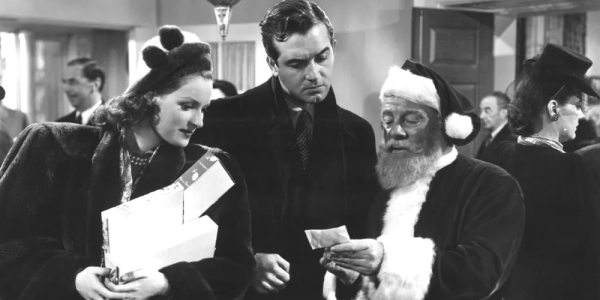
I particularly appreciated the small flashes of frustration. He dislikes fake beards, poor Santa performances, dishonest advertising, and adults who assume children should be manipulated for convenience. These reactions keep him from becoming a decorative symbol of kindness.
Kris has standards. His generosity is not passive. He believes Christmas requires ethical behavior from the people profiting from it.
The Macy’s Parade Opens With an Impostor
The story begins when Kris discovers that the man hired to play Santa in the Macy’s Thanksgiving Day Parade is intoxicated. The situation is comic, but it immediately establishes the difference between appearance and identity.
The hired performer has the costume and official position but lacks the conduct associated with Santa. Kris has no official authority, yet his behavior makes him the obvious replacement.
This pattern continues throughout the film. Institutions decide who is legitimate through employment records, medical evaluations, and legal definitions. Kris becomes convincing through actions those systems cannot measure easily.
The parade also introduces the commercial machinery surrounding Christmas. Santa is not arriving independently. He is part of a department-store event designed to attract customers.
Kris accepts the role but refuses to become merely an advertisement. From his first appearance, he begins changing the purpose of the position from selling products to helping families.
Doris Walker Has Turned Disappointment Into a Parenting Philosophy
Maureen O’Hara plays Doris Walker as intelligent, capable, organized, and emotionally guarded. She works in a demanding professional environment while raising her daughter Susan alone.
Doris does not believe in encouraging fairy tales. She teaches Susan to value facts, logic, and realistic expectations. From her perspective, this is responsible parenting.
I understood her position immediately. Doris does not want her daughter depending on promises the world may not keep. Imagination becomes dangerous when adults use it to avoid telling children the truth.
The film gradually reveals that this philosophy is rooted in personal pain. Doris has experienced enough disappointment to believe that hope should be controlled before it creates vulnerability.
O’Hara avoids making her cold. Doris loves Susan and is genuinely attentive to her welfare. Her mistake is assuming that protection requires eliminating uncertainty.
Her relationship with Kris matters because he does not simply tell her to believe. He gives her repeated examples of honesty, compassion, and courage that do not fit her cynical model of adulthood.
Susan Is Not Unimaginative; She Has Been Carefully Trained
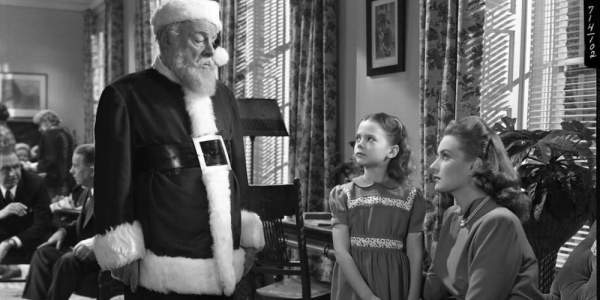
Natalie Wood’s Susan is one of the film’s most convincing child characters. She is observant, direct, and initially suspicious of anything that cannot be demonstrated logically.
Her lack of belief is not presented as a personal flaw. She has learned the rules her mother considers safe. A person pretending to be an animal is not an animal. A department-store Santa is an employee. Wishes do not create houses.
Kris does not win her trust through immediate spectacle. He teaches her how to pretend, imitate, play, and consider possibilities without abandoning intelligence.
I liked that Susan remains capable of asking difficult questions. She does not become a passive believer who accepts every claim.
Her request for a particular house becomes the emotional test of the story. It is large enough to require faith but ordinary enough to reflect a genuine childhood desire for stability and family life.
Susan does not primarily want luxury. She wants a home that resembles the complete family structure she sees around her.
Fred Gailey Believes Before He Has Evidence
John Payne plays Fred Gailey as a lawyer whose optimism contrasts with Doris’s caution. He is playful with Susan, interested in Doris, and willing to entertain Kris’s claim long before doing so becomes professionally sensible.
Fred’s belief is not always literal. At first, he seems less concerned with proving that Kris is Santa than with protecting the value of what Kris represents.
This flexibility is attractive, but it also creates conflict. Doris worries that Fred encourages Susan’s unrealistic expectations and treats serious matters as opportunities for idealistic performance.
I occasionally found Fred too confident in his ability to influence their family. He enters their lives warmly, but his assumption that Doris should simply become more open can overlook the experiences that made her cautious.
His legal defense of Kris gives belief a practical form. Fred risks his career and reputation for someone whom society has already decided is irrational.
The courtroom scenes work because Fred must translate faith into arguments an institution can accept. He cannot simply ask the judge to feel Christmas spirit.
Macy’s Discovers That Honesty Can Be Profitable
One of the film’s sharpest ideas appears when Kris begins sending customers to competing stores if Macy’s does not stock the item they need.
Management initially sees this as unacceptable. A department-store Santa is expected to support sales, not direct money elsewhere.
Customers respond positively because the policy treats their needs as more important than immediate profit. Macy’s quickly recognizes that honesty can produce loyalty and favorable publicity.
I enjoyed the scene because it is both idealistic and cynical. Kris introduces a genuinely generous practice. The corporation adopts it partly because generosity becomes commercially useful.
The result still helps customers, but the motivation remains mixed. The film understands that capitalism is capable of absorbing moral criticism and turning it into a marketing advantage.
Competing stores soon imitate the idea, not because they have all experienced a spiritual awakening, but because refusing would make them appear selfish.
Kris improves behavior even when he cannot purify the reasons behind it.
The Film’s Commercial Criticism Is Gentler Than It First Appears
Miracle on 34th Street clearly criticizes the reduction of Christmas to sales figures, promotions, and manufactured urgency.
Yet the film is set deeply inside department-store culture. Macy’s remains a major location, employers can change policy, and commercial institutions ultimately participate in the miracle.
The story does not argue that shopping itself destroys Christmas. It argues that commerce becomes dehumanizing when it forgets the people behind the transactions.
Kris does not tell parents to stop buying presents. He helps them find the right gifts without allowing store loyalty to become more important than children.
I found this moderate position more effective than a simple rejection of consumer culture. Christmas spending is not presented as morally pure, but neither is poverty romanticized.
A toy can matter because a child wants it. The ethical question is whether adults use that desire honestly.
The Dutch Girl Scene Proves Kris’s Value Without Proving Magic
One of the film’s most touching moments occurs when a young Dutch girl visits Kris. She believes he will be unable to communicate with her because she does not speak English.
Kris begins speaking and singing in Dutch, creating an immediate private connection.
The scene is important because it provides evidence of unusual knowledge without requiring the audience to interpret it as supernatural. A well-travelled man could know another language.
What matters is the way Kris responds. He understands that the girl wants recognition more than a product. Speaking to her directly transforms a public department-store visit into a personal experience.
I found the scene emotionally effective because Gwenn plays it without seeking applause. Kris does not look around to confirm that adults have noticed his kindness.
He behaves as though making one child feel included is sufficient reason for the effort.
Granville Sawyer Represents Expertise Without Empathy
The department-store psychologist, Granville Sawyer, becomes one of the film’s clearest antagonistic figures. He interprets unusual behavior through insecurity, diagnosis, and institutional control.
Sawyer’s problem is not that psychological evaluation is inherently wrong. Kris’s claim reasonably invites examination.
The problem is that Sawyer uses professional authority without compassion or intellectual humility. He appears more interested in confirming his judgment than understanding the person before him.
His treatment of Alfred is especially revealing. He damages a vulnerable young employee while presenting the harm as expert insight.
Kris responds angrily because he recognizes that Sawyer’s authority gives cruelty a respectable form.
The character is written broadly, and the film’s depiction of mental-health institutions reflects the limitations of its era. Still, the larger criticism remains relevant: credentials do not guarantee wisdom, and professional language can be used to silence people who threaten an institution’s comfort.
Bellevue Turns Ambiguity Into Danger
Once Kris is committed for psychiatric evaluation, the story becomes darker. His claim is no longer a charming department-store eccentricity. It becomes the basis for removing his freedom.
Kris initially loses hope because he believes Doris has participated in the decision. His disappointment is not simply fear of confinement. He feels betrayed by someone he hoped was beginning to trust him.
Gwenn allows the character’s confidence to collapse briefly. The man who has spent the film supporting other people suddenly doubts whether his efforts matter.
This scene prevents his optimism from appearing effortless. Even Kris needs evidence that kindness has reached someone.
Fred’s intervention restores purpose by treating the case as something worth fighting publicly. He refuses to allow the institution’s diagnosis to become the final definition.
The Courtroom Makes Belief a Public Responsibility
The trial is the film’s most famous structural choice. Instead of proving Kris’s identity through a secret miracle, the story asks a legal system to decide whether he is Santa Claus.
The question is absurd, but the consequences are serious. Declaring Kris mentally unfit would support his confinement. Accepting his claim appears impossible under ordinary evidentiary standards.
Fred therefore avoids proving supernatural facts directly. He builds an argument around social recognition, institutional behavior, and the practical meaning of identity.
I enjoyed the way legal reasoning turns language into a battlefield. What does it mean to be recognized as Santa? Does the state already participate in that recognition? Can one institution dismiss what another institution publicly accepts?
The judge faces political pressure as well as legal uncertainty. A ruling against Santa could damage his reputation with families and voters.
This adds another layer of satire. The court does not operate outside society’s emotional needs. The judge’s interpretation of law is affected by public consequences.
The Post Office Solves the Case Through Bureaucratic Self-Protection
The courtroom resolution depends on postal workers delivering large quantities of mail addressed to Santa Claus directly to Kris.
The evidence is not a supernatural demonstration. It is an institutional decision. The United States Postal Service has recognized him as the recipient of mail sent to Santa.
Fred uses this action to argue that the federal government has effectively acknowledged Kris’s identity.
I find this conclusion wonderfully clever because it transforms bureaucracy into an accidental source of wonder. The same system associated with rules, sorting, and official procedure produces the evidence needed to protect imagination.
The postal workers are also motivated partly by convenience. Delivering the letters clears an administrative problem.
Once again, good consequences emerge from mixed motives. The film does not require every participant to become morally transformed.
The Judge’s Decision Is Legally Questionable and Emotionally Perfect
I would not use Miracle on 34th Street as a serious guide to courtroom procedure. The logic depends on symbolic recognition rather than rigorous proof.
As dramatic resolution, however, it is extremely satisfying. The court accepts that defining identity can involve how society collectively responds to a person.
Kris is declared sane not because magic has been scientifically established, but because belief is too deeply embedded in public institutions to dismiss without contradiction.
The ruling preserves ambiguity. A skeptic can argue that the legal reasoning is playful and incomplete. A believer can see official recognition of the real Santa.
I prefer this uncertainty to an ending where Kris performs an enormous visible miracle for every character.
The film allows belief to remain a choice supported by evidence rather than a fact forced upon everyone.
Doris’s Transformation Is Quietly More Important Than the Verdict
The courtroom victory protects Kris, but Doris’s emotional change gives the story its deeper resolution.
She begins by teaching Susan that realistic expectations prevent pain. Over time, she sees that her certainty also prevents connection, imagination, and trust.
Kris does not demand that she abandon reason. He asks her to recognize that reason alone cannot determine every human possibility.
Maureen O’Hara plays this development through gradual softening rather than sudden enthusiasm. Doris remains intelligent and practical. She simply becomes willing to act without complete protection from disappointment.
Her relationship with Fred also depends on this change. Loving someone requires accepting uncertainty that cannot be eliminated through planning.
I appreciated that belief becomes broader than accepting Santa. Doris begins to believe in other people’s sincerity and in the possibility that a family future may differ from her past.
Susan’s House Is a Dangerous Promise
Susan asks Kris for a specific house, complete with particular features. The request tests the difference between imagination and expectation.
Doris worries that encouraging the wish will create disappointment. She has a point. Adults should not promise children outcomes they cannot control.
Kris responds carefully rather than guaranteeing that the house will appear immediately. He asks Susan to keep believing while also behaving according to the values he teaches.
The final discovery of the house provides the closest thing to a direct miracle. Susan sees the exact property she imagined, and Fred discovers a cane resembling Kris’s left inside.
The evidence remains incomplete. Kris could have arranged the route and known about the property through ordinary means. The cane could be coincidence or deliberate proof.
I liked that the film ends with possibility rather than certainty. The house satisfies Susan’s wish, but the emotional importance lies in the family that may inhabit it.
Natalie Wood Gives Susan Intelligence Without Losing Vulnerability
Natalie Wood avoids the exaggerated sweetness common in many child performances from the period.
Susan speaks clearly, observes adult contradictions, and tests claims before accepting them. Her skepticism feels learned rather than precocious for comic effect.
When she begins using imagination, the change is visible in small experiments. She practises pretending before committing herself emotionally.
Wood is especially strong during disappointment. Susan’s belief does not make her immune to doubt when the house fails to appear immediately.
The performance keeps the film’s message from becoming “children are naturally magical and adults ruin them.” Susan has been taught caution, but she also possesses the ability to reconsider what she has learned.
Fred’s Romantic Confidence Can Feel Convenient
Fred clearly cares for Doris and Susan, but his position is easier than Doris’s. He can advocate belief without carrying the same history of disappointment or daily parental responsibility.
He frequently appears certain that Doris should open herself to love, family, and possibility. The film generally agrees with him.
I found this slightly uneven. Doris’s caution is treated as something to overcome, while Fred’s optimism receives less critical examination.
Taking Kris’s case places his career at risk, which proves that his idealism is not empty. He acts when belief becomes costly.
Still, the romantic conclusion is smoother than the relationship’s development. The film assumes that shared support for Kris naturally prepares Doris and Fred for marriage.
I accepted the pairing emotionally, but I wanted more evidence that Fred understood Doris’s need for safety rather than simply waiting for her to become less guarded.
The Film Is Surprisingly Critical of Institutional Certainty
Department stores, psychological experts, hospitals, courts, political advisers, and postal systems all attempt to define Kris according to their own interests.
No institution sees him completely. Macy’s sees a profitable employee. Sawyer sees a patient. Bellevue sees a case. The court sees a legal problem. The post office sees an address.
Kris remains the same person while the meaning of his identity changes according to the institution examining him.
I found this aspect of the film more sophisticated than its reputation as a gentle Christmas classic suggests.
The story does not reject institutions entirely. The court and post office ultimately help Kris. It argues that systems become humane only when people use judgment, courage, and imagination inside them.
The Black-and-White Photography Helps the Fantasy
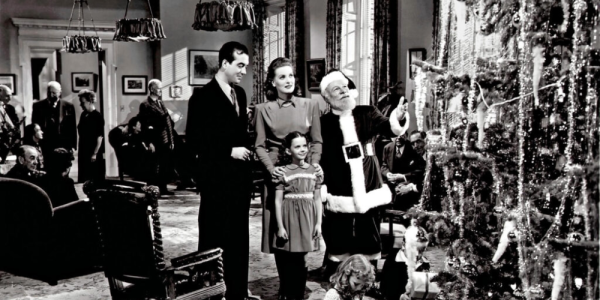
Miracle on 34th Street does not need color to create Christmas atmosphere. Store windows, parade crowds, apartment interiors, winter streets, courtrooms, and holiday displays gain clarity through black-and-white contrast.
The visual restraint supports the ambiguity. The world appears ordinary enough that Kris’s presence never feels separated into a brightly colored fantasy layer.
His beard, face, costume, and physical warmth stand out through texture and performance rather than saturated red fabric.
I also appreciate the documentary value of the parade and city scenes. The film captures public Christmas culture without turning every location into a polished studio dream.
Later colorized versions may make the film appear more conventionally festive, but I prefer the original photography. It keeps the miracle close to everyday reality.
The Humor Comes From Adults Protecting Their Own Logic
The film’s comedy is rarely loud. It emerges from department-store executives discovering that honesty sells, lawyers attempting to prove Santa’s identity, and public officials worrying about the political consequences of opposing Christmas.
Edmund Gwenn’s calmness makes other characters appear more frantic. He does not need to perform the joke because the world’s reaction supplies it.
The judge’s advisers are particularly funny because they understand that a legal ruling can become a public-relations disaster.
I enjoyed how the film allows self-interest to produce decent behavior. People may not act from pure belief, but their desire to avoid embarrassment can still protect Kris.
The comedy has aged better than humor built around contemporary slang or physical spectacle because it depends on recognizable institutional behavior.
What Has Aged Poorly
The depiction of psychiatric evaluation is simplified and often unfair. The film contrasts humane belief with professional skepticism so strongly that mental-health expertise becomes associated with cruelty or arrogance.
Sawyer is written as an obviously unpleasant representative of the profession, reducing the complexity of evaluating someone who makes an extraordinary identity claim.
Gender expectations are also visible. Doris’s professional competence is respected, but her emotional completion is connected closely with marriage and a more traditional family structure.
Fred’s confidence in directing Susan’s imagination sometimes crosses parental boundaries that the film treats lightly.
The courtroom logic is charming but legally fragile, and the resolution depends on public belief more than evidence about Kris himself.
Why the Film Still Works
The performances remain sincere. Edmund Gwenn never reduces Kris to a costume, and Maureen O’Hara gives Doris enough emotional history to make skepticism understandable.
Natalie Wood makes Susan intelligent, vulnerable, and capable of genuine development. John Payne gives Fred optimism that becomes meaningful when he risks his career.
The screenplay connects commercialism, family life, law, psychology, and childhood imagination through one clear conflict.
Most importantly, the film does not force a definitive answer. Kris may be Santa Claus. He may be an extraordinary man whose behavior inspires others to act better.
Either interpretation preserves the emotional result.
Who Should Watch Miracle on 34th Street?
I recommend Miracle on 34th Street to viewers who enjoy classic Hollywood films, gentle courtroom comedy, Christmas stories with limited fantasy spectacle, and family dramas built around trust rather than adventure.
Children may enjoy Susan’s developing belief and Kris’s interactions with young customers, though the dialogue-heavy structure moves more slowly than modern family films.
Adults may connect more strongly with Doris’s fear of disappointment, Fred’s defense of idealism, and the film’s criticism of commercial and institutional behavior.
Viewers expecting a detailed Santa origin story or North Pole adventure should look elsewhere. The film remains almost entirely grounded in New York.
Anyone uncomfortable with older depictions of psychiatry or traditional family expectations may notice dated assumptions alongside the enduring themes.
My Final Verdict
Miracle on 34th Street remains one of the most intelligent Christmas classics because it understands that belief cannot survive through sentiment alone. It must confront commerce, law, professional authority, family history, and the fear of appearing foolish.
Edmund Gwenn gives Kris Kringle dignity, humor, and enough mystery to keep the central question open. Maureen O’Hara makes skepticism emotionally credible, while Natalie Wood shows how imagination can be learned without requiring a child to become less intelligent.
The film has dated elements, particularly in its treatment of psychological evaluation and its assumptions about family completion. Its legal reasoning is more poetic than rigorous.
I rate Miracle on 34th Street 9.1/10. It is warm without being empty, funny without relying on constant noise, and idealistic without pretending that belief is easy.
The film never gave me proof that Kris was Santa Claus.
It gave me something more interesting: a group of practical people discovering that they had become smaller by demanding proof before allowing themselves to trust anything.
Pros:
- Timeless narrative that connects generations through its enchanting story
- Visually charming period details that evoke a deep sense of nostalgia
- Well-developed characters whose growth adds emotional depth
- Skillful balance between realism and magical fantasy
- Encourages viewers to embrace hope, kindness, and belief in the extraordinary
- Widely accessible on multiple streaming platforms for modern convenience
Cons:
- Some viewers may find the sentimentality overly pronounced
- Pacing can feel slow compared to today's fast-paced films
- Limited special effects might not satisfy audiences expecting modern cinematic visuals









Movie Reviews

Minecraft

Grand Theft Auto V

Toca Boca World

Roblox

Leave a comment
Your comment is awaiting moderation. We save your draft here
0 Comments