Review
Toca Life: Vacation does not give me a checklist explaining how to enjoy my trip. It places an airport, a hotel, a sunny beach, a livel...


A New Horizon in Family Gaming: The Magic of Toca Life: Vacation
Toca Life: Vacation does not give me a checklist explaining how to enjoy my trip. It places an airport, a hotel, a sunny beach, a lively boardwalk, dozens of expressive characters, and many movable objects in front of me, then allows my imagination to determine what happens next. There are no points to collect, opponents to defeat, or strict objectives demanding that every location be explored in one approved order. The experience feels less like a conventional mobile game and more like a colorful digital playset whose value depends on the stories I decide to create.
That open-ended structure is immediately appealing because the vacation theme is familiar enough to inspire ideas without requiring lengthy explanations. I can create a realistic family holiday, imagine a chaotic school trip, stage a luxury hotel adventure, or invent a mystery involving strange objects hidden around the island. The same rooms and characters can support completely different situations depending on how I arrange them. Toca Life: Vacation trusts creative play to provide motivation instead of filling the screen with rewards and instructions.
The Airport Makes the Journey Feel Important
The airport is an excellent starting location because it gives every vacation story a natural beginning. Characters can arrive with luggage, pass through security, examine bags using the X-ray machine, wait near the departure area, and eventually enter the plane. These interactions are simple, but together they create enough structure for me to act out the excitement and minor confusion of travel. Even deciding what each character packs becomes part of the story.
I particularly enjoy the luggage inspection because the objects inside a bag remain visible through the machine. This creates opportunities for harmless jokes, surprising discoveries, or small mysteries involving items that one traveler should probably have left at home. I can place unusual combinations inside the suitcases and then imagine how airport staff respond. The game turns an ordinary travel procedure into one of its most playful storytelling tools.
The aircraft continues the sequence rather than functioning as a decorative transition. Characters can sit together, receive snacks, look around the cabin, and visit the cockpit. I can create calm flights, nervous passengers, demanding travelers, or a crew attempting to manage complete disorder. The location is compact, yet it contains enough interactive details to make the journey feel like an event rather than a menu used to reach the resort.
The Hotel Is the Strongest Storytelling Space
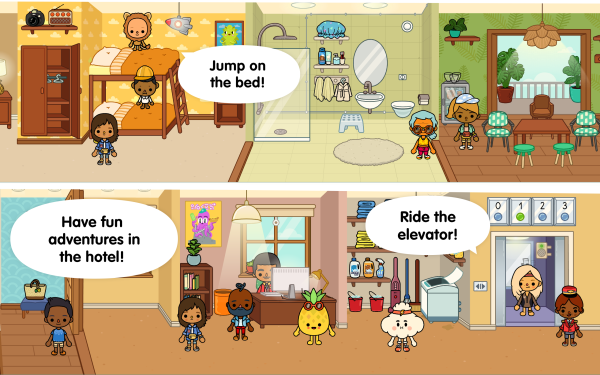
The hotel offers the widest variety of domestic and social situations. Characters can check in, carry bags upstairs, explore rooms, eat from the buffet, open the refrigerator, relax near the pool, or visit the luxurious upper floor. Each area supports a different part of the holiday, making the building feel like a complete miniature world. I can spend an entire session inside the hotel without needing the other locations.
The rooms work particularly well because ordinary objects can be moved between characters and spaces. Clothes, food, toiletries, toys, decorations, and personal belongings allow me to decide who is staying where and what kind of traveler each person might be. One room can belong to an organized family, while another becomes a complete mess after an energetic group arrives. These visual differences help the characters feel connected to the story even though they do not speak independently.
The elevator adds another small but useful layer because traveling between floors creates transitions within the story. A character may accidentally visit the wrong room, attempt to reach the penthouse, or become separated from the rest of the group. The elevator can also move objects between areas, allowing the hotel’s spaces to interact rather than remaining isolated scenes. This kind of simple connection gives imaginative play more continuity.
The Buffet Encourages Delightful Food Experiments
Food is one of the most reliable sources of playful interaction across Toca Boca games, and the hotel buffet makes excellent use of it. Characters can collect meals, combine ingredients, share dishes, and react visually while eating. I can prepare sensible breakfasts or create strange plates containing combinations no real hotel would confidently serve. The absence of failure means experimentation remains funny rather than wasteful.
The buffet also supports social stories. A family might gather for breakfast before visiting the beach, one traveler could take far too much food, or a child might secretly carry snacks back to the room. These situations do not require formal dialogue because character placement and objects communicate enough information. The game gives me the pieces and allows me to decide what every expression means.
I appreciate that the food is colorful and easy to recognize without becoming visually crowded. Younger players can understand the available options immediately, while older players can still enjoy arranging elaborate meals or inventing restaurant-style scenes. The mechanics are extremely simple, yet their creative flexibility gives them lasting value. A single buffet can support comedy, routine, celebration, or minor conflict depending on the story surrounding it.
The Penthouse Adds a Touch of Holiday Fantasy
Reaching the top floor changes the mood from ordinary family travel to exaggerated luxury. The penthouse provides a larger view, more impressive surroundings, and enough visual distinction to make it feel special. I can imagine famous visitors staying there, create a surprise celebration, or move an ordinary family into the suite after an unexpected upgrade. The location expands the range of stories without introducing a completely separate system.
Its usefulness comes from contrast with the simpler rooms below. Characters can compare accommodations, visit one another, or pretend that access to the suite is part of a larger mystery. The penthouse may also become a private headquarters for stories involving treasure, secret meetings, or elaborate parties. Toca Life: Vacation rarely tells me what a room means, which allows its meaning to change between sessions.
The Beach Captures the Freedom of a Summer Holiday
The beach is the most immediately cheerful part of the game. Characters can swim, surf, relax, build scenes around the sand, prepare food, and explore the edge of the ocean. Bright colors and open space create a different rhythm from the busy airport and enclosed hotel. The location feels designed for stories that are more physical, energetic, and spontaneous.
Surfing is especially enjoyable because characters can be placed above the water while ocean animals move below. The interaction is not a difficult sports challenge, but that simplicity suits the wider design. I can create an experienced surfer, a nervous beginner, or a completely unrealistic performance without worrying about scores or control precision. The activity exists to support imagination rather than test reflexes.
The beach also contains hidden discoveries that reward curiosity. Objects can be uncovered, unusual creatures may appear, and parts of the environment respond when I experiment. These secrets create a gentle sense of mystery without changing the relaxed tone. I never feel pressured to find everything, but discovering something unexpected often inspires an entirely new story.
The Ocean Feels Mysterious Without Becoming Frightening
The underwater details give the beach more personality than a simple strip of sand. Creatures and hidden elements suggest that the island contains stories beyond the visible holiday activities. I can imagine marine exploration, treasure searches, or a character claiming to have seen something nobody else believes. The game adds mystery while keeping every discovery friendly and visually inviting.
This balance is important for younger players because suspense never depends on harsh imagery or sudden threats. Curiosity is encouraged rather than punished. A mysterious object may lead to another playful interaction instead of turning the story into a stressful challenge. Toca Life: Vacation understands that adventure can feel exciting without requiring danger.
The Boardwalk Provides a Social Center
The sightseeing and boardwalk area gives characters somewhere to shop, eat, pose for photographs, and spend time away from the hotel. It feels more public than the other resort locations, making it ideal for stories involving strangers, new friendships, performers, shop workers, and tourists. Souvenirs can become reminders of the trip or important objects inside a larger fictional adventure. The area connects vacation activities with the small routines of buying, eating, and exploring.
Photo cut-outs are a simple but charming feature because they encourage me to place different characters into humorous scenes. The resulting image can become part of a family holiday story or an intentionally awkward tourist memory. Several characters can take turns, compare poses, or pretend to work as photographers. A tiny interactive object becomes useful because the game never limits it to one official purpose.
The gift shop provides even more portable items that can be carried back to the hotel, beach, or airport. This movement between locations helps the world feel connected. A souvenir purchased early may later appear in a suitcase during the return journey, giving the story a satisfying sense of continuity. Objects remember nothing mechanically, but the player can give them history.
The Characters Communicate Through Expression and Placement
Toca Life: Vacation includes a large group of characters with varied appearances, ages, clothing, and expressions. They do not deliver written conversations or follow independent schedules, so I decide who they are and how they relate to one another. One character can become a parent in one story and a hotel manager in another. This flexibility prevents the cast from being limited by fixed biographies.
Facial reactions are simple but effective. Feeding someone, moving an object, or placing a character in a particular situation can change the emotional tone of a scene. I can communicate surprise, happiness, discomfort, or excitement without needing spoken dialogue. Younger players can read these expressions easily, while storytellers can interpret them in more detailed ways.
The character variety also helps group stories feel visually clear. Families, staff members, tourists, and unusual visitors can be separated through clothing and placement. I rarely struggle to understand who is participating in the current scene, even when many characters occupy the same area. The visual design favors immediate recognition over realistic detail, which is exactly the correct choice for this kind of digital toy.
Almost Every Object Invites Experimentation
The world is filled with items that can be picked up, moved, worn, eaten, opened, combined, or placed somewhere unexpected. A hat does not need to remain in the shop, food can travel between locations, and luggage can carry objects through the entire vacation. This portability gives the world a flexible logic. Items are not attached permanently to the room where they were discovered.
I enjoy testing objects because the game frequently rewards curiosity with a reaction, hidden compartment, or funny visual result. The interactions are generally easy to understand without text instructions. This makes the experience approachable for children who may not read fluently. It also keeps the screen free from constant explanatory messages.
The lack of strict rules means that some objects have limited practical depth, but they still contribute to storytelling. A camera can represent a family hobby, professional assignment, or evidence in an invented mystery. A piece of food can become breakfast, a gift, or part of a ridiculous experiment. Creative meaning matters more than mechanical complexity.
Secrets Give Exploration a Gentle Purpose
Hidden areas and unusual objects provide enough mystery to encourage careful inspection. A compartment may open after the correct interaction, treasure can appear in unexpected places, and a suspicious statue invites experimentation. These discoveries are not difficult puzzles requiring extensive guidance. They are playful rewards for touching, moving, and observing the environment.
I appreciate that secrets do not create pressure to complete a collection. The game remains enjoyable even when I ignore them completely. Finding one simply expands the available possibilities and may inspire another story. This approach respects different styles of play because a child interested only in hotel role-playing never needs to become a treasure hunter.
The secrets also make repeated visits worthwhile. I can return to a familiar location and notice an object I previously overlooked. Because the game does not present a detailed completion list, discovery feels more personal. The world retains a small amount of surprise even after its main locations become familiar.
The Recording Feature Turns Play Into Performance
The built-in recording tool is one of the most valuable creative features because it allows me to capture character movement while adding my own voice. Instead of only imagining dialogue internally, I can narrate a scene and create a short vacation episode. The resulting video gives the play session a visible beginning and ending. It can also be shared or replayed as a small homemade animation.
The limited recording length encourages simple stories rather than enormous productions. I need to decide which characters appear, where the scene begins, and what action can be completed clearly. This gentle limitation can improve creativity because it encourages focus. A short hotel misunderstanding or beach discovery works better than trying to represent an entire vacation at once.
Recording also supports collaborative play. One person can move the characters while another provides voices, or several players can invent dialogue together. The game becomes a miniature stage rather than a solitary activity. This is especially effective because the expressive characters and clear environments already communicate so much visually.
There Is No Correct Way to Play
Toca Life: Vacation does not judge whether I use every location, discover every secret, or create a coherent story. I can spend several minutes arranging one hotel room and never visit the airport. Another session may involve moving every character to the beach for an enormous party. Both approaches are treated as equally valid.
This freedom is refreshing in a mobile environment filled with daily tasks, timers, reward tracks, and constant instructions. There is no pressure to return before an item expires or complete one more activity to maintain progress. The game can be opened for a brief imaginative scene and closed without punishment. Play remains controlled by interest rather than by retention systems.
The absence of scoring also changes how mistakes feel. Placing an object incorrectly or inventing an absurd situation cannot damage a campaign. I can immediately change the scene or incorporate the accident into the story. Experimentation becomes natural because the game does not measure efficiency.
The Interface Is Designed for Direct Understanding
Characters and objects respond primarily to dragging, tapping, and simple placement. The interface avoids complex menus, written statistics, and layered commands. This makes it accessible to younger players while preserving enough precision for arranging detailed scenes. The best interactions feel like moving physical toys across a playset.
Crowded areas can occasionally make object selection awkward. A small item may become hidden behind a character, or several objects can overlap in ways that require rearranging the scene. These problems are minor but more noticeable when I am attempting to record a carefully planned story. The simplicity of the controls generally outweighs the occasional imprecision.
The locations are visually organized enough that important interactive elements remain easy to recognize. Colors and shapes guide attention without large arrows or text labels. I can usually understand what an object might do by examining it. The interface teaches through playful experimentation rather than formal instruction.
The Art Style Remains Cheerful and Immediately Recognizable
Toca Boca’s rounded characters, bright colors, exaggerated expressions, and clean environments give the game a warm identity. The holiday setting uses sunny beaches, colorful food, playful hotel rooms, and friendly public spaces without becoming visually overwhelming. Every location contains many details, yet the strong shapes keep objects readable. The presentation feels designed from the perspective of play rather than visual realism.
The characters also avoid one narrow idea of what a family or traveler should look like. Different ages, appearances, styles, and personalities can be represented through the available cast. Because relationships are not fixed, players can construct groups that reflect their own ideas and experiences. This openness supports the game’s wider emphasis on self-directed storytelling.
Animation is deliberately simple, but the lack of technical complexity rarely matters. Characters respond clearly, objects move smoothly enough, and environmental reactions communicate their purpose. The game does not need cinematic movement because the player supplies the performance. Its visual style creates readable pieces for imagination to animate.
The Sound Design Supports Play Without Controlling It
Each location uses light music, environmental sounds, and clear interaction feedback. The airport feels busier than the beach, while the hotel uses quieter domestic sounds to create a more relaxed atmosphere. These differences help scenes feel distinct even without narration. Audio adds personality without constantly demanding attention.
Character reactions are expressive enough to support storytelling, though they remain intentionally limited. The absence of fixed spoken dialogue allows players to create their own voices and relationships. This is particularly useful during recording because the game’s audio does not compete heavily with narration. Silence becomes creative space rather than missing content.
The Small Number of Locations Is Both a Strength and a Limitation
Four main locations provide a focused vacation package with clear thematic variety. The airport represents departure, the hotel supports domestic play, the beach provides outdoor activity, and the boardwalk adds shopping and sightseeing. Together they cover the basic rhythm of a holiday surprisingly well. The small scale also makes every area easy to learn.
Players accustomed to the enormous combined world of newer Toca Boca releases may find the standalone game limited. There are fewer buildings, customization systems, and long-term collection opportunities than in a modern platform containing many connected packs. Once every secret has been discovered, new enjoyment depends almost entirely on creating different stories. This is not a problem for imaginative players, but it limits the experience for anyone expecting constant new objectives.
I still appreciate the focus because every location supports the central theme. Nothing feels included only to increase the map size. The game is easy to understand as one complete toy set. Its limitations are visible, but so is the clarity of its design.
The Absence of Advertising Preserves the Experience
One of the game’s most parent-friendly qualities is the lack of third-party advertising and internal purchases. Play is not interrupted by promotional screens, and children are not repeatedly directed toward additional purchases from inside the experience. The available locations and characters belong to the product from the beginning. This makes the game feel safer and more coherent.
The design also avoids using rewards to encourage longer sessions. There are no timed currencies, mystery boxes, or repeated claims waiting behind menus. A child can focus on the story rather than on obtaining digital prizes. This supports healthier creative play because attention remains directed toward imagination instead of acquisition.
The separate premium-app model feels increasingly unusual compared with modern free-to-start mobile games. It may appear less attractive to players who expect an initial free download, but it provides a clearer exchange. The purchase gives access to the complete intended experience without ongoing pressure. For families, that predictability can be more valuable than a larger but heavily commercialized game.
Younger Players Can Learn Through Role-Playing
Toca Life: Vacation is not presented as a formal educational lesson, yet it introduces familiar routines through play. Airport security, hotel check-in, packing, eating in shared spaces, shopping, swimming, and caring for belongings can all be explored safely. Children can repeat unfamiliar situations until they become less mysterious. The game provides a simplified model of travel without demanding correct behavior.
Role-playing can also support language and social development. Players may invent conversations, explain what a character is doing, negotiate roles with another child, or record a narrated story. These activities encourage sequencing and emotional interpretation. The educational value emerges naturally from play rather than from tests.
Adults can participate by asking what happened during the trip or helping create a short scene. The game provides enough visual information for a child to explain a story in their own words. There is no need for the adult to understand complex rules. Shared storytelling becomes the activity.
The Game Respects Quiet Play
Not every session needs to become a dramatic adventure. I can arrange hotel rooms, prepare meals, organize luggage, and place characters around the beach without constructing a large plot. These repetitive and orderly actions can be calming. The game allows play to remain private, slow, and uneventful.
This is an important quality because many children enjoy organizing objects as much as creating stories. Moving food onto plates, sorting belongings, or choosing where everyone sleeps can provide satisfaction without a reward screen. Toca Life: Vacation does not interrupt these routines to demand progress. It allows the player to decide when something is complete.
Repeated Play Depends on Imagination Rather Than Progression
There is no traditional campaign carrying progress from one challenge to another. Replay value comes from changing the cast, relationships, destination plans, and emotional tone of each holiday. One trip may be peaceful, while another becomes an exaggerated comedy involving missing luggage and mysterious treasure. The locations remain the same, but their meaning can change completely.
This makes the game highly reusable for players who naturally invent stories. A child can return to the same hotel dozens of times and create a new situation through different objects or characters. Players who rely on external objectives may become bored much sooner. The game provides creative tools rather than a continuing stream of authored content.
I consider that design honest because Toca Life: Vacation never pretends to offer endless progression. It gives me a compact environment and a clear theme. The experience lasts as long as I continue finding new ideas inside it. Its value is closer to a reusable toy than to a sequence of levels.
A Focused Digital Playset With Enduring Charm
Toca Life: Vacation succeeds because every major feature supports imaginative holiday stories. The airport creates anticipation, the hotel provides domestic and social spaces, the boardwalk adds public activity, and the beach delivers playful freedom. Portable objects connect those locations, while expressive characters allow the same environment to support many different relationships. Secrets reward curiosity without turning exploration into a compulsory task.
The experience is naturally smaller than modern Toca Boca World content, and there are no complex progression systems to provide long-term objectives. Object selection can become awkward in crowded scenes, and players without an interest in storytelling may exhaust the available interactions relatively quickly. These limitations come directly from its identity as a focused creative toy. The game is not attempting to provide competition or an endless service.
I enjoyed it most when I stopped searching for activities the game expected me to complete. Packing a suitcase, checking characters into the hotel, preparing a ridiculous buffet meal, visiting the beach, and recording a short scene became satisfying because I controlled the entire sequence. The holiday existed only through the details I decided were important. Toca Life: Vacation provides a setting rather than a script.
Its greatest strength is the respect it shows for imagination. There are no wrong combinations, failed trips, or low-scoring stories. A quiet family visit and an absurd island mystery can use exactly the same characters and locations. Toca Life: Vacation remains charming because it understands that the most memorable journey is not necessarily the one designed by the game, but the one a player invents while moving its tiny travelers through the world.
Pros:
- Vibrant graphics and immersive visuals appealing to all ages.
- Intuitive user interface and easy-to-learn controls.
- Accessible on multiple platforms including PC, Mac, Android, and iOS.
- Regular updates and active community engagement enhancing longevity.
- Family-friendly content that is suitable for both casual and experienced gamers.
- Engaging and creative sandbox environment that fosters imagination.
Cons:
- Offers limited narrative depth compared to more traditional adventure games.
- Few competitive or strategy-driven elements may not satisfy players looking for intense gameplay.
- Lacks complex challenges for gamers seeking high difficulty.

How much storage do you need?
 Toca Life: Vacation




Recent Reviews

Minecraft

Grand Theft Auto V

Toca Boca World

Roblox

Leave a comment
Your comment is awaiting moderation. We save your draft here
0 Comments