Review
My first successful Fall Guys final was not graceful. I mistimed an early jump, bounced off another player, recovered by landing on the...
Fall Guys: A Carnival of Chaos and Competitive Celebration
My first successful Fall Guys final was not graceful. I mistimed an early jump, bounced off another player, recovered by landing on the edge of a platform, and reached the final stretch convinced that someone behind me would grab my character at the worst possible moment. When I crossed the line and saw the victory screen, I did not feel like a skilled athlete. I felt like the only shopping cart that had reached the bottom of a hill without losing a wheel.
That mixture of competition and physical embarrassment remains the central appeal of Fall Guys. It presents itself as a colorful obstacle-course party game, but beneath the cheerful costumes is a surprisingly tense battle royale structure. Every round removes part of the lobby. One mistake can end an otherwise excellent run, while one ridiculous collision can rescue a player who seemed certain to fail.
I have played enough matches to stop believing that success depends entirely on luck. Route selection, timing, camera control, recovery, and reading other players all matter. Luck still has a seat at the table, however, and it occasionally throws the table through a window.
This is why Fall Guys can produce laughter and irritation within the same thirty seconds. I may execute a sequence of clean jumps, only to be flattened by a rotating obstacle after another bean falls into me. The game constantly places individual control beside collective chaos.
The Bean Is Deliberately Bad at Being an Athlete
My character can run, jump, dive, grab, climb short ledges, and interact with certain objects. That sounds like a conventional platforming toolkit until the physics begin working against precision.
The bean has weight, momentum, and a tendency to lose balance after collisions. A clean jump can become unstable if another player touches me in midair. Landing on a moving platform may cause my character to tumble before standing again. Diving extends horizontal distance but leaves me vulnerable during recovery.
I initially interpreted this as loose control. After more time, I began seeing it as intentional friction. Fall Guys would lose much of its identity if every movement responded with the exact precision of a demanding single-player platformer.
The game wants me to feel capable but never completely elegant. I can learn the correct route through an obstacle course, but executing it inside a crowd remains unpredictable.
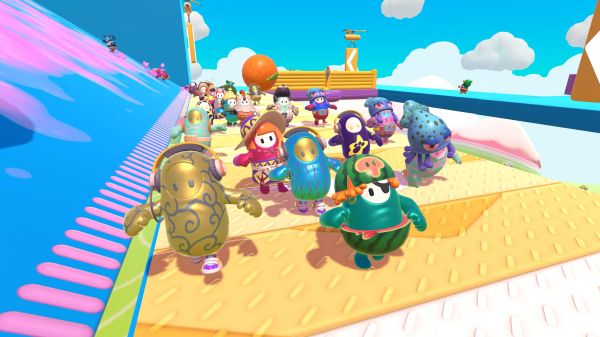
That unpredictability is strongest at the beginning of race rounds. Dozens of beans move toward the same narrow opening, and the entire group behaves like liquid poured through a funnel. Starting near the front creates a genuine advantage because I can engage with obstacles before the crowd changes their timing.
Running Is Simple; Maintaining Momentum Is the Real Skill
Holding the movement control forward will carry me through the easiest sections, but stronger runs depend on preserving speed. Turning too sharply can create a poor approach to a jump. Diving too early may produce unnecessary recovery time. Jumping on an incline can help maintain momentum, while landing against another player may remove it instantly. I found that experienced players rarely appear dramatically faster during individual actions. They simply lose less time.
They approach doors at better angles, avoid crowded routes, jump before rotating bars arrive, and recover from mistakes without panicking. A second saved at five different obstacles can separate easy qualification from elimination near the finish line. This gives Fall Guys a useful learning curve. A new player can understand the controls almost immediately, but efficient movement develops gradually.
The Dive Button Is My Emergency Tool and My Most Common Regret
Diving is one of the most important actions in Fall Guys. It can extend a jump, push the bean through a finish line, avoid a moving obstacle, or turn a poor landing into a successful one. It can also place me face-first on the floor while everyone else runs past. The timing matters because diving trades stability for distance. I use it most confidently near the end of a jump, when the extra reach matters more than immediate recovery.
On seesaws and narrow platforms, an unnecessary dive can become disastrous. The character may slide, roll, or take too long to stand while the surface changes beneath it. I like that such a simple input has several uses. Fall Guys rarely requires complicated button combinations. Its depth comes from choosing the correct moment for a limited set of actions.
Grabbing Turns Friendly Competition Into Social Suspicion
The grab mechanic allows me to hold other players briefly, interact with ledges, and manipulate objects in certain rounds. It is also the fastest way to make a stranger dislike me. A small grab before a jump can disrupt another player’s timing. Near an edge, it can send someone into danger. During survival rounds, one player may hold another while an obstacle approaches both of them.
I use grabbing carefully because it creates risk for the attacker as well. Holding someone reduces my own movement, and a badly timed attempt can eliminate both characters.
The mechanic adds psychological pressure. When another bean stands close behind me near a difficult jump, I begin wondering whether they are waiting for the same opening or preparing to interfere. This suspicion makes final rounds especially tense. A player does not need to be mechanically superior if they can predict when someone else will jump.
Race Rounds Are the Best Introduction to Fall Guys
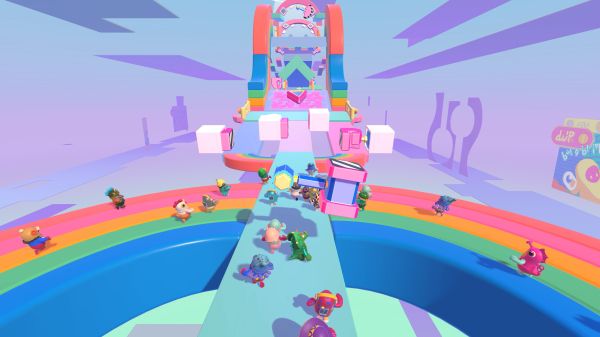
Race rounds ask players to reach a finish line before the qualification limit is filled. They are easy to understand and immediately demonstrate the relationship between movement, obstacle timing, and crowd behavior.
My favorite races usually contain multiple viable routes. One path may be safer but slower. Another may offer moving platforms, fans, shortcuts, or rotating hazards that save time when executed correctly.
This gives me meaningful decisions during repeated play. I can use a conservative route when qualification matters or practise a dangerous shortcut when the lobby appears less competitive.
The weaker race rounds create an illusion of choice while one path remains clearly superior. Once the community identifies the fastest route, the course becomes a test of execution rather than adaptation. Even familiar races can remain entertaining because other players alter the rhythm. A doorway that was open in one match may become completely blocked in another.
Survival Rounds Reveal How Much I Trust My Own Positioning
Survival rounds remove the finish line and ask me to remain active until enough players are eliminated or a timer expires. These rounds shift my attention from speed to space. I need to know where the safest area currently exists, where it will exist several seconds later, and how many other players are moving toward it. A platform may be safe mechanically but dangerous socially. If too many beans gather in one section, collisions and grabs become greater threats than the obstacle itself.
I enjoy survival rounds because they punish tunnel vision. Watching only my character is rarely enough. I need to monitor rotating bars, disappearing tiles, incoming objects, moving walls, and nearby players simultaneously.
Some survival rounds can feel passive during their opening moments, especially when elimination pressure remains low. The strongest versions increase intensity steadily and force movement before players become comfortable.
Logic Rounds Make Me Question Whether I Was Paying Attention
Logic and memory rounds create a different kind of pressure. Instead of relying primarily on movement, they ask players to identify patterns, remember symbols, or choose correct platforms.
I enjoy the change of pace, although these rounds can expose an awkward truth: following the crowd is often easier than solving the problem personally. If most players move decisively toward one answer, joining them can become the safest strategy. The entire group may still be wrong, producing one of the game’s funniest mass eliminations.
I try to solve these rounds independently because the small moment of certainty feels satisfying. Standing alone on a platform is terrifying until everyone on the crowded alternative disappears. The weakest logic rounds move too slowly or explain themselves poorly. When failure feels connected to unclear information rather than misunderstanding, the comedy disappears quickly.
Team Rounds Can Make One Excellent Performance Feel Meaningless
Team rounds divide players into groups and connect individual survival with collective performance. These activities can involve scoring goals, carrying objects, collecting items, protecting territory, or preventing opponents from completing objectives.
At their best, team rounds create frantic cooperation. I may defend while another player attacks, or recover an object after a teammate creates an opening. At their worst, they remove too much control. I can perform well and still lose because several teammates ignore the objective or chase the same object inefficiently.
This is one of my recurring frustrations with Fall Guys. Individual mistakes are easier to accept than elimination caused by a group I cannot coordinate. Playing with friends improves these rounds because even limited communication creates structure. With strangers, I often need to identify what the team is neglecting and fill that role myself.
Final Rounds Transform Silly Mechanics Into Serious Pressure
Reaching a final changes my relationship with every movement. The same jump I performed casually earlier can feel dangerous when one mistake ends the entire run. Finals generally test racing, survival, tile management, or control of limited space. Strong finals reward skills introduced during earlier rounds while adding greater pressure.
I prefer finals where several strategies remain viable until late in the match. A race should allow recovery after a small error. A survival arena should create interaction without making one starting position overwhelmingly superior.
Some finals become less satisfying when random obstacle patterns decide too much or when latency affects a decisive grab. Winning still feels meaningful because a crown represents several successful rounds rather than one isolated result. Even after many hours, the final qualification screen creates tension.
The Camera Is Sometimes a More Dangerous Opponent Than the Course
Fall Guys uses a third-person camera that I can rotate while moving. In open areas it works well, allowing me to monitor nearby threats and plan routes. Problems appear near walls, enclosed spaces, or large moving obstacles. The view can become blocked or shift at the moment I need precise spatial information.
I have failed jumps because another object filled the screen, leaving me unable to judge the landing. Crowded sections make this worse because costumes and effects can obscure the character.
The camera is rarely disastrous for an entire match, but small failures feel significant in elimination-based play. I learned to adjust it before entering difficult sections rather than reacting during the jump. That reduces problems without eliminating them.
Latency Can Turn Clear Contact Into a Different Reality
Online competition introduces moments where what I see does not align perfectly with what the server records. A player may appear behind me before qualifying first. A grab may connect from an unexpected distance. A collision can affect my bean after the other character appears to have moved away. These discrepancies are particularly frustrating in finals because tiny differences decide the result.
Most matches remain playable, but Fall Guys depends heavily on physical interaction between many characters. Even minor synchronization issues become visible. I have learned not to trust the exact visual distance between beans during high-pressure grabs. Leaving extra space is safer than assuming the model represents the full interaction range.
Randomness Creates Stories but Sometimes Weakens Competition
Fall Guys benefits from randomness because perfectly repeatable courses would become stale quickly. Moving obstacles, object trajectories, player collisions, and changing paths produce situations I cannot memorize completely. This creates excellent stories. A bouncing object may push me over a gap, saving a failed jump. Another player may accidentally block an obstacle and create an opening. The same randomness can feel unfair when it removes a strong run without giving me a reasonable response.
The game constantly negotiates between party chaos and competitive legitimacy. It rarely resolves that tension completely. I enjoy Fall Guys most when randomness changes the problem but still allows skilled reaction. I enjoy it least when the outcome is effectively determined before I can respond.
Creative Mode Changed the Shape of the Game
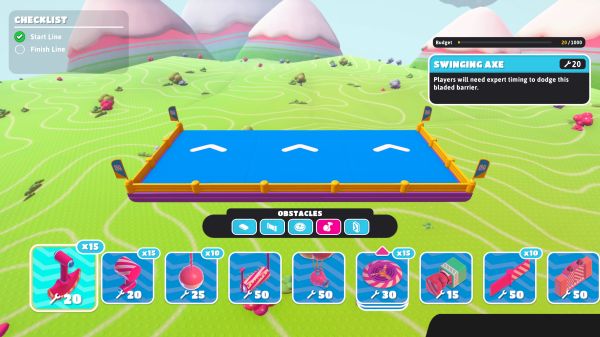
Creative mode allows players and developers to build custom rounds using obstacle pieces, platforms, checkpoints, moving elements, and rule variations. This dramatically expands the possible course library.
I enjoy exploring well-designed community creations because they can target specific movement skills more aggressively than standard matchmaking rounds. Some focus on precision jumps, while others build elaborate races, puzzles, survival arenas, or unusual mechanical experiments.
Creative also introduces inconsistency. For every excellent community course, I encounter levels with unclear routes, excessive waiting, awkward checkpoints, visual clutter, or difficulty created through poor readability.
Featured selections help, but discovery remains important. A good sharing system can determine whether creative tools produce a living ecosystem or a large archive where strong work becomes difficult to find. The mode gives Fall Guys a long-term source of content, though handmade developer rounds often feel more polished and easier to read.
Some Creative Courses Confuse Difficulty With Inconvenience
A difficult course can be satisfying when failure teaches me something. I may need better timing, a different angle, or a more efficient sequence. An inconvenient course repeats long sections after one mistake, hides the correct route, or uses obstacles whose behavior is difficult to read. I have played community rounds where the creator clearly understands advanced movement. I have also played levels where every platform is narrow simply because narrow platforms appear difficult.
Checkpoints matter enormously. Placing them too frequently removes tension, while placing them too far apart turns practise into repetition. The strongest creators understand rhythm. They alternate demanding moments with short recovery spaces and allow the course to communicate what it expects.
Ranked Play Reveals a More Competitive Game Beneath the Costumes
Ranked play changes the emotional tone by attaching visible progression to results. The bean remains cheerful, the music remains playful, and everyone still falls over. I simply care more about every mistake. This structure gives experienced players a clearer reason to improve. Efficient routes, consistent recovery, and knowledge of obstacle cycles become increasingly important.
I like having a mode where competitive performance receives direct recognition. Standard shows can feel casual even when I am trying seriously. Ranked play also exposes balance issues more clearly. A round that feels amusing in a casual playlist may feel frustrating when rating is at stake.
Randomness, team dependence, latency, and uneven starting positions become harder to dismiss as harmless comedy. The mode works best when the selected rounds emphasize individual decision-making and consistent mechanics.
Playing With Friends Changes Failure Into Entertainment
Fall Guys is enjoyable alone, but group play improves its social value considerably. Watching a friend miss an easy jump can be funnier than completing the course myself. Squad modes also give eliminated players a reason to remain invested because team placement can keep everyone alive. Communication helps with cooperative activities, although individual rounds still create moments where one person’s result affects the entire group. I enjoy the combination of assistance and mockery. Friends may explain a shortcut, then celebrate when I ignore it and fall immediately.
The game is accessible enough that people with different skill levels can share a session. Stronger players gain consistency, while newer players can still qualify through smart movement or fortunate chaos.
Squad Modes Reduce the Pain of One Mistake and Add New Frustrations
In squad modes, team placement is calculated across members rather than treating every player independently. This allows a strong teammate to compensate for one poor result. It also means an early finish may not guarantee qualification if the rest of the group struggles. I like the shared tension during race endings. After qualifying, I can watch the remaining teammates and calculate whether their points will be enough.
The downside appears when a random teammate stops moving, leaves the match, or repeatedly ignores the objective. A squad system can soften individual failure, but it also distributes the consequences of disengaged players.
The Art Style Makes Failure Easier to Accept
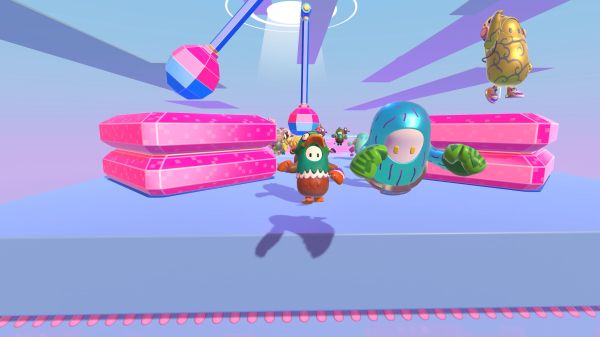
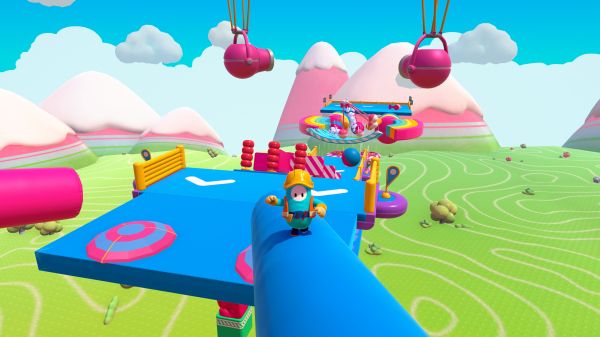
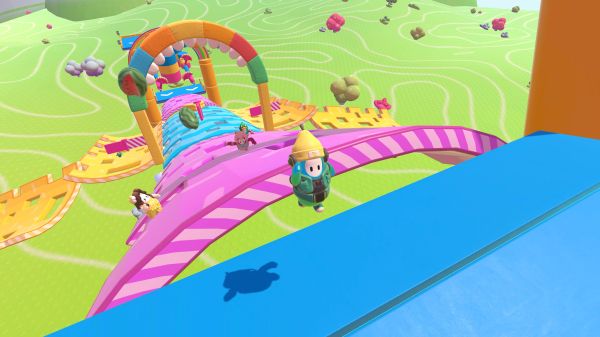
Fall Guys uses rounded characters, bright obstacle colors, soft materials, oversized props, and environments resembling television game shows built from inflatable equipment.
The visual design communicates danger without making the world hostile. Spikes, rotating bars, fans, hammers, and collapsing platforms appear playful rather than realistic. Being launched across the arena feels embarrassing instead of painful.
This matters because players fail constantly. A harsher visual style could make repeated elimination exhausting. The beans are especially effective designs because their proportions explain the physics. Their short legs and rounded bodies make clumsiness feel natural.
Costumes Turn the Bean Into a Walking Collection Shelf
Customization includes colors, patterns, upper and lower costume pieces, emotes, nameplates, celebrations, and other cosmetic options. The basic bean remains recognizable beneath almost every outfit, allowing collaborations and themed costumes to fit the same silhouette. I enjoy creating intentionally ridiculous combinations. A serious-looking upper piece paired with an unrelated lower half often feels more appropriate than a complete matching set.
Cosmetics provide one of the game’s major long-term motivations. Winning is temporary, while obtaining a memorable outfit gives the account a persistent reward. The problem is that many desirable items are connected to the premium store, bundles, or limited availability. Customization remains fun, but it is also the main commercial engine.
The Interface Is Bright but Can Become Crowded
Menus communicate the game’s energy through large panels, animated characters, event banners, progression tracks, challenges, store sections, and multiple playlists. Important information is usually accessible, but the number of systems can make the interface feel busy. A returning player may encounter ranked progression, a Fame Pass, daily tasks, limited events, Creative selections, store offers, and rotating shows simultaneously.
I occasionally spend more time checking reward paths than I would prefer. The visual hierarchy is strongest when the game presents one clear primary show. It becomes weaker when several promotional panels compete for attention.
The Soundtrack Understands Controlled Panic
Fall Guys uses energetic electronic music, playful vocal sounds, countdown effects, qualification signals, and exaggerated obstacle noises. The soundtrack gives rounds urgency without making them feel aggressive.
I particularly like how final-round music increases pressure while retaining the game’s cheerful identity. Character sounds add personality without requiring spoken dialogue. Beans communicate excitement, surprise, and distress through short noises that remain amusing after repeated exposure. The audio can become overwhelming during crowded moments, but that sensory confusion fits the action.
Technical Performance Is Usually Stable but Not Invisible
Fall Guys benefits from simple visual geometry and a clear art direction, allowing it to run smoothly on a wide range of hardware. Performance matters because platforming depends on stable timing. A small frame drop during a jump can be more damaging than a brief visual issue in a slower game. My experience has generally been stable, though occasional connection problems, loading delays, collision oddities, and interface bugs remain noticeable. Creative rounds can vary more because complex user-built layouts may create additional visual or performance pressure. The game’s technical weaknesses rarely stop an entire session, but they become memorable when they affect elimination.
Matchmaking Is Fast Until a Specific Playlist Is Not
Popular shows generally place me into matches without excessive delay. Less populated or restricted modes can take longer, particularly when matchmaking considers region, group size, or competitive rank.
The waiting experience is softened by the falling-bean loading screen, although its charm cannot completely hide a long queue. Cross-platform support helps maintain the available population and makes group play easier across different systems. I value cross-progression as well because cosmetic unlocks and account progress are not confined to one device.
The Free-to-Play Transition Expanded Access and Changed Rewards
Fall Guys is easy to recommend for a trial because entry does not require purchasing the base game. A new player can download it, understand the controls quickly, and participate in standard modes without paying for a competitive advantage. The monetization focuses on cosmetics, premium currency, passes, and bundles rather than stronger movement or exclusive gameplay abilities. This means the game is not pay-to-win in the traditional sense. Spending money will not improve jump distance, increase speed, or provide a superior grab.
The less pleasant consequence is that cosmetic progression can feel heavily commercialized. Some outfits that would once have served as meaningful gameplay rewards are presented primarily as purchases. I never felt forced to spend money to compete. I did feel frequently reminded that the store existed.
The Fame Pass Gives Structure but Can Turn Play Into Administration
Progression passes provide rewards across a sequence of levels, giving regular play a clear short-term objective. I enjoy the steady flow of costumes, currency, patterns, and other items when the reward track contains a theme I like.
The system becomes less enjoyable when I begin choosing modes only to satisfy challenges rather than because I want to play them. Daily and weekly objectives can encourage variety, but they can also make a casual session feel like maintenance. I prefer challenges that reward normal play or introduce a small twist. Tasks requiring repeated participation in a mode I dislike quickly become work.
The Store Uses Scarcity More Than I Would Like
Rotating cosmetic availability encourages players to make decisions before items disappear from the current selection. This creates excitement around collaborations and seasonal outfits, but it also uses urgency as a sales tool.
I would prefer a larger permanent catalogue where players can plan purchases without guessing when an item might return. Prices are easier to judge when a costume can be compared calmly with other options. Rotation reduces that clarity. The cosmetics remain optional, yet they are central to self-expression. That makes store design more emotionally influential than the word “optional” suggests.
Fall Guys Respects Short Sessions Better Than Many Live-Service Games
One of the game’s greatest strengths is how easily it fits into limited time. I can play one show, complete several rounds, and leave without committing to a long match. Elimination naturally creates stopping points. A poor result may end a session in minutes, while a strong run extends it toward the final. This structure makes Fall Guys useful between larger games or during social sessions where nobody wants to begin something demanding. The danger is the familiar “one more show” effect. A quick elimination feels like an unsatisfying ending, while reaching a final creates the desire to repeat the attempt.
Repetition Arrives Before the Game Runs Out of Content
Fall Guys contains many rounds and community creations, yet a session can still feel repetitive when matchmaking selects the same courses frequently. Variety depends not only on the total catalogue but on rotation quality. I have experienced evenings where one familiar race appears repeatedly while several rounds I enjoy remain absent. Modifiers and alternate modes help refresh known courses, but repeated obstacle patterns eventually become routine. Creative content addresses this partly, although its uneven quality creates a different problem.
Winning Is Satisfying, but Improvement Is the Better Long-Term Reward
Crowns and ranked progress provide visible success, but I remain engaged because movement becomes cleaner over time. A shortcut that once appeared impossible eventually becomes reliable. A survival pattern that seemed random begins revealing timing. I learn where crowds form and which routes become dangerous under pressure. This improvement is subtle because the controls remain simple.
Fall Guys does not ask me to memorize dozens of abilities. It asks me to understand momentum, positioning, timing, and other players more precisely. The best moment is not always winning. Sometimes it is executing a difficult section cleanly after several failed attempts.
The Game Is Friendly to Beginners but Not Always Gentle
Fall Guys is easy to understand, visually inviting, and free from complex combat systems. That accessibility does not guarantee easy qualification.
Experienced players know optimized routes, advanced movement, obstacle timing, and social tactics that new players cannot identify immediately. A beginner may understand the objective and still lose before seeing most of the course. I think the game works best when early rounds allow broad qualification and later rounds increase pressure. Harsh opening courses can remove new players before they have time to enjoy the chaos.
Parents Should Understand the Social and Commercial Systems
The game’s presentation is suitable for a broad audience, with cartoon competition rather than realistic violence. Its accessibility makes it appealing to younger players, but the online environment includes interactions with strangers, user-generated courses, cosmetic purchases, and rotating offers.
Account controls and spending settings therefore matter. The game itself does not require purchases for competitive success. A child may still place strong emotional value on limited costumes or collaboration items. Creative levels also vary in quality and clarity, so curated playlists are generally more predictable than arbitrary share codes.
My Biggest Annoyances
Collisions can remove control at moments when I have executed the correct input. Latency makes grabs and close finishes occasionally look inconsistent. Team rounds can eliminate strong individual players because of weak or disconnected teammates.
Repeated course selection can make a large catalogue feel smaller than it is. The store relies too heavily on rotating availability and premium cosmetics. Some Creative levels replace thoughtful challenge with visual clutter or long repetition. The camera struggles in enclosed and crowded spaces.
Who Should Play Fall Guys?
I recommend Fall Guys to players who enjoy party games, short competitive sessions, obstacle courses, colorful customization, social chaos, and platforming that does not demand complex controls.
It is particularly effective for groups whose members have different experience levels. Everyone can understand the objective, while stronger players still have room to improve. Players who enjoy creating levels may find long-term value in Creative mode. Those who want serious competition can use ranked play, though randomness and physics remain part of the experience.
I would be more cautious recommending it to players who dislike losing control because of collisions, depend heavily on precise online synchronization, or want progression centered on gameplay rewards rather than cosmetics.
My Final Verdict
Fall Guys remains one of the most distinctive multiplayer party games because it understands that failure can be entertaining without becoming meaningless.
Its controls are simple, but movement has enough physical depth to reward practice. Race, survival, logic, team, and final rounds create useful variety, while Creative mode gives the game a continuing supply of community-built experiments.
The free-to-play structure makes it easy to begin and does not sell competitive advantages. Its store, rotating cosmetics, premium passes, and limited availability can still make progression feel more commercial than rewarding.
Technical inconsistencies, camera problems, latency, uneven Creative courses, and frustrating team dependence prevent the game from feeling completely reliable as a competitive experience.
I rate Fall Guys 8.3/10. It works best when I accept that skill helps me control the course but never gives me full control over the crowd. I may enter a round with the correct route, perfect timing, and a clear strategy. Then another bean lands on my head. That is not an interruption of Fall Guys. That is Fall Guys.
Pros:
- Intuitive gameplay accessible to both newcomers and experienced gamers
- Regular updates introducing new levels, features, and challenges
- Strong multiplayer and community engagement fostering creative play
- Seamless cross-platform access allowing gameplay on multiple devices
- Balanced challenge blending simplicity with strategic depth
- Unique and vibrant visual design that captivates players
Cons:
- Steep learning curve for new players adapting to complex mechanics
- Occasional technical issues or server instability disrupting the experience
- Unpredictable obstacles can sometimes lead to frustrating outcomes

How much storage do you need?
 Fall Guys








Recent Reviews
Minecraft

Grand Theft Auto V

Toca Boca World
Roblox
Leave a comment
Your comment is awaiting moderation. We save your draft here
0 Comments