Review
Farming Simulator 25 made me appreciate how satisfying a quiet working routine can become when every small task contributes to a much l...
Farming Simulator 25: Cultivating a New Era in Virtual Agriculture
Farming Simulator 25 made me appreciate how satisfying a quiet working routine can become when every small task contributes to a much larger plan. My first field did not look impressive, and the machinery I could afford was far from the most advanced equipment in the catalogue. However, preparing the soil, choosing a crop, watching the weather, and finally collecting the harvest created a strong sense of ownership. The game rarely manufactures excitement through dramatic missions because the pleasure comes from building an efficient agricultural operation one careful decision at a time.
I entered the game expecting a familiar Farming Simulator structure with newer machines and improved visuals. That foundation is still present, but the addition of East Asian agriculture, rice paddies, expanded livestock, ground deformation, dynamic weather events, and GPS-assisted steering gives the new entry a broader identity. The improvements do not completely redesign the series, and experienced players will recognize many systems immediately. Even so, the larger range of farming activities made my long-term farm feel more personal than a simple continuation of an old save.
From my perspective as a gamer, Farming Simulator 25 works best when I treat it as a management sandbox rather than a game that must constantly provide a new objective. I decide whether the next investment should be land, machinery, animals, production buildings, forestry equipment, or additional workers. Every choice changes the rhythm of the farm and creates another responsibility that must be maintained. The game provides the tools, but the story of success or financial disaster develops through the way I use them.
My First Farm Was Mostly Expensive Mistakes
The beginning of a new career can feel peaceful until I start examining the price of machinery, land, seeds, fertilizer, livestock, and maintenance. A tractor that looks essential may consume most of the available budget while still requiring several separate attachments to perform useful work. I quickly learned that purchasing the largest machine was not the same as making the smartest investment. Farming Simulator 25 rewards planning because an impressive garage can leave the actual business without enough money to operate.
My early mistakes were rarely dramatic, but they remained visible for many in-game days. I bought equipment that was too large for the fields I owned, accepted tasks without checking whether my machinery could complete them efficiently, and underestimated how much time transportation would require. Selling an unnecessary vehicle recovered only part of the cost, so every impulsive purchase created a lasting financial lesson. The game’s economy becomes engaging because poor decisions do not disappear after one short mission.
The Three Maps Support Different Farming Fantasies
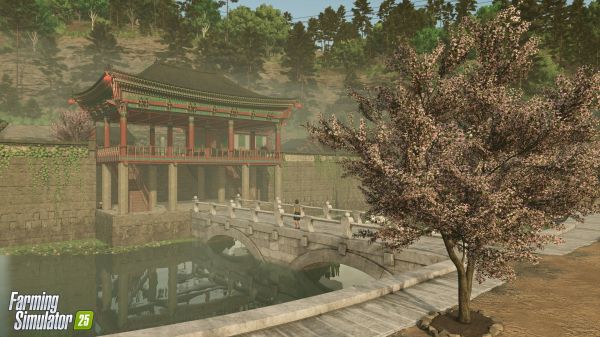
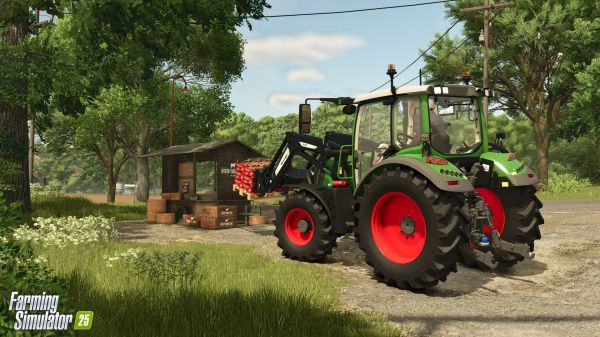
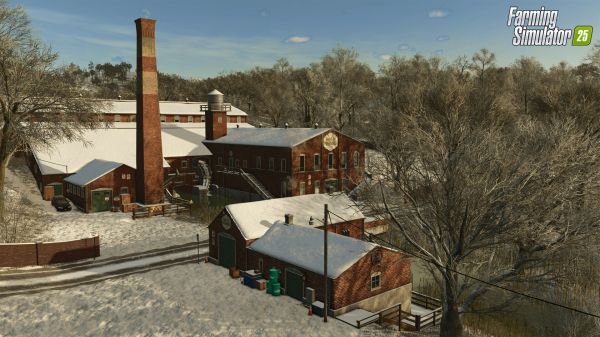
Farming Simulator 25 offers regions inspired by North America, Central Europe, and East Asia, and each map changes the atmosphere of building a farm. The North American environment gives me broad fields, industrial structures, and enough open space to imagine a large machinery-focused business. The Central European region feels greener and more compact, with waterways and settlements creating a stronger relationship between farmland and local community. The East Asian map provides the most distinctive change through rice paddies, smaller field arrangements, and scenery that immediately separates it from earlier series locations.
I appreciated that choosing a map was not only a cosmetic decision. Field shapes, travel distances, road layouts, available building space, and local production points influence which machinery feels practical. A large harvester may work beautifully in an open region while becoming awkward on narrow roads or compact fields. The maps encourage different styles without placing strict restrictions on what I can eventually build.
East Asian Agriculture Gives the Sequel Its Clearest New Identity
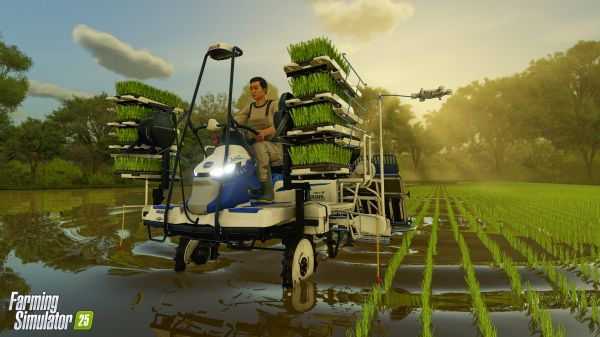
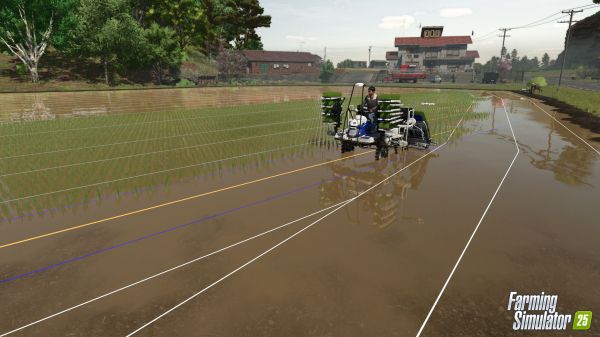
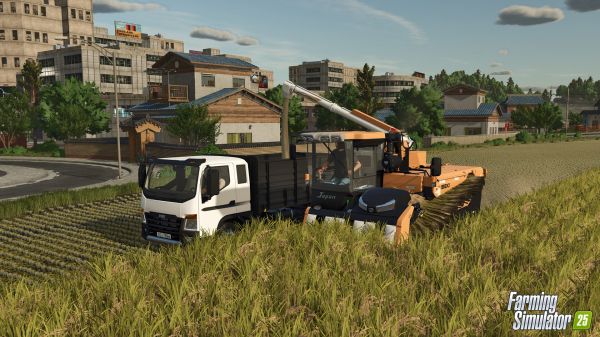
The addition of an East Asian farming environment is the feature that made Farming Simulator 25 feel most visibly different from its predecessor. Rice fields require a different visual and mechanical routine from ordinary grain production, especially because water management becomes part of preparing the field. Specialized machinery changes how I approach planting and harvesting, while the flooded paddies create a landscape unlike the dry fields found elsewhere. The process remains accessible, but it adds enough novelty to justify learning another agricultural workflow.
I liked how rice farming changes the appearance of the farm across the season. A prepared paddy reflects the sky and surrounding vegetation, making the agricultural space feel integrated with the environment rather than simply painted onto the terrain. Working in shallow water also gives the machinery a different sense of weight and motion. The system could be developed even further, but it provides an enjoyable foundation for a farming style the series had not previously emphasized.
Two Types of Rice Create More Than One Routine
The game includes more than one method of rice cultivation, which prevents the new crop from becoming a single novelty activity. One approach relies more heavily on prepared paddies and specialized planting, while another fits differently into the larger crop system. This gives me a reason to compare equipment costs, field preparation, and expected returns rather than simply selecting rice because it is new. The distinction also makes the East Asian map feel mechanically considered instead of functioning only as an attractive background.
I enjoyed testing both types because the equipment requirements affected the financial plan. Specialized machinery can become difficult to justify on a very small operation, especially when it has limited use outside one crop. Leasing gives a practical solution during early seasons, while ownership becomes more attractive once rice occupies a larger part of the business. Farming Simulator 25 repeatedly turns agricultural variety into economic decision-making.
Spinach, Peas, and Green Beans Expand the Harvest Calendar
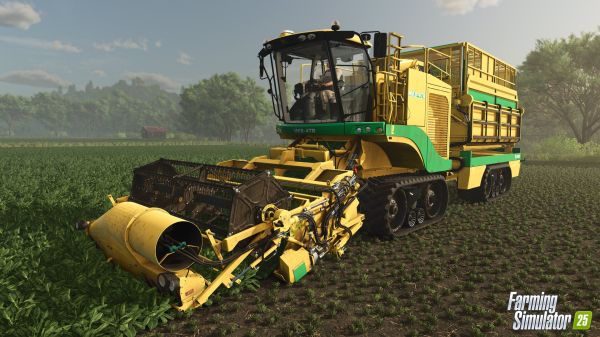
New field crops such as spinach, peas, and green beans provide additional reasons to diversify beyond familiar grains. Each crop brings different machinery, timing, and production opportunities, which helps prevent every season from following the same sequence. Specialized harvesters can be expensive, so adopting a new crop often requires careful calculation. The field may be ready, but the business must also be ready to collect it efficiently.
I found these crops most interesting when they supported a wider production plan rather than existing only as another commodity to sell immediately. Diversification can spread work across the calendar and reduce dependence on one market price. It also creates more complex equipment logistics because the farm needs tools that may remain unused for part of the year. The variety improves long-term play, even though learning the required machinery can initially feel overwhelming.
Field Preparation Remains the Core Ritual
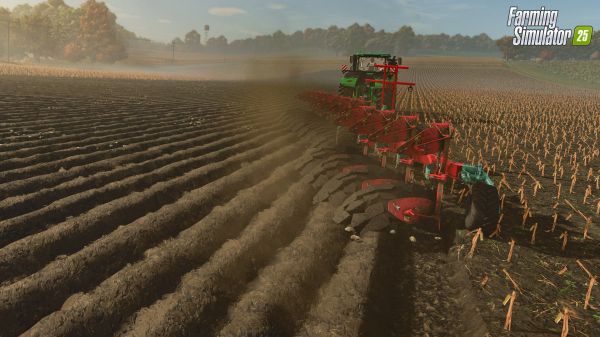
Most crops still depend on a familiar chain of preparation, planting, maintenance, and harvesting. Cultivating or plowing the soil, removing stones where necessary, applying fertilizer, managing weeds, and choosing the correct planting period can turn one field into a long-term project. These tasks may sound repetitive, but the satisfaction comes from watching an empty area move through several visible stages. The field becomes a record of the work already completed and the work still waiting.
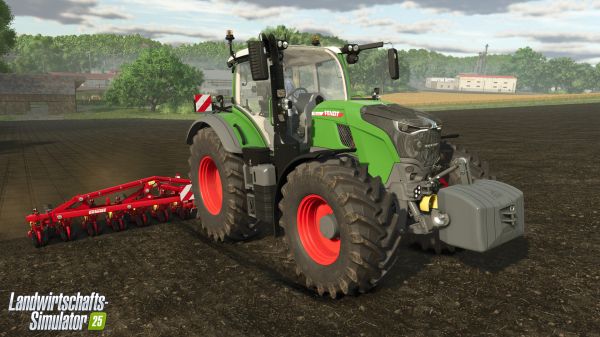
I enjoy this routine because every implement changes the sound, speed, and appearance of the job. A narrow cultivator makes progress slowly but may suit a small farm, while wider equipment improves efficiency at a much higher purchase price. The game constantly connects time with money. Better machinery does not simply look more impressive; it gives me back hours that can be spent expanding another part of the operation.
Seasonal Growth Gives Planning Real Consequences
Seasonal settings make the agricultural calendar one of the most important management tools. Crops need to be planted and collected within suitable periods, preventing me from treating every field as permanently available. Missing the correct window can delay income and disrupt production plans for an entire year. This makes preparation before the season more important than reacting after it has already started.
I enjoyed planning several fields around different harvest months because it distributed work more evenly. Planting everything at once may simplify the schedule, but it can also create a period where every machine and worker is needed simultaneously. A diversified calendar allows one harvester to serve several crops at different times. Farming Simulator 25 becomes much more interesting when I manage time as carefully as land.
Weather Is Beautiful Until It Threatens the Crop
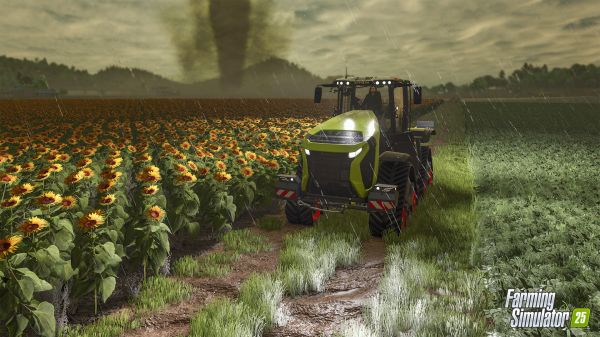
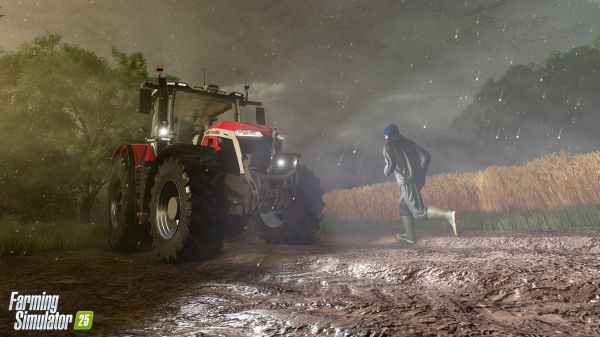
Dynamic weather gives the farm stronger visual variety and creates occasional practical problems. Morning fog, changing clouds, rain, and shifting light make familiar fields feel different throughout the day. Hail and severe weather events add more pressure because the environment can affect crops and disrupt planned work. The forecast therefore becomes more than decorative information in the menu.
I liked the atmosphere created by storms, especially when dark skies developed while machinery remained active in the field. The danger can feel inconsistent and less detailed than a full weather simulation, but it still changes the emotional rhythm of routine tasks. A calm harvest becomes more urgent when the conditions begin deteriorating. The farm feels more connected to nature because the player cannot control every variable.
Twisters Add Spectacle but Not Always Deep Strategy
Severe wind events are among the most dramatic additions because they can move through the map and affect the surrounding environment. Seeing one approach creates an immediate sense that ordinary work may need to stop. The event adds visual danger to a series usually focused on predictable machinery routines. It also helps the new engine demonstrate more dynamic atmospheric effects.
From a management perspective, I wanted these events to produce a deeper range of preparation and recovery decisions. They are memorable when they appear, but they do not completely transform the long-term farming systems. The spectacle is stronger than the simulation behind it. Even so, the possibility of severe weather makes the world feel less static than before.
Ground Deformation Makes Heavy Machinery Feel More Connected
Vehicle tires now leave more noticeable impressions in the soil, giving fields and muddy areas a stronger sense of physical response. The effect makes large tractors feel as though they have genuine weight instead of gliding over a flat visual surface. Repeated routes can produce visible tracks that remain for a time and give work areas a used appearance. This is primarily a presentation improvement, but it adds immersion during slow field operations.
I would not describe the system as a complete terrain simulation because the farm does not become an endlessly deformable landscape. The changes are controlled enough to preserve gameplay and performance across large maps. However, the visual connection between tire, soil, and weather makes machinery more convincing. Small physical details matter greatly in a game where I may spend an hour watching the same implement move across one field.
GIANTS Engine 10 Improves Atmosphere More Than Fundamental Physics
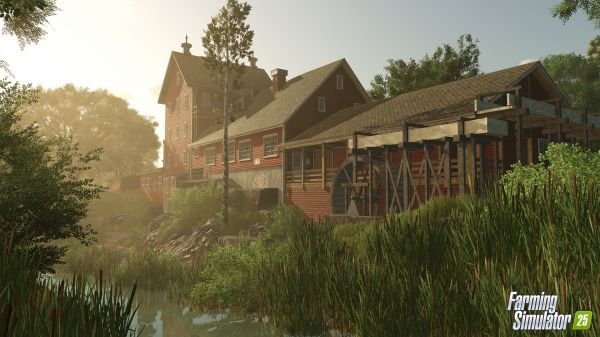
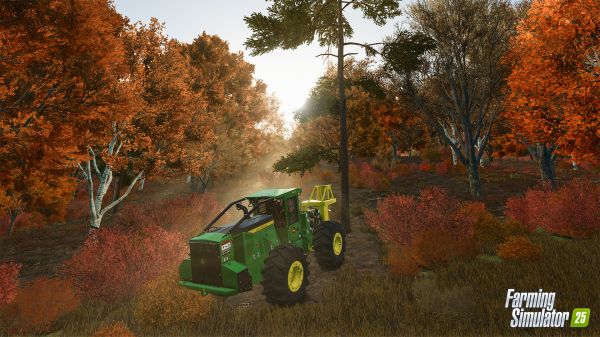
The updated engine brings better lighting, weather effects, vegetation, reflections, distance detail, and environmental presentation. Sunlight moving through morning mist can make a routine journey feel surprisingly cinematic. Fields appear denser, machines receive more convincing materials, and the maps benefit from stronger visual depth. The improvement is easy to notice when returning to an older entry immediately afterward.
Not every physical interaction has reached the same level of improvement. Vehicles and objects can still behave awkwardly when trailers, pallets, logs, or uneven terrain become involved. The series remains capable of producing accidental mechanical comedy when two objects collide in an unexpected way. Farming Simulator 25 looks more modern, but parts of its physics still reveal the familiar foundation beneath the new engine.
More Than 400 Machines Create a Wonderful Equipment Problem
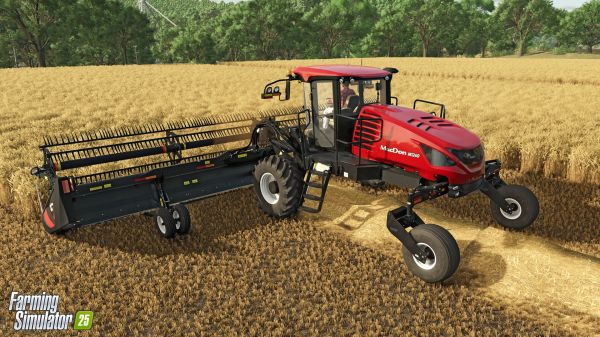
The machinery catalogue is one of the game’s greatest strengths and one of the most intimidating systems for a new player. Tractors, harvesters, trailers, seeders, cultivators, sprayers, forestry tools, animal equipment, transport vehicles, and specialized machines appear across numerous real-world brands. Every category contains different working widths, power requirements, capacities, and price levels. Choosing equipment becomes a practical puzzle rather than a purely cosmetic preference.
I spent a surprising amount of time comparing specifications before purchasing anything expensive. A powerful tractor provides flexibility, but it may consume more money and fuel than the current farm needs. A wide implement improves field efficiency, but only if the tractor can pull it comfortably and the roads can accommodate it. The garage becomes a strategic system because every machine should justify its storage space and operating cost.
Brand Variety Adds Authenticity Without Changing the Basic Goal
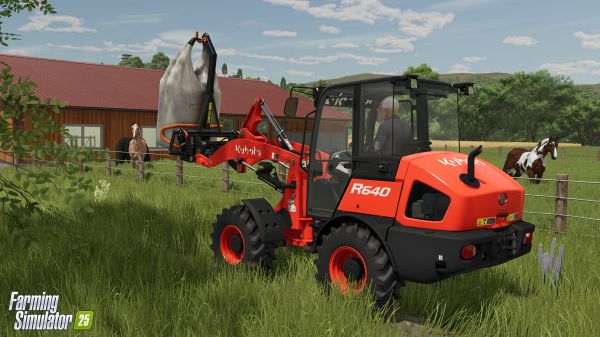
Recognizable manufacturers give the equipment catalogue much of its identity. Machines from John Deere, CLAAS, Fendt, Case IH, Kubota, New Holland, Massey Ferguson, Valtra, and many other brands arrive with distinctive cabins, controls, sounds, shapes, and color schemes. Fans of agricultural equipment can build fleets around personal preferences, while newcomers can discover brands through practical use. The licensing creates a digital machinery showroom inside the simulation.
Most brand differences are expressed through specifications and presentation rather than completely unique mechanical systems. Two tractors with similar power may perform related tasks despite looking and sounding different. I did not see this as a weakness because the choice still affects price, handling, size, and emotional attachment. Owning a favorite machine makes repetitive fieldwork more enjoyable even when another model could complete the same job.
GPS-Assisted Steering Is a Major Quality-of-Life Improvement
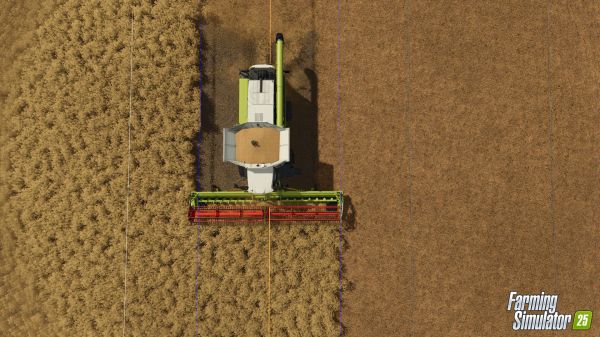
GPS guidance helps maintain clean, parallel routes across fields and reduces the constant need for tiny steering corrections. This is especially useful with wide equipment because one poor angle can leave unworked strips or create unnecessary overlap. Activating guidance allows me to focus more on speed, turning, and the next field operation. The feature makes precision feel accessible without requiring external modifications.
I enjoyed using it during long repetitive jobs because it reduced physical fatigue while preserving control. The system does not perform every action automatically, and I still need to align the machine and manage headland turns. It feels like practical agricultural technology rather than a shortcut that removes gameplay. For returning players, built-in guidance is one of the clearest improvements to everyday work.
Helpers Are Useful Until the Field Becomes Complicated
AI workers can take over repetitive jobs, allowing me to manage several areas of the farm simultaneously. A helper can cultivate one field while I deliver grain, care for animals, or prepare another machine. This makes larger operations possible without requiring multiplayer partners. The cost of hired labor also prevents automation from becoming completely free.
Worker behavior remains inconsistent around irregular fields, narrow entrances, obstacles, and complicated equipment. A helper may stop unexpectedly, leave sections unfinished, or choose a route that creates unnecessary delays. GPS and improved automation make certain tasks smoother, but they do not eliminate supervision. I treat helpers as useful employees who still require occasional rescue rather than perfect autonomous farmers.
Contracts Provide Structure Without Forcing a Career Path
Contract work gives me temporary access to jobs on fields owned by other farmers. These tasks provide income, equipment experience, and a reason to explore unfamiliar parts of the map. Borrowing machinery can also introduce tools I have not yet purchased. Contracts are especially valuable during the early game when my own fields are waiting for crops to grow.
The system becomes repetitive because many jobs follow the same fieldwork routines used on my own land. However, that repetition is appropriate for a farming simulation where work itself forms the central loop. I enjoyed selecting contracts that fit the machinery already available and avoiding those requiring inefficient travel. They become another part of time management rather than isolated missions.
Animal Farming Adds a Daily Routine Beyond the Fields
Livestock changes the farm from a seasonal operation into a business requiring more regular attention. Animals need food, shelter, and appropriate management while producing milk, wool, eggs, manure, slurry, or other useful resources. Their output can feed additional production chains, creating a stronger connection between different agricultural systems. A field may grow crops specifically to support livestock rather than direct sale.
I liked how animals provide continuity during months when major fieldwork becomes limited. Checking feed levels, moving products, and expanding enclosures gives me smaller tasks between harvests. The system remains simplified compared with dedicated livestock simulations, but it provides enough management to influence farm planning. Animals make the property feel inhabited rather than functioning only as a collection of machines.
Goats Fit Naturally Into Smaller Operations
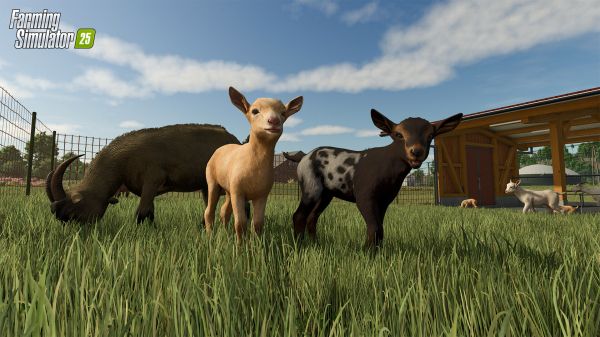
Goats add another livestock option that works well with a farm focused on dairy production and varied animal management. Their smaller physical scale and enclosure requirements give them a different visual presence from cattle. They can contribute milk to production systems while making compact farms feel more active. The animals are easy to appreciate even before their economic value becomes important.
I enjoyed including goats because they created another reason to build specialized areas instead of placing every animal inside one large industrial operation. Their management is not radically different from established livestock systems, but the additional choice supports farm identity. A player can create a property that feels more personal through the combination of animals selected. Farming Simulator 25 benefits from variety even when the underlying systems share familiar rules.
Water Buffalo Strengthen the East Asian Theme
Water buffalo are one of the most visually distinctive new animals and fit naturally beside rice-focused agriculture. Their size and movement give pastures a different atmosphere from ordinary cattle enclosures. They can become part of dairy and livestock production while reinforcing the regional identity of the East Asian map. The addition feels connected to the new setting rather than inserted randomly into the catalogue.
I wanted slightly deeper interaction between the animals and rice-farming environment, because the thematic connection is stronger than the mechanical one. Even so, building a farm around paddies, specialized machinery, and buffalo creates a style unavailable in earlier entries. The combination gives the sequel a recognizable visual signature. It is one of the best examples of new content supporting a coherent farming fantasy.
Young Animals Make Pastures Feel More Alive
The presence of younger animals adds visual variety and makes breeding progression easier to notice. Herds no longer appear composed entirely of identical adults from the moment they arrive. Watching animals develop gives livestock management a stronger sense of time. The improvement is small mechanically but meaningful for immersion.
I appreciated seeing different ages sharing the same enclosure because it makes the farm appear less like an automated production facility. The animals still follow relatively limited behavior patterns, so the system does not become a detailed life simulation. However, visual growth helps connect breeding decisions with visible outcomes. It adds warmth to a game otherwise dominated by machinery and financial calculations.
Custom Pastures Improve Farm Design Freedom
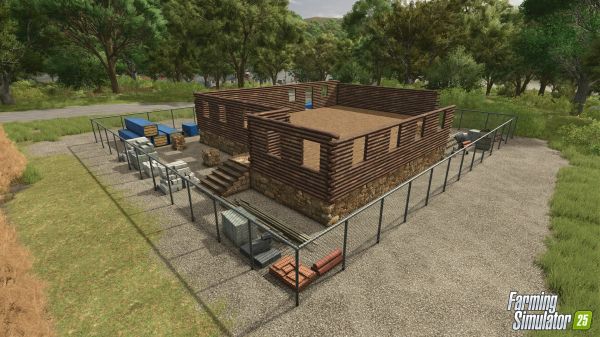
Pasture tools allow animal areas to fit the available property more naturally. Instead of relying entirely on fixed rectangular buildings, I can shape some spaces around terrain, roads, and existing structures. This makes the farm easier to personalize and helps avoid the appearance of identical prefabricated layouts. Designing where animals live becomes another part of property planning.
The construction tools still require patience because terrain, snapping, and object placement can create awkward results. A fence section may refuse to align exactly as imagined, while uneven ground can complicate a simple design. I often saved before beginning major construction because correcting mistakes could become expensive. When the system cooperates, it produces a far more believable farmyard than placing only standard buildings.
Production Chains Transform Crops Into Business Assets
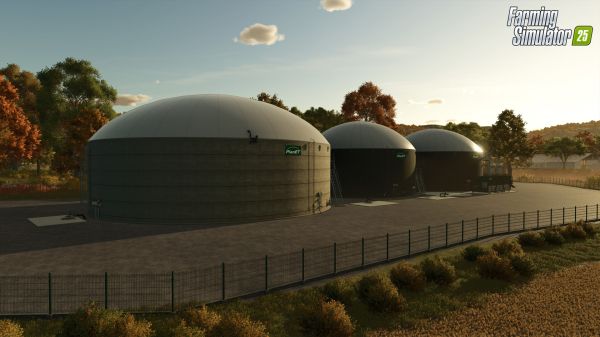
Selling raw crops immediately provides simple income, but processing them can generate greater value and create a more complex operation. Grain can move into mills and bakeries, milk can support dairy production, while other crops feed specialized factories and shops. Each chain requires transportation, storage, and attention to production capacity. Farming becomes the first stage of a wider commercial system.
I enjoyed gradually purchasing production points because they gave long-term purpose to expansion. A larger harvest was no longer valuable only because the market price increased. It could support another factory, create a new product, and justify buying larger transport equipment. The farm slowly develops into a regional business network rather than remaining one isolated property.
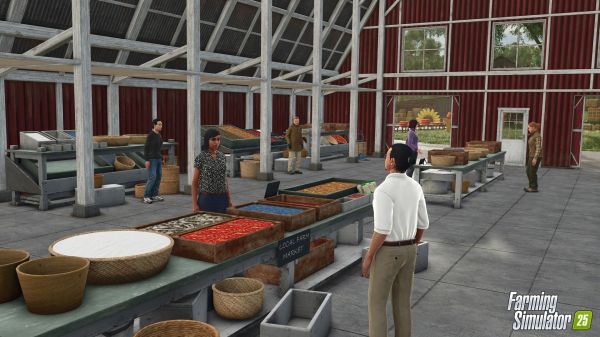
Farm Shops Give Finished Products a More Visible Destination
Farm shops make production feel more connected to the local economy. Instead of sending every item toward an anonymous selling point, I can build or support a location that displays the products created by the farm. This creates a satisfying visual conclusion to the production chain. The shop becomes evidence that raw crops have been transformed into a recognizable business.
The management remains relatively streamlined and does not become a detailed retail simulation. I am not designing shelves, hiring individual cashiers, or negotiating daily customer behavior. The system focuses on agricultural logistics and product value rather than store management. That limited scope keeps it compatible with the rest of the game while still expanding the sense of ownership.
Construction Projects Make the Region Respond to My Work
Some maps contain community projects that can be completed through deliveries and financial investment. These may involve restoring local sites, improving public spaces, or contributing to regional development. I liked having objectives that affected the environment beyond my own property. The farm becomes part of a larger community rather than a business operating in complete isolation.
The projects are not as dynamic as a full city-building system, but they provide visible results and additional reasons to produce specific materials. Completing one feels more meaningful than simply watching the bank balance increase. I would like future games to expand this idea with stronger changes to local traffic, businesses, and residents. Farming Simulator 25 provides a promising foundation for community-focused progression.
Forestry Remains Profitable, Difficult, and Occasionally Chaotic
Forestry offers a completely different work rhythm built around tree selection, cutting, processing, loading, and transportation. Specialized machinery can handle large volumes efficiently, but the initial investment is significant. Logs also have a reputation for behaving unpredictably when several physical objects interact. One poorly balanced load can turn a careful transport job into a long recovery operation.
I enjoy forestry most when I approach it as a separate business rather than a quick side activity. Preparing a work area, choosing suitable equipment, and processing trees systematically produces satisfying progress. Attempting the same work with inadequate tools creates frustration very quickly. The physics remain imperfect, but successful loading feels rewarding precisely because it demands patience.
Greenhouses Provide Reliable Income With Less Field Work
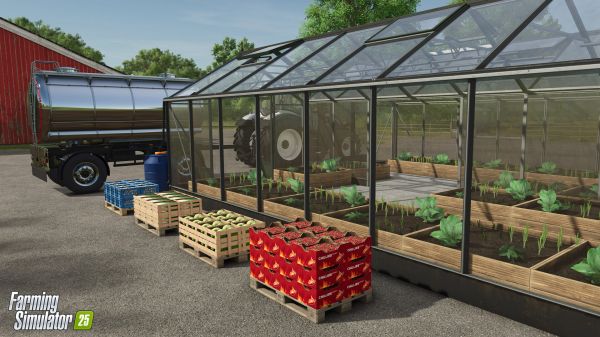
Greenhouses allow the production of vegetables and other goods without requiring a complete field cycle. They need resources and regular collection, but the work is less machinery-intensive than traditional crops. This makes them useful for smaller farms or players building a mixed business. Their predictable output can support income while larger fields move through seasonal growth.
I liked using greenhouses as financial stability rather than the central attraction of the farm. They generate useful products, but managing many of them can become a transportation routine involving repeated pallet movement. Automatic distribution reduces some of that work when connected to production chains. The system provides flexibility, although manual handling still reveals the game’s occasional object-physics problems.
Pallets Remain the Quiet Enemy of Large Production Farms
Moving pallets sounds simple until several finished products accumulate at once. Forklifts, front loaders, and trailers can handle them efficiently when alignment and physics cooperate. A slightly poor angle may cause a stack to shift, tip, or become difficult to secure. Logistics can therefore consume more time than the production process itself.
I developed greater respect for storage space and automatic distribution after several frustrating loading sessions. Organizing product flow before factories became busy prevented the farmyard from filling with objects. The game rewards planning here just as strongly as it does in the fields. A successful production empire depends on movement and storage, not only on producing the goods.
Transportation Makes Map Knowledge Valuable
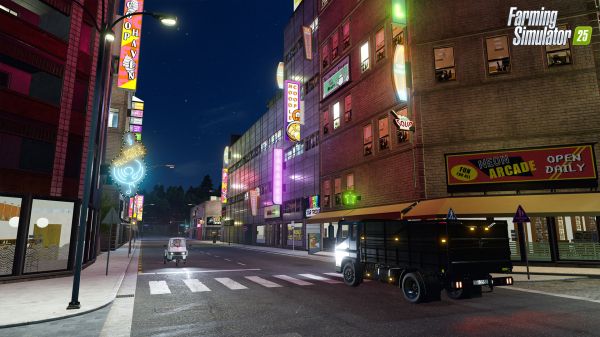
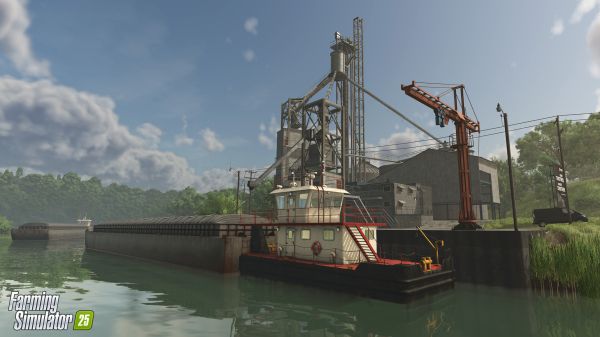
Large farms require constant movement between fields, shops, production buildings, animal areas, and selling points. The fastest route is not always the safest because narrow roads, traffic, bridges, and heavy trailers can complicate travel. I gradually learned which roads suited large equipment and where shortcuts created more trouble than they saved. Map familiarity improves efficiency in ways that cannot be purchased through upgrades.
Long drives can become repetitive, but they also create a sense of scale. A field located far from the main yard may be inexpensive yet costly to service throughout the year. Land value therefore includes travel time as well as purchase price. Farming Simulator 25 becomes more strategic when distance is treated as an operating expense.
The Economy Encourages Growth Without Making It Automatic
Income from crops and products needs to cover seeds, fertilizer, fuel, repairs, labor, loan payments, construction, and new machinery. A profitable harvest may look impressive until several seasonal expenses arrive together. I enjoyed this delayed financial pressure because it prevented one successful sale from solving every problem. Expansion remains tempting, but each new field or factory creates ongoing costs.
The difficulty settings allow the economy to become more forgiving or demanding according to personal preference. On easier settings, I can experiment with machinery and production chains without spending many seasons saving money. Harder economic conditions make leasing, contracts, crop choice, and market timing much more important. The flexible setup supports both relaxed sandbox play and a stricter business challenge.
Leasing Is One of the Most Important Financial Tools
Specialized machinery may be required for only a few days each year, making full ownership difficult to justify. Leasing allows me to complete a harvest or test a machine without spending the entire purchase price. The ongoing fees still matter, especially when equipment remains unused for too long. Returning machinery promptly becomes part of efficient planning.
I relied heavily on leasing during the early stages of new crop production. It allowed the farm to diversify before the garage had enough capital for permanent ownership. Once a crop became central to the business, buying the required equipment made more sense. The system supports gradual growth and prevents the machinery catalogue from becoming inaccessible to smaller farms.
Maintenance Gives Every Vehicle a Working Life
Machines accumulate wear through use, gradually affecting performance and repair costs. Keeping equipment in good condition adds another expense to long-term ownership. Older machines may remain useful, but they require a decision about whether continued maintenance is worthwhile. The garage therefore develops a history rather than functioning as a permanent collection of perfect vehicles.
I liked maintaining a few reliable tractors across several seasons because they became associated with the development of the farm. Replacing them was not only a statistical upgrade; it marked a new stage of the business. The maintenance model is simplified, but it gives ownership more meaning. Every machine represents both productive capacity and future cost.
Fuel Management Is Light but Still Part of Planning
Vehicles consume fuel during operation, requiring occasional refilling and creating another reason to organize the farmyard carefully. Running low in the middle of a distant field interrupts work and wastes travel time. The system is not demanding enough to dominate gameplay, but it reinforces the idea that machinery needs support. Large equipment cannot operate indefinitely simply because it has been purchased.
I often placed fuel access near the main equipment storage area to make refilling part of the daily routine. This small planning decision reduced interruptions during busy seasons. Farming Simulator 25 is filled with similar opportunities where organization saves more time than raw vehicle speed. Efficiency grows from dozens of small improvements rather than one major upgrade.
Multiplayer Turns Repetitive Work Into Team Strategy
Cooperative play allows several people to manage one farm or operate separate businesses within the same map. Tasks that take a long time alone can be divided between players, with one preparing fields while another transports products or manages animals. This makes large machinery fleets feel justified because several vehicles can operate simultaneously. Communication becomes important when shared money and equipment are involved.
I enjoyed multiplayer most when everyone accepted a clear responsibility without turning the session into rigid work. One person may prefer field operations while another enjoys production logistics or forestry. The game provides enough systems for different players to remain useful. A coordinated farm can grow rapidly, but one impulsive purchase can also create an excellent argument about financial management.
Multiplayer Creates Better Stories Than Formal Missions
The most memorable cooperative moments often come from mistakes rather than successful harvests. A trailer may become stuck, a machine may arrive without the correct attachment, or two players may discover they have prepared the same field unnecessarily. Solving these problems together gives the farm a shared history. The simulation provides enough physical systems for accidents to create natural comedy.
Dedicated groups can also build impressive operations that would require much longer in solo play. Watching several machines work the same harvest gives the game a sense of scale unavailable when one player switches between every role. The farm feels like a genuine business with departments instead of one person performing every task. Multiplayer is not required, but it reveals the full potential of the machinery catalogue.
ModHub Is Essential to the Game’s Long-Term Life
The official ModHub provides access to developer-tested community creations directly through the game. New vehicles, tools, buildings, maps, scripts, and quality-of-life features can expand the simulation far beyond the original catalogue. Mods allow players to recreate local farming styles, add favorite machinery, or change systems that feel too restrictive. The community effectively becomes an ongoing development partner.
I consider mod support one of the strongest reasons to remain with the series for hundreds of hours. The base game provides a broad foundation, while community content allows the farm to evolve according to personal interests. Console availability naturally differs from the freedom of PC modification, but the integrated browser keeps the process accessible. Farming Simulator 25 feels less like a fixed release and more like a platform that continues growing.
Mods Can Also Make Save Management Complicated
Installing many modifications introduces dependencies, conflicts, performance concerns, and the possibility that a future update changes compatibility. A save built around specific vehicles or buildings may become difficult to continue if one mod disappears. I learned to add content gradually and avoid downloading every attractive machine at once. A carefully managed collection produces a more stable farm.
The in-game testing process reduces risk but cannot guarantee that every combination will behave perfectly. Script-heavy modifications can influence performance or other systems in unexpected ways. Backing up important saves becomes worthwhile before major changes. Modding adds enormous value, but it also transfers part of the technical responsibility to the player.
The Tutorial Helps With Basics but Cannot Explain the Whole Simulation
Farming Simulator 25 attempts to be more approachable through guided starting options, interface improvements, and clearer assistance. New players can learn how to attach equipment, prepare fields, and complete basic crop cycles without studying every system immediately. The game is more welcoming than its enormous machinery catalogue suggests. However, understanding production chains, animal feed, crop calendars, and economic optimization still requires experimentation or outside reference material.
I appreciated the freedom to learn gradually because a complete tutorial covering every possibility would become exhausting. The problem appears when a small missing detail prevents an entire process from working. A machine may require a specific attachment, a crop may need another header, or a production building may be waiting for one overlooked input. The game could still improve contextual explanations when a player is clearly attempting the wrong setup.
The Shop Interface Requires Careful Reading
The vehicle shop organizes hundreds of items into categories, but finding the correct relationship between a tractor, implement, header, trailer, and crop can remain confusing. Compatibility icons and power requirements help, although they do not answer every practical question. I often examined equipment descriptions repeatedly before confirming a purchase. One wrong choice can be expensive enough to justify the extra caution.
The ability to customize tires, engines, colors, and accessories adds personality to purchases. These options can also increase cost without improving the immediate job significantly. I enjoyed creating visually consistent machinery fleets once the farm became profitable. During the early game, function mattered far more than appearance.
First-Person Cab View Creates the Strongest Machinery Immersion
Driving from inside the cabin changes fieldwork from an overhead management task into a detailed vehicle simulation. Mirrors, dashboards, controls, windows, and changing visibility make every machine feel distinct. GPS guidance becomes especially useful because maintaining a straight route is harder without the external camera. The slower perspective helps communicate the scale of large equipment.
I do not use cab view for every task because attaching tools, reversing trailers, and navigating tight spaces are easier from outside. Switching perspectives gives the best balance between immersion and efficiency. Long field passes are relaxing from the cabin, while complicated yard work benefits from a wider view. Farming Simulator 25 allows both styles without forcing one definition of realism.
Sound Gives Machines Much of Their Personality
Engine tone, hydraulic movement, equipment contact, tire noise, and changing load help distinguish one machine from another. A tractor working hard with a large implement sounds different from the same vehicle traveling empty on a road. These details create feedback even when the visual task changes very little. Repetitive work becomes more satisfying when the equipment responds audibly.
Environmental sound also supports the quieter rhythm of farming. Wind, animals, rain, distant traffic, and machinery from another field make the maps feel active without constant music. I often played with background radio or personal audio during long jobs, but the original soundscape remained important. The simulation benefits from allowing ordinary mechanical noise to become part of the atmosphere.
The Radio Helps During Long Field Sessions
Radio stations provide music and conversation while I repeat long passes across a field. This makes time-consuming work feel more natural because real machinery operators rarely perform every task in complete silence. The feature is easy to ignore for players who prefer environmental audio. For me, it became part of the routine during harvesting and cultivation.
The available selection can become repetitive across a very long career, especially when the same tracks return frequently. Personal playlists or internet radio options may provide greater variety where supported. The built-in system still adds useful atmosphere without requiring another application. It recognizes that farming includes long periods where entertainment and work coexist.
Visual Progress Makes Expansion Deeply Satisfying
A new farm begins with limited land, a small garage, and empty spaces that have not yet acquired a purpose. Over time, fields expand, buildings appear, roads become busier, animals fill pastures, and production goods accumulate. The property gradually becomes a visible record of financial decisions. This transformation is more satisfying than a conventional level number because I can drive through the result.
I enjoyed comparing the farm after several seasons with the simple operation that existed at the beginning. Every structure represented a period of saving or a crop that performed well. Mistakes also remained visible through awkward building placement or equipment purchased too early. The farm becomes personal because perfection is rarely possible without restarting.
Construction Tools Offer Freedom With Some Frustration
Buildings, roads, decorations, fences, storage areas, and production facilities can be placed to create a custom farmyard. Terrain painting and landscaping help connect new structures with the existing environment. The system supports impressive designs when enough money and space are available. It also makes one poorly planned placement extremely expensive.
Snapping, slopes, object collisions, and terrain changes can make precise construction difficult. A building may appear aligned from one angle and look awkward after placement. Undo options and stronger preview tools would reduce the fear of experimentation. I still enjoyed construction because it turns economic progress into a physical space I designed myself.
Collectibles Provide a Reason to Explore Beyond Farmland
Maps contain hidden items and points of interest that reward players for leaving machinery behind and examining settlements or remote locations. These collectibles provide extra money and reveal details that are easy to miss while driving quickly between jobs. They also make the map feel like a place rather than only a work surface. Exploration becomes a small break from agricultural routine.
The activity is simple and does not offer complex puzzles, but it supports players who enjoy complete map discovery. Community construction projects can give some collectibles a visible destination or display. I liked searching during quiet periods when no urgent fieldwork remained. The process adds variety without becoming mandatory for farm success.
Traffic Makes Roads Feel Active and Occasionally Irritating
AI vehicles create the impression that the map contains residents with their own routines. They also become obstacles when I am moving oversized equipment through narrow roads. Cars may stop in awkward positions, fail to understand a wide turn, or create a queue behind a slow tractor. This inconvenience is realistic enough to be amusing until an expensive trailer becomes stuck.
Disabling traffic provides a cleaner logistical experience, but the roads then feel strangely empty. I usually keep it active because the occasional frustration adds character to transportation. Better AI awareness around large agricultural vehicles would improve the system significantly. The world should respond to equipment size instead of treating every vehicle like an ordinary car.
Performance Depends Heavily on Map Complexity and Mods
The updated visuals and large machinery count can place meaningful demands on hardware, especially at high resolutions or with dense farms. Performance may change according to weather, number of vehicles, mirrors, object detail, production areas, and installed modifications. A new save often runs more smoothly than a property filled with equipment and buildings. Long-term farms therefore need practical graphics settings rather than only impressive initial benchmarks.
I prioritize stable frame pacing because uneven performance becomes noticeable while driving or aligning equipment. Reducing mirrors, shadows, vegetation distance, or other expensive options can help without destroying the overall atmosphere. The engine scales across a broad hardware range, but maximum settings are not necessary to appreciate the art direction. A consistent simulation feels better than one alternating between beautiful and sluggish.
The Simulation Still Contains Familiar Technical Oddities
Vehicles can become trapped, objects may behave strangely, workers can lose their route, and production items sometimes create awkward physical interactions. These problems are familiar to long-time players and occasionally become part of the series’ humor. They are less entertaining when a large investment or long task is disrupted. Saving regularly remains a sensible habit.
Updates have improved many issues, but the complexity of machines, maps, physics, multiplayer, and mods makes complete stability difficult. I can forgive occasional odd behavior because the broader sandbox remains functional. However, stronger object handling and AI logic would improve the experience more than another collection of machinery. The foundation is excellent, but certain weaknesses have followed the series for several entries.
The Game Is Relaxing Only When I Allow It to Be
Farming Simulator 25 can become a peaceful routine where I work one field, listen to the machinery, and watch the weather change. It can also become a demanding logistics business involving loans, production schedules, seasonal deadlines, animal feed, contracts, and vehicle maintenance. The player controls how much pressure enters the experience. Turning off selected systems creates a comfortable sandbox, while enabling everything produces a deeper management challenge.
I appreciate this flexibility because relaxation means different things to different players. Some people want realistic field preparation and difficult economics, while others want unlimited money and access to every machine. The game does not insist that one approach is more legitimate. It provides enough options for a quiet hobby and a serious long-term simulation to exist in the same package.
Progress Is Slow Enough to Make Machinery Meaningful
Buying a new harvester after several profitable seasons feels different from receiving one through a short mission reward. The machine represents time, planning, and successful operation. Its larger capacity or working width can transform future harvests and justify expanding into more land. Progress becomes satisfying because each upgrade solves a problem I have experienced personally.
The pace may frustrate players who want constant unlocks and immediate access to the largest equipment. Easier economic settings or sandbox options can reduce that waiting. I prefer a moderate pace where upgrades remain achievable without becoming automatic. The best purchases are the ones I have spent several hours wishing I could afford.
The Game Creates Goals Without Demanding an Ending
There is no single final mission that defines success for every career. I can decide to own all nearby fields, build a dairy empire, operate a forestry company, collect a favorite machinery brand, or create the most visually detailed farm possible. These self-defined objectives give the sandbox extraordinary longevity. The absence of an ending allows the farm to continue as long as I remain interested in improving it.
This freedom can also leave new players uncertain about what to do after learning the basic crop cycle. Contracts, production chains, livestock, and community projects provide possible directions, but the player must choose among them. Farming Simulator 25 is less motivating when I wait for the game to assign purpose. It becomes much stronger when I create a plan and use the simulation to pursue it.
What I Would Improve on the Next Farm
I would refine helper AI so irregular fields, narrow entrances, and complicated routes require less supervision. Better worker management would make large solo farms more practical without removing the need for planning. Object physics around pallets, logs, and stacked goods also deserve continued improvement. These systems create too much frustration in areas intended to reward careful logistics.
I would also expand the consequences of weather and community development. Severe events could involve more preparation, insurance, repair, and regional recovery, while completed projects could influence traffic, prices, or local activity. Deeper animal behavior would make pastures feel more dynamic and distinguish species mechanically. The game already contains a broad foundation capable of supporting these improvements.
Why I Continued Returning to the Fields
Farming Simulator 25 remained installed because it provides a type of progress few other games deliver. I do not save a kingdom, defeat a final enemy, or complete a dramatic campaign. I turn an empty property into a working agricultural business through hundreds of ordinary decisions. The satisfaction comes from knowing that every field, building, machine, and production line exists because I planned and financed it.
From my perspective as a gamer, the new East Asian agriculture gives this entry its strongest fresh idea. Rice paddies, water buffalo, specialized equipment, and a visually distinctive map create a farming style that feels different from the familiar European and North American routines. Spinach, peas, green beans, goats, and younger animals add further variety across the other regions. These additions expand the sandbox without weakening the recognizable Farming Simulator structure.
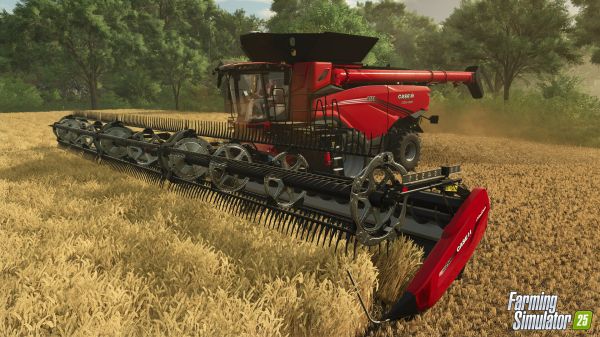
The machinery remains the heart of the experience. More than 400 vehicles and tools create an enormous range of possible operations, from compact family farms to industrial harvesting fleets. GPS-assisted steering makes fieldwork more comfortable, while realistic specifications turn each purchase into a strategic decision. I can spend as much time planning the equipment as actually operating it.
The updated visuals, atmospheric weather, morning mist, ground deformation, and denser environments make routine work more enjoyable to observe. GIANTS Engine 10 does not completely rebuild every physical system, and familiar technical oddities remain. However, the farm feels more alive than in earlier entries. The visual improvements matter because repetitive tasks depend heavily on atmosphere.
Production chains and farm shops give crops a purpose beyond immediate sale. A field can support animals, feed a factory, supply a store, or contribute to a larger regional project. This creates long-term goals and makes transportation an important part of the business. The farm gradually becomes a network of connected operations rather than a collection of isolated fields.
Multiplayer and ModHub support greatly extend the value of the package. Friends can divide responsibilities and operate machinery simultaneously, while community creations introduce vehicles, maps, buildings, and systems long after release. The base game is already broad, but mods allow it to become far more specific to individual farming interests. Few simulation series depend on their community this effectively.
The weaknesses are equally familiar. Worker AI can become unreliable, object handling remains frustrating, construction tools lack precision, and the large catalogue can overwhelm beginners. Repetitive contracts and long transportation routes may also become tiring without personal goals. Farming Simulator 25 improves the formula more than it reinvents it.
That gradual approach will disappoint players expecting a completely different agricultural simulation. For me, the series works because the core routine is already strong. Preparing a field, selecting a crop, watching it grow, organizing machinery, and finally moving the harvest into a larger production plan remains deeply satisfying. The sequel adds enough new systems to make that routine worth beginning again.
My favorite moment was not buying the largest tractor or finishing the most profitable harvest. It was driving back to the farm at the end of a long working day and seeing the entire property operating as one connected system. Animals had enough feed, factories were processing crops, another field was ready for planting, and the garage finally contained equipment chosen for a clear purpose. The farm looked ordinary, but every part of it represented a decision I had made.
Farming Simulator 25 understands that slow progress can be powerful when the player controls its direction. It gives me land, machines, crops, animals, weather, and an economy, then allows me to decide what success should look like. Some days involve careful business planning, while others involve driving one tractor in a straight line and enjoying the sound of the engine. Both experiences belong naturally inside the same simulation.
Pros:
- Extensive mod and customization support allowing for a personalized gameplay experience
- High-fidelity graphics and dynamic environments that enhance visual appeal
- Engaging and detailed career mode with progressive challenges
- Robust multiplayer modes and active community engagement
- Intuitive interface with user-friendly controls that facilitate smooth gameplay
- Immersive and realistic simulation experience that draws players into agricultural management
Cons:
- Steep learning curve for beginners due to intricate game mechanics
- Lengthy initial installation and update process can deter new users
- Occasional performance dips when multiple mods are active









Recent Reviews

Minecraft

Grand Theft Auto V

Toca Boca World

Roblox

Leave a comment
Your comment is awaiting moderation. We save your draft here
0 Comments