Review
Red Dead Redemption 2 did not win me over through its gunfights, horses, or enormous map alone. What stayed with me was the feeling tha...
Journey Through the Untamed Frontier: Exploring the Artistry of Red Dead Redemption 2
Red Dead Redemption 2 did not win me over through its gunfights, horses, or enormous map alone. What stayed with me was the feeling that almost everything in its world was already disappearing before I arrived. The Van der Linde gang still talks about freedom, loyalty, and one final escape, but every town, railway, factory, government agent, and expanding road suggests that their version of the frontier has no future. The game turns that inevitable decline into both a personal tragedy and one of the most convincing open-world journeys I have played.
I initially struggled with its deliberate pace because movement is heavy, animations are long, and routine actions demand more attention than they would in a conventional action game. Arthur Morgan does not instantly collect every object or turn with perfect responsiveness, and the camp cannot be treated as a decorative menu between missions. After several hours, that resistance became part of the experience rather than an obstacle. Red Dead Redemption 2 wants me to feel the physical effort behind travel, work, violence, and survival, even when that commitment occasionally creates unnecessary inconvenience.
Arthur Morgan Carries the Entire Story
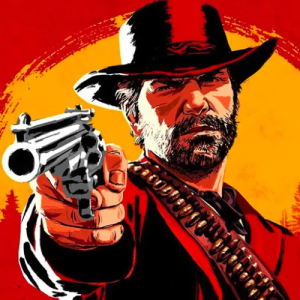
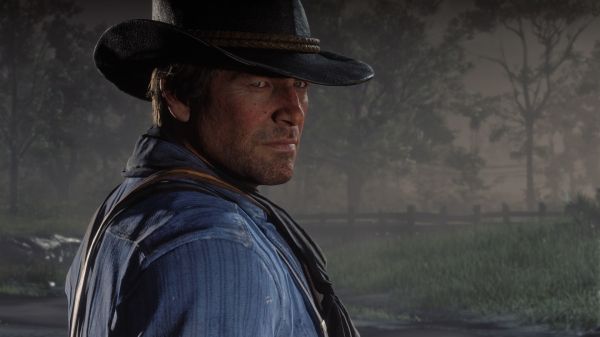
Arthur Morgan is one of the most carefully developed protagonists I have encountered in a large commercial game. He begins as a capable enforcer who has spent years accepting Dutch van der Linde’s ideals without examining them too closely. Arthur can be intimidating, sarcastic, practical, and surprisingly gentle depending on the situation, yet those qualities never feel like unrelated personality settings. His contradictions make sense because he is a man who understands the brutality of his life long before he fully accepts what that brutality has made him.
The performance gives Arthur a sense of interior life that exists beyond the player’s immediate choices. His pauses, tired expressions, quiet observations, and changing tone reveal thoughts that the dialogue does not always state directly. I could choose honorable or selfish actions, but the central emotional journey remained coherent because Arthur’s growing uncertainty was written into the story itself. The game allows role-playing without turning him into an empty character waiting for me to provide a personality.
Arthur’s journal is especially effective because it reveals a more reflective side than the gang usually sees. His drawings, notes, and reactions make exploration feel connected to character development rather than to completion percentages. A strange animal, isolated cabin, or brief conversation may become meaningful because Arthur records it in his own way. The journal quietly transforms the map into a record of what he noticed before time ran out.
Dutch van der Linde Is More Than a Charismatic Leader
Dutch dominates the gang through language as much as authority. He speaks about freedom, family, loyalty, civilization, and the promise of a better life somewhere beyond the next robbery. His plans repeatedly depend on everyone believing that failure is temporary and that one more act of violence will finally purchase independence. The tragedy is that his speeches contain enough truth to remain persuasive even as his decisions become increasingly destructive.
I found Dutch most compelling when the game allowed him to be genuinely warm. He is not introduced as an obvious fraud who somehow controls a group of foolish followers. Arthur, Hosea, John, and the others have real memories of being protected, educated, and given a place inside a community. That history explains why leaving him is emotionally harder than recognizing that he has changed.
His decline is written through repetition rather than one sudden transformation. Every new disaster produces another promise, another enemy, and another reason why the gang must trust him more completely. Dutch gradually begins treating disagreement as betrayal because loyalty becomes the only proof that his identity still matters. Watching Arthur understand this process is painful because he is not only losing faith in a leader; he is losing the story that gave his entire life meaning.
The Gang Camp Feels Like a Community Before It Becomes a Prison
The camp is one of the game’s most important locations because it turns supporting characters into people rather than mission providers. Members sing, argue, cook, complain, tell stories, drink, work, and react to recent events. I often returned after a long trip and discovered conversations that had nothing to do with the main plot. These moments create a sense that the gang continues living when Arthur is not directly controlling the scene.
Early camps feel warm despite the poverty and danger surrounding them. The group shares food, children play nearby, and the dream of escaping together still seems possible. Contributing supplies and money reinforces the idea that Arthur is supporting a family rather than funding a generic upgrade hub. Even small improvements to food, medicine, and shelter make the camp feel more stable.
As the story progresses, the same shared space becomes increasingly uncomfortable. Conversations turn suspicious, several members withdraw, and Dutch’s presence changes from reassuring to oppressive. The camp layout may remain functional, but emotionally it begins shrinking around everyone inside it. Red Dead Redemption 2 uses the deterioration of ordinary camp life to show the gang’s collapse more effectively than any dramatic speech could.
The Opening Is Slow for a Reason
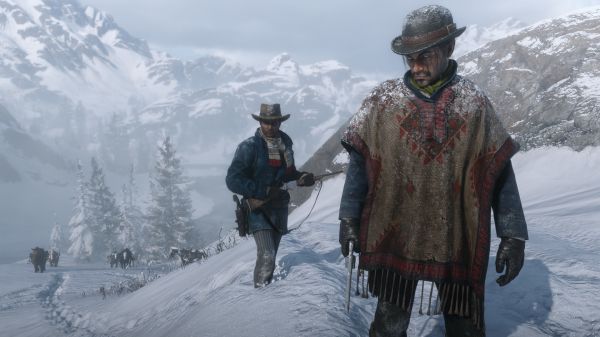
The snowy introduction is often criticized for being restrictive, and I understand why. Movement is limited, missions follow a controlled sequence, and the game introduces systems gradually while keeping the player away from the open world. On a second playthrough, these early hours can feel especially long because the freedom waiting beyond the mountains is already familiar. However, the chapter establishes the gang as a desperate group surviving one failure rather than as confident legends beginning an adventure.
The cold, hunger, exhaustion, and isolation create the correct emotional starting point. Arthur is already tired, Dutch is already promising recovery, and the gang has already lost people before I fully understand who they were. The opening teaches that decline is not a later twist but the condition under which the story begins. Every temporary success afterward exists inside that larger instability.
I appreciate the atmosphere even when the tutorial structure becomes heavy. Snow limits visibility, horses struggle through the landscape, and every shelter feels valuable. The game begins by reducing movement and comfort so that reaching the warmer open world feels like genuine relief. That contrast gives the first arrival near Valentine more impact than an immediate unrestricted start would have provided.
The World Feels Observed Rather Than Merely Constructed
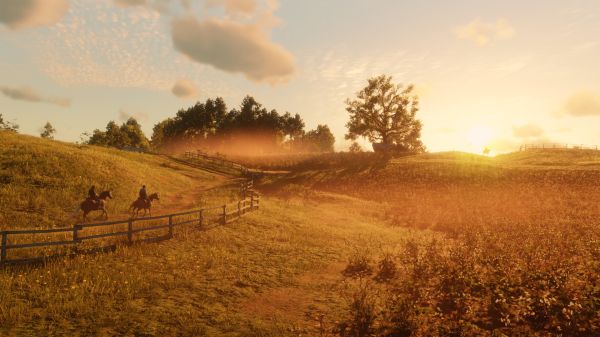
The map is impressive because its regions feel shaped by climate, history, labor, and settlement rather than by the need to contain evenly distributed activities. Forests contain logging operations, rivers support fishing and transport, railways cut through wilderness, and towns develop according to their local economy. The world often seems as though it existed before Arthur entered it. This makes exploration feel less like clearing content and more like moving through a place with its own past.
Environmental details rarely demand attention directly. A damaged cabin, abandoned camp, animal remains, distant argument, or unusual grave may reveal a story without adding a formal objective. I could ignore these discoveries completely, yet they make the landscape more believable because not everything is designed to reward me with a large marker or rare item. The world contains tragedy and humor that do not need Arthur’s involvement.
I particularly enjoyed how settlements communicate different versions of the changing frontier. Valentine feels muddy, energetic, and temporary, while Saint Denis represents industry, wealth, law, pollution, and social hierarchy. Rhodes hides old hostility beneath polite appearances, and isolated mountain communities feel removed from the institutions spreading across the country. Every region contributes to the central theme without becoming a symbolic display detached from ordinary life.
Saint Denis Represents the Future the Gang Cannot Escape
Saint Denis is visually and mechanically overwhelming after spending so much time in open countryside. Streets are crowded, traffic blocks movement, police response is rapid, and the city’s social divisions are immediately visible. Arthur looks physically out of place among trams, factories, mansions, markets, and formal institutions. The city demonstrates that the world is not becoming more civilized in a simple moral sense; it is becoming more organized, controlled, and difficult for people like the gang to navigate.
I enjoyed walking through Saint Denis more than riding quickly because the density rewards observation. Newspapers are sold, workers move between districts, wealthy residents occupy cleaner spaces, and poorer communities live near industrial pollution. Entertainment, politics, business, and crime exist beside one another rather than inside separated gameplay zones. The city feels like a functioning machine that does not care whether Arthur understands it.
The gang’s plans become increasingly desperate here because urban systems reduce the value of their older skills. Robbing isolated travelers is different from operating inside a city with telegraphs, organized police, witnesses, and concentrated wealth protected by institutions. Dutch continues talking as though boldness can overcome these changes. Saint Denis proves that the problem is larger than one failed plan.
Travel Is Intentionally Slow and Often Rewarding
Long rides are central to the rhythm of Red Dead Redemption 2. Missions often begin with extended conversations on horseback, while personal exploration requires moving through large distances without constant distractions. This pace gives the world room to establish mood and allows relationships to develop during ordinary journeys. I learned more about several gang members while riding beside them than during their formal story scenes.
The slowness can also become frustrating when I want to complete one specific task quickly. Fast travel exists but is less convenient than in many open-world games, and returning to a distant location may involve several minutes of riding. The cinematic camera can reduce the effort during safe routes, though it also distances me from direct control. Rockstar clearly values continuity and atmosphere more than complete convenience.
I generally accepted the travel because unexpected events made routes feel alive. A stranger may request help, an animal can appear near the road, or a distant sound may lead toward a small encounter. Not every journey produces something dramatic, which is important because constant interruptions would make the world feel artificial. The possibility of discovery is enough to keep familiar roads from becoming completely empty.
Horses Become Companions Through Routine
Horses are not simply vehicles with different speed values. They react to danger, require care, carry equipment, and gradually develop a bond with Arthur. Feeding, brushing, calming, and riding the same animal repeatedly creates attachment through maintenance rather than scripted dialogue. I became protective of my horse because it had survived journeys and encounters alongside me.
Different breeds and temperaments influence how a horse feels during travel and danger. A fast animal may still become nervous around predators or gunfire, while a more reliable horse can feel valuable even without the highest statistics. Saddles and equipment improve practical performance, but familiarity matters emotionally. Replacing a horse with a statistically stronger one can feel strangely disloyal.
The controls sometimes produce awkward situations near rocks, trees, fences, and crowded streets. Horses can misread the intended direction or collide with obstacles in ways that interrupt the otherwise natural movement. These moments are irritating because the game places so much emphasis on believable travel. Even with those problems, few open-world games have made me care so much about the animal carrying me between objectives.
Gunfights Are Cinematic but Mechanically Conservative
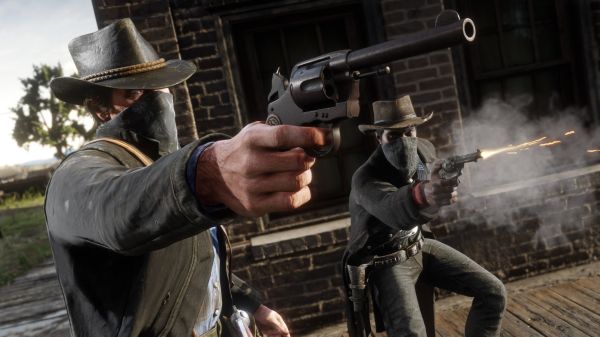
Shooting follows a familiar Rockstar structure built around cover, assisted targeting, weapon selection, and large groups of enemies. Guns sound powerful, impacts are dramatic, and the detailed animation makes each encounter feel physical. The combat supports the western fantasy effectively without offering the precision or tactical complexity of a dedicated shooter. I often enjoyed how fights looked more than the decisions required to win them.
Dead Eye gives Arthur a substantial advantage by slowing time and allowing precise targeting. The mechanic is visually satisfying and fits the image of an experienced outlaw, but it can reduce difficult encounters to repeated resource use. Health tonics, ammunition, and cover provide enough safety that many story gunfights become manageable even when Arthur is heavily outnumbered. Narrative danger and mechanical danger do not always match.
The strongest fights use environment, movement, and story context rather than relying only on enemy numbers. Escaping through a burning location, protecting a moving group, or fighting during a chaotic robbery gives the gunplay a clearer purpose. Repeated waves of opponents can eventually feel excessive, especially when the story presents the gang as vulnerable immediately after Arthur has defeated an entire army. The game’s realism is selective whenever cinematic action becomes the priority.
Weapon Maintenance Adds Texture but Limited Strategy
Weapons become dirty through use and exposure, reducing their performance until Arthur cleans them. The system supports the game’s physical approach because guns are treated as objects requiring care. Cleaning a favorite rifle before a major trip fits naturally into camp preparation. It also gives weapon condition visible and statistical meaning.
The mechanic rarely creates a difficult decision because cleaning supplies are easy to obtain and the process is straightforward. Once I formed the habit, maintenance became another repeated interaction rather than a meaningful survival concern. A neglected weapon may perform worse, but the game rarely creates situations where repair resources are genuinely scarce. The system exists mainly to reinforce atmosphere.
Customization is more engaging because different barrels, sights, grips, metals, engravings, and finishes make weapons feel personal. I could build a practical hunting rifle, an elegant revolver, or an intentionally worn firearm suited to Arthur’s appearance. Most visual changes do not transform combat, but they deepen attachment to equipment. The guns become part of the character’s identity rather than disposable loot.
Hunting Is One of the Best Optional Systems
Hunting works because animals behave as part of the environment rather than appearing only inside marked activity zones. Tracks, sounds, wind direction, habitat, time, weapon choice, and shot placement influence the result. A poor approach may frighten the animal or damage the quality of the pelt. The process encourages observation and patience instead of immediate combat.
I enjoyed preparing for a hunting trip because it required different tools from a robbery or story mission. The correct rifle, ammunition, clothing, horse storage, and destination all mattered. Legendary animals added stronger structure without removing the importance of tracking. Their encounters felt like deliberate expeditions rather than ordinary map icons.
The crafting rewards connect hunting to camp upgrades, clothing, equipment, and visual progression. Completing a valuable set feels earned because the materials represent several successful trips. Some requirements become repetitive when a rare animal refuses to appear or the required pelt quality depends on a perfect encounter. Even then, hunting remains one of the most coherent systems in the game because every mechanic supports the fantasy it represents.
Fishing Provides a Different Kind of Patience
Fishing slows the game even further and asks for attention without urgency. Selecting bait, choosing a location, casting, and controlling the line creates a quiet contrast with robberies and gunfights. The activity is mechanically simple but benefits from the scenery and ambient sound. It gives Arthur an opportunity to exist in the world without immediately causing conflict.
Some story moments use fishing to develop relationships, making the activity emotionally more important than its rewards. Conversations can unfold without the pressure of travel or combat, allowing characters to reveal themselves naturally. These scenes demonstrate how well the game uses ordinary actions as a setting for writing. The activity becomes memorable because of who shares it rather than what is caught.
I would not spend hours fishing solely for mechanical depth, but it strengthens the larger experience. Red Dead Redemption 2 needs these slower activities because the story is partly about recognizing a life beyond violence. Hunting, fishing, caring for a horse, and sitting around camp show Arthur participating in a world he has spent years treating mainly as a resource. That change in attention supports his broader emotional development.
The Honor System Works Better as Tone Than Morality
Arthur’s honor changes through choices, behavior, and treatment of strangers. Higher honor affects prices, dialogue, reactions, and certain story details, while lower honor supports a more ruthless interpretation of the character. The system gives ordinary actions some continuity because helping someone may influence how the world responds later. It also encourages me to think about whether Arthur is becoming different from the man introduced at the beginning.
The morality can feel overly numerical when repeated greetings or small actions change honor visibly. Complex behavior becomes reduced to a scale that sometimes rewards easy correction after serious violence. The main story also requires Arthur to participate in acts that may conflict with a highly honorable playstyle. This tension reflects his life, though the mechanics do not always distinguish between narrative obligation and player choice elegantly.
I found honor most effective when it influenced atmosphere rather than functioning as a score. Music, dialogue, Arthur’s reflections, and the emotional framing of later scenes can change according to the path taken. These differences make the ending feel connected to how I played without rewriting the entire plot. The system is imperfect, but it gives role-playing meaningful emotional consequences.
Side Missions Often Contain the Game’s Best Writing
Stranger missions introduce inventors, artists, photographers, religious figures, criminals, scientists, performers, and ordinary people living at the edges of the main conflict. These stories can be humorous, disturbing, tragic, or unexpectedly gentle. They reveal parts of Arthur that the gang rarely encourages. Helping strangers becomes a way for him to experience relationships without Dutch’s ideology controlling the outcome.
Several side characters return over time, allowing short encounters to become small arcs. Arthur’s reactions may change as his own perspective develops, giving optional content a place inside the larger narrative. I appreciated that some missions do not end with money, combat, or a major reward. Their value lies in the conversation and the glimpse of another life.
The best side content also expands the historical setting. Scientific optimism, industrial exploitation, racial violence, entertainment, poverty, and cultural change appear through personal stories rather than textbook explanation. Red Dead Redemption 2 uses its world to examine the period without pretending that the frontier was equally free for everyone. These missions deepen the game far beyond its outlaw fantasy.
Random Encounters Make Repeated Travel Feel Personal
The world regularly presents roadside situations involving injured travelers, ambushes, escaped prisoners, animal attacks, robberies, and unusual strangers. These encounters may lead to rewards, information, future recognition, or immediate danger. The lack of a formal quest structure makes them feel like events Arthur discovered rather than content assigned to him. They give travel enough uncertainty to remain engaging.
Some encounters repeat, and experienced players eventually recognize their structure. The illusion weakens once I understand which situations lead toward predictable outcomes. However, context can still change the result because time, location, honor, equipment, and personal intention affect how I respond. A familiar encounter may become different when Arthur is injured, carrying a valuable animal, or being pursued.
I enjoy that helping someone can produce a later consequence in town. A person may recognize Arthur and offer a reward, making the world appear to remember small decisions. These connections are not always deep, but they create continuity across long sessions. The map feels less like a reset environment and more like a place where Arthur has left traces.
The Wanted System Creates Friction Between Freedom and Realism
Crimes can be witnessed, reported, investigated, and connected to Arthur unless he prevents identification or escapes quickly. Masks reduce recognition under certain conditions, while witnesses may be threatened or stopped before reaching authorities. This creates interesting moments where one mistake becomes a chain of increasingly desperate decisions. A minor robbery can produce a large bounty because I refused to accept the initial consequence.
The system is not always intuitive. Law enforcement may identify Arthur more quickly than expected, witnesses can appear in isolated locations, and officers sometimes respond with overwhelming force. The simulation wants crime to produce persistent consequences while the open world encourages experimentation. These goals occasionally conflict when a small action creates more punishment than the situation seems to justify.
I learned to treat bounties as part of the cost of being an outlaw. Paying them removes pressure, while leaving them active makes travel more dangerous through patrols and bounty hunters. This creates a practical consequence without permanently blocking regions. The system works best when it generates stories and weakest when its detection rules feel arbitrary.
Robberies Are More Restricted Than the World Suggests
The game presents Arthur as an experienced outlaw and fills the world with stores, trains, travelers, homes, and businesses. I expected a highly systemic robbery sandbox where detailed planning could create many approaches. Some activities support that fantasy, but the most elaborate robberies are usually tied to scripted missions. Ordinary crime is flexible enough to provide experimentation without matching the complexity implied by the narrative.
Train robberies can be exciting because passengers, guards, law response, movement, and escape routes create several overlapping pressures. Store robberies provide smaller opportunities, occasionally including hidden illegal businesses. Home invasions and gang tips add variety, though many are limited events rather than repeatable systems. The world gives the impression of unlimited outlaw possibility while carefully controlling the most dramatic versions.
I still enjoyed crime more when I created my own plan. Wearing a mask, selecting a remote location, preparing an escape horse, and leaving before law enforcement arrived made the action feel personal. The mechanics rarely support truly complex strategy, but they provide enough freedom for role-playing. A deeper systemic robbery structure could have made the open world even stronger.
The Mission Design Often Limits the Freedom of the Open World
Story missions are cinematic, carefully paced, and strongly directed. They provide memorable dialogue, location changes, set pieces, and character development. The cost of that control is a narrow tolerance for alternative approaches. Moving too far from the intended route or attempting an unexpected tactic can result in failure even when the action seems reasonable.
This contrast is one of the game’s most noticeable design tensions. The open world encourages improvisation, but missions frequently demand exact positioning, timing, and sequence. I may spend hours learning that the environment supports creative problem-solving, only to enter a story objective where creativity becomes a mistake. Rockstar prioritizes authored drama over complete systemic freedom.
I accepted the limitation because many missions are exceptionally staged, though it reduced replay value. Once I understood the required sequence, repeating it offered fewer surprises. More flexible objectives could have preserved the story while allowing the player to use knowledge gained from the world. The game sometimes feels like a freeform western interrupted by an excellent but rigid television production.
The Controls Are Detailed and Frequently Awkward
Arthur can interact with people, animals, bodies, containers, weapons, horses, camps, and environmental objects through a context-sensitive control system. The number of possible actions creates impressive physical detail. It also means that one button may perform different functions depending on position and current focus. Mistakes can be funny, frustrating, or disastrous when Arthur grabs the wrong object or threatens someone unintentionally.
Movement is intentionally weighty, but input delay and animation commitment sometimes go beyond believable physicality. Turning in small interiors, positioning beside a container, or selecting one object from a crowded space can feel unnecessarily difficult. The game often prioritizes the appearance of natural motion over immediate responsiveness. This choice supports immersion until it interferes with the action I clearly intended.
I eventually adapted by moving more slowly and waiting for prompts to stabilize. That behavior fits the game’s pace, though it should not be required for every simple interaction. Red Dead Redemption 2 is filled with advanced systems that can occasionally be harder to control than to understand. Its physical realism is both one of its greatest strengths and one of its most consistent sources of friction.
Animation Makes Ordinary Actions Feel Significant
Arthur physically searches drawers, skins animals, picks up objects, eats food, prepares camp, cleans weapons, mounts horses, and moves bodies. These animations create continuity between the character and the environment. Resources do not disappear into an abstract inventory the moment I approach them. The world feels tangible because actions occupy time and space.
The same detail can become exhausting during repeated tasks. Collecting several objects or looting multiple bodies takes long enough that efficiency becomes a concern. Some players will appreciate the consistency, while others will want a faster option after the atmosphere is already established. The game rarely compromises its animation philosophy for convenience.
I found the system most effective during emotionally important moments. Arthur’s physical condition, posture, and speed communicate changes that dialogue alone would not capture. The body becomes part of the narrative, especially when familiar actions begin feeling harder. Rockstar’s commitment to animation gives the story a physical dimension that few games attempt at this scale.
Food, Cores, and Weight Create a Light Survival Layer
Health, stamina, and Dead Eye use cores that influence regeneration and performance. Eating, resting, drinking, and maintaining Arthur’s condition support these systems. His weight can change according to habits, affecting appearance and certain statistics. The mechanics encourage basic care without turning the game into a demanding survival simulator.
I rarely experienced true scarcity because food and supplies are widely available. Tonics can compensate for poor preparation, and camp resources are easy to maintain once money becomes plentiful. The system therefore functions more as role-playing texture than as sustained difficulty. Arthur needs care, but neglect is usually inconvenient rather than catastrophic.
The light approach suits the story because strict survival demands could distract from missions and exploration. I enjoyed cooking at camp, sleeping during bad weather, and carrying suitable clothing because these actions made travel feel more intentional. The mechanics support immersion when used voluntarily. They become less convincing when the game’s abundant economy removes most practical pressure.
Money Loses Value Too Quickly
Early expenses make cash feel meaningful. Weapons, clothing, camp upgrades, ammunition, horse equipment, and bounties compete for limited funds. Robberies and treasure hunts therefore provide useful motivation. Arthur’s financial situation appears connected to the gang’s repeated need for one more successful score.
Later, money becomes abundant enough that ordinary expenses lose significance. The camp may continue speaking as though survival depends on donations while Arthur carries more wealth than most characters could imagine. This creates a visible gap between story urgency and player economy. The gang’s financial desperation becomes increasingly theatrical.
More meaningful long-term costs could have preserved economic pressure. Maintaining properties, supporting individual gang members, investing in large plans, or dealing with regional consequences might have given wealth additional purpose. Instead, money gradually becomes a way to remove inconvenience and purchase appearance. The emotional economy remains stronger than the mechanical one.
The Sound Design Gives the World Distance and Weight
Gunfire echoes across valleys, storms approach gradually, animals reveal themselves through movement and calls, and town noise changes according to density. The soundscape makes the world feel larger than the visible area. I often identified danger or opportunity through audio before seeing it. These cues support exploration without covering the screen in markers.
Music is used with remarkable restraint. Long journeys may contain only environmental sound, allowing specific songs to become more powerful when they finally appear. Several major story moments are inseparable from the music chosen for them. The soundtrack does not constantly instruct me what to feel, which gives its strongest appearances greater emotional force.
Voice acting is consistently excellent across the main cast and many smaller characters. Camp conversations feel natural because dialogue overlaps with movement and daily activity. Arthur and Dutch receive the most obvious attention, but even minor gang members possess recognizable speech patterns and emotional histories. The performances hold the large narrative together during sections where the plot itself becomes repetitive.
The Visual Detail Still Feels Extraordinary
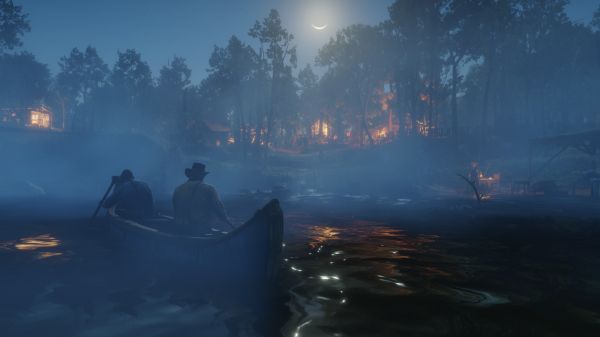
Landscapes, weather, animal animation, facial performance, clothing, mud, snow, water, fire, and lighting combine into one of the most convincing visual worlds in gaming. The game often creates remarkable scenes without formal cinematography. Riding into fog, watching a storm cross open land, or seeing Saint Denis emerge at night can feel as carefully composed as a cutscene. The visual direction remains impressive because it serves atmosphere rather than only technical demonstration.
Small details strengthen the illusion. Clothing becomes dirty, hair and facial growth change, animal bodies decompose, construction progresses, and towns respond to time and events. Not every system has deep gameplay consequences, but together they make the world feel persistent. The player is encouraged to notice change even when the game does not provide a reward for doing so.
The visual ambition also creates occasional inconsistencies. Animation errors, object clipping, abrupt character behavior, and unusual physics stand out more clearly inside such a polished environment. No open world of this scale can remain perfect under every interaction. Red Dead Redemption 2 comes unusually close to making imperfections feel like exceptions rather than the normal state.
The Chapter Structure Gradually Removes Comfort
Each chapter introduces a new camp and regional focus, giving the story a visible progression across the map. Early locations provide greater warmth and stability, while later camps feel increasingly isolated, hostile, or decayed. The gang does not simply lose members and resources; it loses spaces where ordinary life seems possible. Geography becomes part of the emotional decline.
I enjoyed how returning to earlier areas created nostalgia even within one playthrough. A former camp may be empty, but memories of conversations and activities remain attached to the location. The world continues while the gang moves on, emphasizing how temporary their presence always was. Their dream of a permanent home repeatedly collapses into another abandoned site.
The chapter pacing is not perfect. Certain sections introduce conflicts that feel separated from the strongest character material, while others contain repeated plans and failures that could have been shorter. However, the overall movement from hope toward inevitability is extremely effective. The structure gives the story the scale of a long novel rather than a conventional action campaign.
Guarma Is Visually Interesting but Structurally Disruptive
The Guarma chapter removes Arthur from the familiar world and places him inside a more concentrated sequence of conflict. The tropical environment is visually distinct and reinforces how far Dutch’s plans have moved from their original purpose. The gang is no closer to freedom despite reaching a distant island. Their problems follow because the real source of collapse is already inside the group.
Mechanically, the chapter feels more restrictive than the surrounding game. Exploration is limited, missions are heavily directed, and the open-world systems that define the main map become less important. The sudden change can feel like a detour during the period when the gang’s internal conflict is becoming most compelling. I appreciated its thematic role more than its playable structure.
The chapter also accelerates Dutch’s deterioration and Arthur’s changing perspective. Events become increasingly exaggerated, which reflects the group’s loss of control but can weaken the grounded tone established earlier. Returning to the main world provides relief and renewed clarity. Guarma is memorable, though not always for the same reasons as the game’s strongest regions.
John Marston Gives the Epilogue Necessary Purpose
The epilogue initially feels unusually long after the emotional intensity of Arthur’s story. John performs ordinary work, attempts to support his family, and struggles with habits that repeatedly threaten the life he claims to want. The pace returns to daily labor and domestic responsibility rather than immediate revenge. This can feel anticlimactic until the larger purpose becomes clear.
John’s section shows how difficult it is to build a future after surviving the gang. Freedom is no longer imagined as an untouched paradise beyond the reach of society. It becomes a house, stable work, family trust, and the discipline required to avoid returning to violence. These goals are smaller than Dutch’s speeches and far more real.
The epilogue also connects the game directly to the original Red Dead Redemption. Characters, locations, and unresolved relationships acquire additional weight for players who know what follows. The hopeful moments are complicated by that knowledge. The ending offers temporary stability without pretending that history has been escaped completely.
The Main Story Repeats Its Pattern Deliberately, but Not Always Gracefully
Dutch proposes a plan, the gang attempts it, complications emerge, violence escalates, and another retreat becomes necessary. This repetition communicates the leader’s inability to adapt and the gang’s dependence on hope. Arthur gradually recognizes the pattern while others continue believing that the next attempt will be different. The structure is thematically appropriate.
It can also make the middle of the story feel longer than necessary. Several missions reinforce ideas that are already clear, and the gang repeatedly survives action sequences that should make continued secrecy impossible. The narrative occasionally sacrifices credibility to preserve its large set pieces. A more selective campaign could have maintained the decline with less repetition.
I remained engaged because the character writing continued evolving even when the external pattern stayed familiar. Arthur’s relationships change, John begins separating from Dutch, and several gang members reveal where their loyalty truly lies. The repeated failures become a background against which these emotional movements occur. The plot is not always efficient, but the people inside it remain compelling.
Violence Becomes Less Exciting as Arthur Changes
The game initially presents robberies and gunfights as part of the outlaw fantasy. Weapons are satisfying, escapes are dramatic, and the gang’s confidence gives violence a sense of adventure. Over time, the same actions become heavier because their consequences are increasingly difficult to ignore. Arthur begins seeing victims, frightened families, and ruined communities rather than only obstacles.
This change is not always reflected in the mechanics because the player continues fighting large numbers of enemies. The story questions violence while missions repeatedly depend on it. That contradiction can feel hypocritical, but it also reflects Arthur’s inability to leave the only life he knows immediately. Understanding the harm does not automatically provide another way to survive.
The emotional framing becomes more important than the number of enemies defeated. Later gunfights feel desperate rather than triumphant, and familiar weapons carry a different meaning. Arthur’s changing relationship with violence gives the action a narrative progression even when the controls remain the same. The game uses repetition to reveal a moral change in how those actions are understood.
The Game Is About Loyalty Without Treating Loyalty as Virtue
Arthur has spent most of his life believing loyalty is the highest measure of character. Dutch uses that belief to keep the gang together, but loyalty gradually becomes a demand for obedience. Questioning a plan is treated as weakness, and protecting individuals can be interpreted as betrayal of the group. The story distinguishes caring for people from surrendering judgment to a leader.
Arthur’s most meaningful choices involve deciding who deserves his remaining time. He can continue serving Dutch’s increasingly unstable vision or help others reach lives beyond it. Loyalty becomes valuable only when directed toward people rather than ideology. This is a more mature treatment than simply celebrating the gang as a family.
The theme extends beyond Arthur and Dutch. John must decide whether loyalty to the past matters more than responsibility to Abigail and Jack. Hosea attempts to guide Dutch without abandoning him completely, while other members choose survival, power, fear, or personal advantage. The gang collapses partly because everyone defines loyalty differently once trust disappears.
Redemption Is Presented as Action, Not Forgiveness
Arthur cannot undo years of violence through a few honorable choices. The game never suggests that helping several strangers completely erases the damage he caused. Redemption instead becomes the decision to use limited time differently after recognizing the truth. The value lies in protecting a future Arthur may never share.
This approach makes the story emotionally effective because it avoids easy moral accounting. Arthur does not need everyone to forgive him, and he cannot demand that the world recognize his change. Several people continue seeing him as the dangerous outlaw he has always been. His transformation matters because he acts differently even when no reward is guaranteed.
The honor system sometimes simplifies this theme mechanically, but the writing remains stronger than the numerical scale. Arthur’s final decisions feel meaningful because they are made under conditions where personal survival is no longer the only priority. Redemption is not presented as escape from consequence. It is the attempt to prevent consequence from reaching others.
Online Play Does Not Match the Strength of the Story
Red Dead Online uses the same remarkable world and provides cooperative missions, competitive modes, roles, businesses, and free exploration. Riding with friends, hunting, trading, collecting, or participating in frontier activities can be enjoyable because the environment remains excellent. The shared world creates opportunities for spontaneous cooperation and conflict. It should have been one of the strongest long-term multiplayer settings available.
The experience never received the same sustained depth and narrative attention as the single-player game. Progression can become repetitive, economic balance creates frustration, and several roles rely on similar collection or delivery structures. The world feels capable of supporting much more than the available systems provide. Its potential is visible in nearly every session.
I consider Red Dead Redemption 2 primarily through Arthur’s story because that is where the design, writing, performance, and world fully support one another. Online play can extend time inside the setting but rarely reaches the same emotional or structural quality. The difference makes the single-player achievement even more impressive and the unrealized multiplayer potential more disappointing.
Its Realism Is Selective but Usually Purposeful
The game is frequently described as realistic because of its animations, animal behavior, maintenance, travel, weather, and physical detail. It is not realistic in every system. Arthur survives extraordinary gunfights, carries large amounts of equipment on a horse, and uses tonics to recover quickly. Rockstar chooses realism when it strengthens physical presence and abandons it when cinematic action requires flexibility.
This selective approach is generally sensible. A completely realistic western would make injury, travel, disease, and law response so punishing that the story could barely function. The game instead creates the feeling of reality through consistency and detail. I believe in the world even when individual mechanics are clearly designed for entertainment.
Problems arise when the commitment to physicality produces inconvenience without adding meaning. Long looting animations and awkward movement can feel realistic once and repetitive afterward. The best realism deepens attachment, as seen with horses, weather, and environmental change. The weakest version simply adds time between intention and result.
A Second Playthrough Feels Different Because the Ending Is Already Present
Replaying the game changes the meaning of early conversations. Dutch’s language, Arthur’s loyalty, John’s frustration, and Hosea’s concerns contain warnings that are easier to recognize once the outcome is known. Warm camp moments become painful because the temporary nature of the group is impossible to ignore. The story gains dramatic irony without depending on hidden twists alone.
I also noticed how often Arthur reveals discomfort before he can explain it directly. Small comments, journal entries, and reactions show that doubt existed long before the central crisis. His transformation is gradual rather than triggered by one isolated event. A second playthrough makes the writing feel more carefully layered.
The slower mechanics can be more difficult to tolerate when discovery is reduced. Long rides and restrictive missions provide less surprise, while the emotional context becomes richer. Replaying therefore requires greater patience but offers stronger character understanding. The world remains beautiful, though the narrative details become the main reason to return.
A Masterpiece That Is Not Always Enjoyable in the Conventional Sense
Red Dead Redemption 2 contains some of the best environmental design, character performance, animation, sound, and narrative development I have experienced in an open-world game. Arthur Morgan’s story gives the enormous production a personal center, while the collapse of the Van der Linde gang provides a tragic structure that extends across dozens of hours. The world feels observed, inhabited, and historically specific. Few games create such a convincing relationship between landscape and theme.
It is also slow, restrictive, mechanically uneven, and occasionally frustrating. Mission freedom is limited, controls can be awkward, gunfights rely on familiar design, and several realism systems become repetitive. The game demands patience without always rewarding that patience immediately. Players seeking constant action or effortless exploration may feel that Rockstar repeatedly interrupts fun in order to preserve its preferred pace.
I came to value that pace because it made attachment possible. Arthur’s horse mattered because of the journeys shared with it, camp mattered because of the hours spent among its people, and the changing world mattered because I had moved through it slowly enough to notice. The game does not rush toward tragedy because it needs ordinary life to exist before that life can be lost. Its length becomes part of the emotional design.
Red Dead Redemption 2 is memorable not because it lets me dominate the frontier, but because it shows how temporary that domination always was. Railways continue expanding, towns grow, institutions strengthen, and the wilderness becomes something to be mapped, owned, and controlled. Arthur cannot stop that process, save the gang, or completely repair his past. What he can do is decide what kind of man he will be while the world he understands disappears around him.
Pros:
- Stunning, highly detailed graphics that bring the world to life
- Fluid and responsive gameplay mechanics for both exploration and combat
- Expansive open world that encourages exploration and discovery
- Integration of a robust online multiplayer mode with community engagement
- Attention to minute details enhancing environmental storytelling and realism
- Rich, immersive narrative with deep character development
Cons:
- Occasional technical glitches and bugs during extended play sessions
- Complex controls and learning curve that might deter casual players
- High hardware requirements for optimal performance on PC









Recent Reviews

Minecraft

Grand Theft Auto V

Toca Boca World
Roblox

Leave a comment
Your comment is awaiting moderation. We save your draft here
0 Comments