
Review
My first hours in Farming Simulator 25: Highlands Fishing Expansion did not begin with a dramatic voyage or a record-sized catch. I arr...



Highland Harvests: Merging Farming and Fishing in a Simulation Revolution
My first hours in Farming Simulator 25: Highlands Fishing Expansion did not begin with a dramatic voyage or a record-sized catch. I arrived in Kinlaig, drove slowly past stone buildings and dark water, inspected several fields, and spent far too long deciding where a new farm should begin. The map immediately felt different from the broad, bright agricultural regions I had become used to because its personality comes from overcast skies, narrow roads, rocky slopes, and a coastline that always seems close enough to influence the weather. Before I had planted an onion or operated a fishing boat, I already understood that this expansion wanted farming to feel tied to a specific landscape.
Highlands Fishing is not a separate game and does not replace the central rhythm of Farming Simulator 25. I still prepare fields, purchase machinery, manage animals, transport goods, build production chains, and spend suspicious amounts of time deciding whether an expensive machine will actually save enough labor to justify its price. The expansion works by adding water-based production to that familiar structure rather than turning the series into a dedicated fishing simulator. This distinction matters because the strongest new systems are still about logistics, investment, equipment, and long-term planning, even when the product being moved is salmon instead of wheat.
Kinlaig Feels Like a Region Before It Feels Like a Sandbox
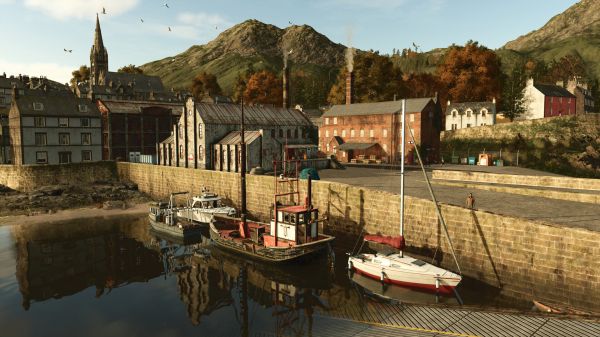
Kinlaig is the main reason I would recommend the expansion even to players who are only moderately interested in aquaculture. Its green hills, coastal roads, old stone structures, ruined castle, harbor, rough pastures, and heavy skies create a strong regional identity that influences how I plan a farm. Large flat spaces are less dominant than on some base-game maps, so buildings and fields need to respect slopes, road access, and the visual character of the area. I enjoyed working around the terrain because it made farm placement feel like a decision rather than a process of clearing one enormous rectangle.
The map also understands the value of distance. Fields, production points, construction projects, shops, and the harbor are spread widely enough that transportation becomes part of the experience, but the region rarely feels empty. Roads curve through landscapes that are attractive without becoming exaggerated tourist scenery, and the architecture creates a convincing relationship between farming, history, and coastal industry. I often chose a longer route simply because driving through the town or beside the sea made routine deliveries more pleasant.
There are practical inconveniences within that beauty. Narrow roads become awkward when I am transporting wide implements, while steep entrances and stone walls can make large machinery difficult to position. Some land looks useful from a distance but becomes less attractive once I examine access or building space. These frustrations fit the location, although players who prefer enormous flat American-style farms may find Kinlaig restrictive rather than atmospheric.
The Sea Is Not Decorative Anymore
Water has existed around Farming Simulator maps for years, but it usually functions as scenery, a boundary, or an obstacle. Highlands Fishing changes that relationship by making the sea a productive area connected to vehicles, fish management, transport, and income. I can now look at the coastline and see potential business rather than empty visual space. That change makes Kinlaig’s layout feel purposeful because the harbor and open water are tied directly to the expansion’s economy.
Operating boats creates a different physical rhythm from driving tractors. Acceleration feels slower, turns need more space, and approaching docks requires patience because water removes the firm visual references I rely on while positioning road vehicles. I enjoyed learning this movement because it gave the expansion a genuine mechanical identity instead of applying a fishing texture to ordinary land equipment. The boats are not complicated enough to become a serious maritime simulation, but they are different enough to make a trip offshore feel like a separate part of my working day.
The novelty does weaken after repeated journeys. Once I know the correct routes and docking positions, water transport can become another delivery cycle with fewer environmental variables than field work. I would have welcomed stronger waves, changing sea conditions, more demanding navigation, or additional reasons to plan around weather. The current system is relaxing and readable, but it rarely becomes dangerous or technically demanding.
Aquaculture Fits Farming Simulator Better Than I Expected
Fish farming sounds like a major departure from crops and livestock, yet its economic structure fits the series naturally. I need suitable facilities, input resources, equipment, transport capacity, and a plan for selling or processing the final product. Growth takes time, production efficiency matters, and the most profitable decision is not always the one that creates the most interesting routine. In other words, aquaculture becomes another business that rewards organization rather than quick reactions.
Salmon and rainbow trout provide different visual and production identities, but I spent more time thinking about capacity, supply chains, and transport than observing individual fish. This is consistent with Farming Simulator’s approach to animals, where management usually matters more than detailed biological simulation. I can breed, raise, harvest, and move fish through the system without needing specialist knowledge about water chemistry or disease control. That accessibility makes aquaculture easy to integrate into an existing career, though it also limits the depth for players hoping for a realistic fish-farm simulator.
The most satisfying moment comes when the whole operation begins functioning as one system. Feed or other required inputs arrive on time, fish production remains active, boats and transport vehicles are positioned correctly, and the output moves into a profitable chain without unnecessary waiting. Reaching that point requires investment and experimentation, which gives the new activity a stronger sense of progression than casual rod fishing. It feels like building a working enterprise rather than completing a side minigame.
Professional Fishing Is About Workflow, Not the Excitement of the Catch
Players expecting dramatic battles with individual fish should adjust their expectations. Professional fishing in Highlands Fishing is designed around Farming Simulator’s existing interest in machinery and production, so the main pleasure comes from operating equipment and managing output. I am more concerned with where fish are raised, how they are collected, and what happens after harvest than with the behavior of one animal beneath the surface. The system is calm, methodical, and closely related to other agricultural industries in the game.
This approach works for me because I play Farming Simulator to establish repeatable processes. I like purchasing equipment, discovering where a bottleneck exists, and changing my layout until fewer minutes are wasted between stages. Fishing gives me another type of production to optimize without abandoning the economic language of the series. It also provides a useful alternative when I want a break from field preparation or livestock routines.
The weakness is that fish can feel abstract. I wanted more visual feedback inside the facilities, clearer differences between growth stages, and stronger signs that I was managing living stock rather than numbers inside a production menu. Farming Simulator has always balanced representation and simulation selectively, but aquaculture exposes how much of the process remains hidden. The system works economically while sometimes feeling distant physically.
Shore Fishing Is Relaxing but Too Thin to Carry the Expansion
Casual fishing with a rod offers a slower and more personal contrast to the commercial systems. I can stand near the water, cast, wait, and enjoy a quiet activity without planning an entire industrial chain. The mechanic suits Kinlaig’s atmosphere because the map encourages me to stop treating every minute as an opportunity for maximum profit. Fishing from shore is pleasant when I want a short break between larger tasks or when I simply want to spend time near the coast.
The interaction itself is intentionally simple. It does not provide the lure selection, fish behavior, equipment customization, line management, or environmental complexity of a dedicated fishing title. That makes it accessible, but it also means the activity becomes repetitive quickly if I approach it as a major progression path. I enjoyed it as an atmospheric addition rather than a reason to purchase the expansion alone.
More species, location-dependent behavior, weather influence, and equipment upgrades would have helped casual fishing develop into a stronger secondary system. As it stands, it adds life to the coastline and gives my character something to do outside a vehicle. Its value is emotional and environmental more than mechanical.
Onions Turn an Ordinary Field Into a Specialized Project
The new onion crop gives land farming a clear reason to remain important within an expansion marketed around fishing. Onion production involves familiar preparation stages, but harvesting requires specialized steps and dedicated machinery. I need to plant during the correct seasonal window, manage weeds and fertilization, remove the haulms, and collect the crop using suitable equipment. The process is more involved than harvesting a standard grain and gives me another crop where machinery choice matters.
I liked onions because they create a compact chain of planning decisions. Specialized equipment is expensive, field size affects whether ownership or leasing makes sense, and the harvest period can become busy if onions are only one part of a larger farm. The machinery also looks and behaves differently from standard combines, which prevents the work from feeling like another texture applied to an old crop. Learning the sequence gives the first harvest a satisfying sense of preparation.
The crop becomes repetitive after the novelty fades, particularly if I plant large areas. Working widths and capacity limitations mean that harvesting can take a long time, while the process demands more attention than its eventual economic value may justify in every save. I enjoyed maintaining a moderate onion operation connected to production rather than converting half of Kinlaig into one enormous field. The crop is strongest as part of a diversified farm.
Onion Production Gives the Crop a Reason to Exist Beyond Selling It Raw
New production chains allow onions to become products such as soup, onion salt, and fried onions. These options matter because raw-crop profitability is only one way to judge whether specialized equipment is worth purchasing. Processing creates longer-term value and gives me a reason to coordinate crop storage with production capacity. It also makes the new crop feel integrated into the broader economic game rather than included only as a harvesting demonstration.
I enjoyed planning around processing because factories create their own bottlenecks. A large harvest is not automatically useful if storage fills faster than the production point can work, and a high-value product still requires transportation and selling strategy. The system encourages me to consider seasonal supply rather than harvesting and immediately disposing of everything. This is familiar Farming Simulator logic, but onions fit it well.
The production interfaces remain functional rather than visually exciting. I would like to see more physical activity around factories, more workers, and clearer external signs that processing is happening. As with many production chains in the series, much of the work occurs invisibly after I deliver inputs. The economic loop is satisfying even when the industrial environment feels quiet.
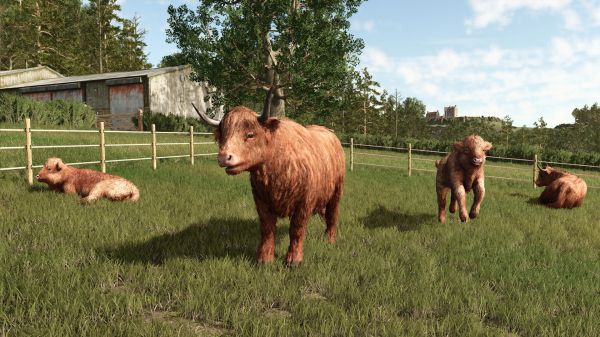
Highland Cattle Belong in Kinlaig Immediately
The shaggy Highland cattle are an obvious thematic choice, and they fit the map so naturally that they feel like part of the landscape rather than an expansion feature placed on top of it. Their coats, horns, and slower visual presence suit the rough grass and cool weather. Building a pasture near stone walls or open hills creates one of the expansion’s most convincing images. I often kept them because they strengthened the identity of my farm even when another livestock strategy might have been more profitable.
Management follows the broader cattle systems of Farming Simulator 25, so experienced players will understand feeding, breeding, housing, and output without learning a completely new interface. This makes the animals easy to add, though it also means they do not transform livestock simulation mechanically. The difference is mainly visual, thematic, and economic rather than a new system with unique health or behavior requirements. I was happy to have them, but I never felt that I was managing a radically different breed.
More breed-specific behavior would have improved their long-term value. Adaptation to rough grazing, different feed efficiency, weather resistance, or unique market conditions could have made them more than attractive cattle. They remain one of the expansion’s strongest aesthetic additions and one of its lighter mechanical ones.
The Machinery List Supports the Theme Rather Than Simply Inflating the Garage
Highlands Fishing adds more than twenty machines across land and water, with new brands including Monosem, Can-Am, Agri-Spread, and GT Bunning. The selection includes boats, tractors, utility vehicles, trailers, crop equipment, and implements supporting onions, livestock, transport, and general farm work. I appreciated that the list is not limited to fishing because a Kinlaig career still needs dependable machines for ordinary agriculture. Several additions feel selected specifically for the region’s narrow roads, mixed farming, and rugged terrain.
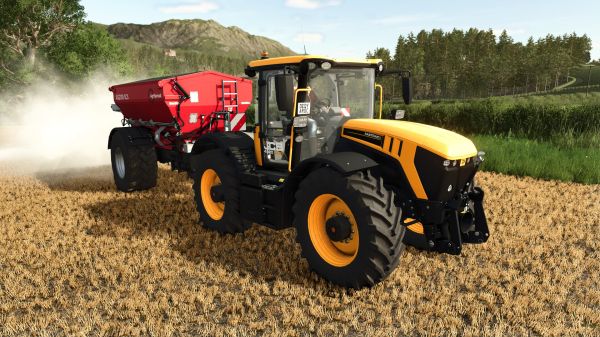
The JCB Fastrac models became especially useful during longer transport runs because their speed reduces travel time across the map. That performance is valuable in Kinlaig, where businesses and fields can be separated by winding routes. Can-Am vehicles are useful for scouting, light transport, and moving around areas where a full tractor feels excessive. The mixture gives me choices beyond purchasing the largest possible machine for every job.
Some equipment feels more essential than distinctive. Players with extensive ModHub collections may already have alternatives that perform similar roles, reducing the value of individual additions. The official machines benefit from consistent quality, proper integration, and recognizable branding, but the expansion’s equipment list is strongest when judged as a complete regional package. It supports a style of farming rather than introducing twenty entirely new mechanics.
The Boats Are Mechanically Important and Visually Awkward at Times
Driving a working boat out of the harbor is one of the clearest signs that Farming Simulator 25 has expanded beyond traditional land agriculture. The vessels have enough physical scale and equipment detail to make them feel like serious assets rather than novelty vehicles. Positioning them beside docks, moving through open water, and returning with productive cargo changes the visual language of my farm. The harbor begins functioning like a second machinery yard.
Boat handling remains forgiving, which helps prevent constant frustration. I can correct a poor approach more easily than I would in a realistic maritime simulator, and collisions rarely produce the severe consequences that their physical scale might imply. This keeps the system accessible but reduces the satisfaction of mastering navigation. Water work feels different from tractor work without becoming equally detailed.
Dock interaction can also feel awkward. Camera angles, collision boundaries, and the relationship between boats and fixed structures occasionally make simple positioning less smooth than expected. The system works, but it does not always possess the polished physical confidence of the game’s best land machinery. I learned to approach slowly and accept that elegance was optional.
Construction Projects Give the Map a Sense of Recovery
Kinlaig includes projects such as rebuilding the ruined castle and restoring a windmill. These tasks provide goals that are not tied only to purchasing more land or increasing annual profit. Delivering materials and seeing structures improve gives the region a visible sense of progression. I enjoyed these projects because they make my work affect the shared landscape rather than remaining inside the boundaries of my own property.
The restored windmill also gains practical value as a production point, which connects visual improvement with economic function. This is a good direction for the series because construction should change how a map operates rather than serving only as decoration. The castle project is more atmospheric, but it helps reveal the history and identity of Kinlaig. Together, these goals make a new career feel like participation in a regional revival.
I would like more projects of this kind and greater choice in how they are completed. Alternative designs, staged construction, community benefits, or competing priorities could create meaningful long-term decisions. The current projects are satisfying but largely linear. They demonstrate potential that the expansion does not explore fully.
Alasdair Gives the Harbor a Human Voice
Kinlaig includes Alasdair, a local character who shares information about the sea, fish, and the region’s history. His presence adds context to systems that could otherwise be introduced only through menus and tutorials. I appreciated having a recognizable person connected with the harbor because Farming Simulator maps can sometimes feel like large industrial spaces with very few people. Even limited conversation helps the region feel inhabited.
The character system remains modest, and I would not compare it with a narrative farming role-playing game. Alasdair does not develop through a large branching story or respond deeply to the changing economy. His role is closer to guide, local storyteller, and atmospheric anchor. Still, he represents an improvement over delivering every explanation through anonymous interface boxes.
I wanted more residents with distinct relationships to farming, fishing, tourism, and local development. Kinlaig’s architecture suggests a rich community, but the streets and businesses remain quiet. Additional characters could have made production decisions feel connected to people rather than markets alone.
Collectibles Encourage Me to Leave the Cab
Messages in bottles are scattered around Kinlaig and recorded in a ledger at the castle. Searching for them gives me a reason to explore areas that do not contain fields, production points, or obvious business value. I enjoyed these quiet detours because the map contains attractive coastal and historic spaces that I might otherwise pass at high speed. The collectibles also support the feeling that Kinlaig has a past beyond my current save.
The activity remains simple and can feel like a familiar open-world checklist. Finding a bottle does not require substantial puzzle solving, and the reward is more about completion and regional information than a new mechanic. It works best when discovered naturally during work rather than pursued through an external location guide. The moment I turned it into a systematic search, some of the charm disappeared.
Seasonal Decorations Make the Town Feel Less Static
Kinlaig changes its decorations during Halloween and Christmas, giving the settlement visible awareness of the calendar. These changes are small compared with the economic systems, but they make repeated travel through town more rewarding. Seasonal farming already influences crops and weather, so allowing public spaces to respond as well makes the year feel more complete. I especially liked seeing familiar streets gain a different tone without requiring me to place every decoration personally.
The effect also reveals how static the rest of the town can be. Decorations change, but traffic, residents, and public activity remain limited. I would welcome seasonal markets, changing shop activity, or local events connected with agricultural production. Visual decoration is pleasant, though a more active calendar could make Kinlaig feel genuinely alive.
The Economy Rewards Diversification but Does Not Demand It
Highlands Fishing gives me several new businesses, yet Farming Simulator still allows specialization. I can focus on fish, onions, cattle, traditional crops, forestry, or a mixed operation depending on starting capital and personal preference. Diversification becomes appealing because different activities fill different seasons and create multiple income sources. A farm with onions, aquaculture, livestock, and processing rarely leaves me without something useful to manage.
The game does not always balance every path equally. One production may generate stronger returns for less attention, while another requires expensive equipment and repeated transport for a modest improvement. I do not need perfect economic balance in a sandbox, but dramatic differences can discourage experimentation. I often chose activities because they suited the region rather than because a spreadsheet identified them as optimal.
This expansion is at its best when I role-play a believable Kinlaig farm instead of pursuing maximum profit. A coastal operation with fish, Highland cattle, onions, and local production feels coherent even if another strategy would grow money faster. The map and equipment give me enough thematic support to value identity over efficiency.
Multiplayer Makes the New Industries More Manageable
Cooperative play improves Highlands Fishing because land and water operations can continue simultaneously. One player can manage fields while another works at the harbor, and a third can transport materials between production points. The wider range of tasks gives a multiplayer group more meaningful ways to divide responsibility. Nobody needs to follow the same tractor across a field simply because only one major job is available.
Communication remains important because expensive machines and boats need coordinated purchasing. A group can waste money quickly by buying specialized equipment before deciding which business deserves priority. Shared planning creates satisfying operations when every player understands the production chain. It can also create the familiar Farming Simulator argument where one person buys a vehicle because it looks interesting and explains the economic logic afterward.
Technical synchronization is generally reliable, although large equipment collections, mods, and complex production networks can still create problems depending on platform and connection quality. Water operations add another environment where unusual positioning may become visible between players. I found multiplayer enjoyable, but I would still establish saves carefully before introducing a large mod list.
The Expansion Benefits From Farming Simulator 25’s Improved Ground and Weather
Kinlaig’s rough terrain, wet appearance, fog, clouds, and coastal atmosphere work well with the visual systems of Farming Simulator 25. Ground deformation and vehicle interaction help fields and roads feel used, especially when heavy machinery operates under poor conditions. Weather does not transform gameplay as radically as I would like, but it contributes strongly to the map’s identity. A sunny day in Kinlaig feels like a temporary event rather than the default setting.
The lighting can produce beautiful views over the sea and hills, particularly in the early morning or near sunset. At the same time, heavy cloud cover can flatten colors and make long sessions visually subdued. This is thematically appropriate but may not appeal to players who prefer bright, highly saturated maps. I enjoyed the restrained mood because it distinguishes Kinlaig from more cheerful agricultural regions.
Performance Is Solid Until the Farm Becomes Ambitious
The expansion requires an updated version of Farming Simulator 25, and overall stability benefits from patches released alongside and after the new content. Kinlaig performs well during ordinary play, though large farms, dense placeable areas, many vehicles, active productions, and complex mods can still reduce smoothness. The new water environments and boats do not fundamentally change the engine’s limitations. Performance remains tied to how much machinery and decoration the save accumulates.
I encountered occasional object interaction oddities, visual clipping near docks, and moments where workers or vehicle paths behaved poorly around narrow roads. Artificial intelligence remains more comfortable in open fields than in Kinlaig’s tighter spaces. Automated driving can save time on simple routes, but I supervise it more closely near the town, harbor, and steep entrances. The map’s personality sometimes exposes the weaknesses of navigation systems designed for easier terrain.
None of these issues prevented me from enjoying the expansion, but they affect how confidently I automate large operations. A map encouraging narrow roads and specialized transport needs strong worker behavior, and the game is not always dependable there. Manual driving remains the safest solution, even when my business has grown beyond what one player can manage comfortably.
The Expansion Is Substantial, but the Price Requires Commitment
Highlands Fishing is priced like a major expansion rather than a small machinery pack. In return, it includes a full map, aquaculture, shore fishing, boats, onions, Highland cattle, new production chains, construction projects, collectibles, and more than twenty machines. This is meaningful content, especially for someone beginning a new long-term career in Kinlaig. The value becomes weaker for players who only want to add fishing to an existing farm on another map.
The Year 1 Season Pass improves the calculation for players interested in the complete set of scheduled content. Buying the expansion alone makes more sense when Kinlaig and aquaculture are the main attractions. I would not recommend purchasing it only for rod fishing, one cattle breed, or the onion crop. The package earns its price through the combined regional experience rather than one isolated feature.
Mods also complicate value because Farming Simulator has an exceptionally active community. Free maps and equipment can provide hundreds of hours, sometimes matching official content in visual quality. Highlands Fishing justifies itself through new systems, official integration, and a coherent package that community additions cannot immediately reproduce as easily. Whether that is worth the price depends on how strongly the player values aquaculture and Kinlaig.
The Expansion Still Inherits the Series’ Old Habits
Highlands Fishing expands what I can produce, but it does not fundamentally change how Farming Simulator communicates information. Menus remain dense, production chains require checking percentages and capacities, and tutorials do not always explain every financial consequence clearly. New players may understand how to start fish farming without understanding whether their chosen scale will become profitable. External guides and experimentation remain part of the experience.
Non-player workers, traffic, and the general human population also remain limited compared with the detail given to machines. Kinlaig looks like a functioning region but often sounds and behaves like a quiet model railway. I can restore structures and operate major industries without creating much visible employment or social change. The simulation is deeply interested in equipment and only lightly interested in the communities surrounding it.
This is not a new criticism, but the expansion’s strong setting makes the absence more noticeable. I wanted the harbor to become busier as my fishing business grew and the town to respond when production increased. The game tracks economic success accurately enough while rarely showing its human consequences.
Who Should Buy Highlands Fishing?
I recommend Highlands Fishing to Farming Simulator 25 players who want a fresh long-term map, enjoy mixed farms, appreciate coastal environments, and are interested in building production chains beyond conventional crops. Aquaculture adds a new category of business, while onions and Highland cattle ensure that land operations remain relevant. Kinlaig is especially suitable for players who value atmosphere and regional farm identity more than enormous flat fields. Multiplayer groups also benefit from having several distinct industries available at the same time.
I would be more cautious recommending it to players who expect a detailed recreational fishing simulator or a complex maritime game. Shore fishing is a pleasant side activity, boat handling remains accessible, and fish management focuses on production rather than biology. Players satisfied with existing maps and free ModHub content may also find the standalone price difficult to justify. The expansion is strongest as a complete Kinlaig career, not as a collection of individual features added casually to an old save.
My Final Verdict
Farming Simulator 25: Highlands Fishing Expansion is a confident addition that makes the series’ world feel broader without abandoning its central interest in machinery, logistics, and gradual business growth. Kinlaig is the highlight, offering a rugged and visually coherent environment where roads, hills, fields, stone architecture, and coastline influence the shape of my farm. Aquaculture fits the economic structure surprisingly well, while boats give transportation a new physical rhythm. Onions, Highland cattle, production chains, construction projects, and regional machinery keep the expansion from depending on one novelty.
The package is less convincing when examined as a deep fishing simulation. Shore fishing is limited, fish management can feel abstract, boat handling is forgiving, and water conditions rarely demand advanced planning. Artificial intelligence still struggles with difficult routes, the town remains quieter than its architecture suggests, and the expansion inherits the base game’s dense menus and repetitive production cycles. Its value also depends on starting a meaningful Kinlaig operation rather than sampling each feature briefly.
I rate Farming Simulator 25: Highlands Fishing Expansion 8.6/10. It does not transform Farming Simulator into a maritime simulator, but it successfully adds another believable form of farming and gives it a map capable of carrying an entire career. I began by treating the sea as the expansion’s headline feature, yet Kinlaig itself became the reason I stayed, slowly building a farm where tractors, cattle, onions, factories, and fishing boats all looked as though they belonged under the same gray sky.
Pros:
- Realistic weather and water physics enhance gameplay immersion
- Extensive customization options with mods and cheats
- Detailed highland environment with vibrant visuals and audio
- Smooth installation and user-friendly interface
- Dynamic gameplay that balances strategy with relaxation
- Immersive blend of farming and fishing activities
Cons:
- Complex mod and cheat system may overwhelm newcomers
- Some features may feel repetitive for seasoned simulation fans
- Performance can suffer on lower-end devices









Recent Reviews

Minecraft

Grand Theft Auto V

Toca Boca World

Roblox

Leave a comment
Your comment is awaiting moderation. We save your draft here
0 Comments