
Review
My first serious journey in RV There Yet? lasted less than ten minutes before the motorhome became trapped sideways between two rocks....

Beyond the Highway: Exploring the Immersive World of RV There Yet?
My first serious journey in RV There Yet? lasted less than ten minutes before the motorhome became trapped sideways between two rocks. One friend insisted that the front wheels still had traction, another attached the winch to a tree at an angle that made the situation worse, and the person standing near the rear offered advice without touching a single tool. I was inside the vehicle trying to reverse while watching objects slide across the floor, and nobody could agree on whether the engine noise sounded healthy. That sequence explained the entire game more effectively than any tutorial could have.
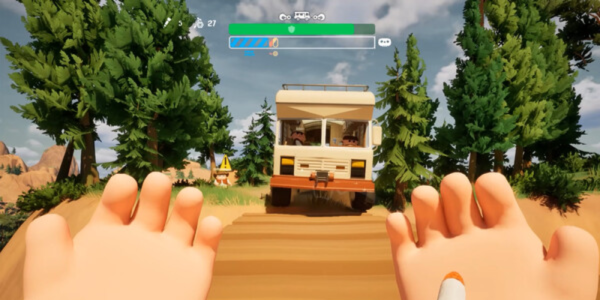
RV There Yet? is a physics-based cooperative road adventure about guiding one recreational vehicle through terrain that clearly does not want it there. The basic objective sounds simple: survive Mabutts Valley, follow the alternate route, and eventually find the exit to Route 65. In practice, every slope, bridge, river, animal encounter, and damaged component becomes a group problem that requires communication. The game is not primarily about driving well; it is about convincing several people to cooperate while a large, badly balanced machine slowly slides toward disaster.
The RV Is the Main Character and the Main Source of Conflict
The motorhome feels heavy, awkward, and vulnerable in a way that makes every successful climb satisfying. Acceleration is slow, steering requires planning, and the suspension reacts dramatically to rocks, holes, slopes, and careless driving. I cannot approach the vehicle like a racing car because momentum becomes dangerous quickly, especially when the road narrows or the terrain becomes uneven. The driver needs to think several seconds ahead while the rest of the group watches for threats the cabin view may not reveal.
The vehicle is also a shared living space filled with tools, supplies, food, furniture, windows, storage, and loose objects that react to movement. A sharp turn may send useful equipment sliding away from the person who needs it, while a rough descent can transform the interior into a moving pile of bottles and repair items. This physical clutter adds personality, but it also creates practical consequences because poorly stored equipment becomes difficult to locate during an emergency. I began organizing the interior carefully, then watched that organization disappear after one steep hill.
Driving Requires Patience More Than Speed
The safest approach is usually slow, deliberate, and visually unimpressive. I need to study the terrain, choose a line, maintain controlled momentum, and stop before a small mistake becomes an unrecoverable position. Fast driving can work on open ground, but confidence often leads directly into a hidden rock or sudden drop. The game repeatedly rewards drivers who are willing to leave the seat, walk ahead, and inspect the next section before committing the entire RV.
This creates an unusual rhythm where driving and scouting become equally important. One person may stand outside and guide the wheels around an obstacle while the driver responds to voice instructions with limited visibility. Clear communication matters because phrases such as “turn a little left” become useless when four players have different ideas about distance. I learned quickly that good directions need landmarks, timing, and enough calm to remain understandable while the RV is already moving.
The Winch Is the Most Important Tool and the Fastest Way to Start an Argument
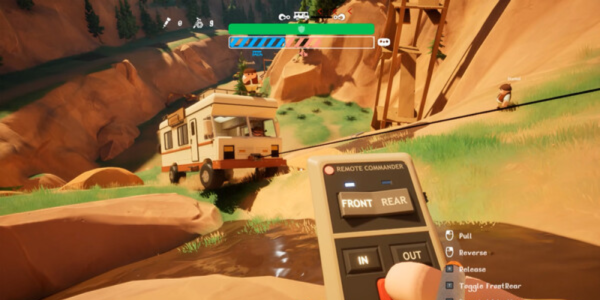
The RV has winches at the front and rear, allowing players to attach cables to trees, structures, and other useful points. This system can pull the vehicle up steep terrain, stabilize it near an edge, change its direction, or recover it after a poor driving decision. The physical behavior of the cable makes each solution feel improvised rather than automatic. A correctly placed anchor can save the run, while a bad angle can rotate the RV into a worse position.
Using the winch effectively requires coordination between the person controlling the cable and the person operating the vehicle. The driver may need to accelerate gently while another player adjusts tension and someone else watches the wheels. I enjoyed these moments because the group must develop a plan rather than rely on one skilled player to solve everything. The game becomes funniest when everyone has a different plan and most serious when the team finally chooses one.
Communication Is a Gameplay Mechanic, Not a Social Extra
Proximity voice chat changes how information moves through the group. Players near each other can communicate clearly, while someone scouting farther ahead may become difficult to hear. This creates natural roles because the person outside the RV must sometimes shout directions from a distance, and the people inside may not know what has happened until the scout returns. The system also makes panic more entertaining because voices become part of the physical scene.
A microphone is not technically the only way to play, but the game loses much of its personality without spoken communication. Coordination becomes slower through text, and many urgent situations require immediate instructions. The strongest sessions feel like a group road trip where mechanical problems, poor decisions, and private jokes become part of the same conversation. I rarely remember the exact route afterward, but I remember who gave the worst directions and who disappeared when repairs were needed.
Every Player Naturally Develops a Job
The game does not force a strict class system, yet groups quickly assign responsibilities. One player becomes the main driver, another handles the winch, someone manages food and supplies, and another scouts dangerous terrain or repairs damage. These roles are flexible, which prevents one person from remaining trapped in an unwanted task for the entire journey. The best teams rotate responsibilities while still respecting who is currently comfortable with each system.
The problem appears when one role becomes invisible labor. Organizing supplies, cooking food, and checking the RV’s condition may look less exciting than driving, but those tasks prevent later disasters. I appreciated how the game makes support work valuable without turning it into a separate menu. A player standing inside the vehicle with tools may contribute more than the person moving dramatically across the landscape.
Survival Systems Add Pressure Without Becoming a Full Simulation
Mabutts Valley contains environmental hazards, dangerous animals, health problems, and situations where players need burgers, antidotes, EpiPens, or other useful supplies. The survival systems are intentionally exaggerated and easy to understand. I do not need to manage realistic nutrition, body temperature, or complex medical conditions. Instead, the game uses recognizable items to create quick cooperative emergencies.
This approach keeps attention on the road rather than menus. A player may suddenly need help while the RV is already stuck, forcing the group to divide attention between recovery and survival. The absurd tone prevents these moments from feeling too severe, but losing a teammate can still affect the entire journey. Supplies become valuable because they protect the group’s momentum as much as individual characters.
The Bears Turn Quiet Exploration Into Immediate Panic
The valley’s animals are not decorative background elements. Bears can appear when the team is already distracted, forcing players to retreat, defend themselves, or move quickly. Their presence creates tension because the RV may not be ready to escape when the threat arrives. A badly positioned vehicle becomes much more frightening when the group no longer has unlimited time to plan.
I like how animal encounters interrupt confidence. After several successful sections, the team may begin acting carelessly, leaving doors open and supplies scattered outside. A sudden threat punishes that comfort without requiring a scripted cinematic sequence. The best encounters feel like consequences emerging naturally from the group’s current condition.
Cooking Burgers Is Ridiculous Until Everyone Needs One
The RV includes a grill, and food preparation becomes part of the group’s survival routine. Cooking is simple enough to avoid slowing the game, but it still requires someone to notice when supplies are low and prepare them before an emergency. I initially treated the grill as a comic object because the team was discussing burgers during a dangerous journey. Later, I appreciated how food created another reason for players to organize the interior and assign responsibilities.
The act of cooking also strengthens the road-trip atmosphere. The group is not travelling through the valley as a military unit or professional expedition. These are ordinary people attempting to survive with a recreational vehicle and whatever equipment they can manage. The contrast between domestic objects and dangerous terrain gives the game much of its identity.
Smoking and Drinking Fit the Tone but Will Not Appeal to Everyone
The game includes cigarettes and alcoholic drinks as interactive items, presenting them as part of its exaggerated middle-aged road-trip humor. These mechanics match the deliberately irresponsible personalities suggested by the character designs and dialogue. They contribute to the feeling that the group is making poor lifestyle choices while attempting an already questionable journey. I understood the joke, though it can become repetitive when players treat every item interaction as the main source of comedy.
This content also affects who will feel comfortable with the game. The presentation is cartoonish rather than realistic, but the humor still depends on substances and careless behavior. Players expecting a completely family-friendly cooperative adventure may be surprised. The game works best for groups that appreciate its specific style instead of expecting a neutral physics puzzle experience.
The Physics Create Better Stories Than Scripted Missions Could
Most of my memorable moments came from systems interacting unexpectedly rather than from prepared story scenes. The RV might slide because the ground is wet, rotate because the winch is attached poorly, or become unstable after one wheel climbs a rock. Loose objects move inside, players fall, doors open, and several small problems combine into a situation nobody planned. These events feel personal because the team caused them through its own choices.
Physics-based comedy is difficult to balance because too much unpredictability removes responsibility. RV There Yet? usually keeps enough control for me to understand why something went wrong. I may not predict every movement, but I can identify the careless turn or bad anchor point that began the disaster. This makes failure funny without feeling entirely random.
Failure Is Entertaining Until It Erases Too Much Progress
A spectacular crash can be the best moment of a session, especially when the group understands immediately which decision caused it. Watching the RV slowly tip after several desperate attempts to correct it creates a type of comedy that only works because everyone knows the journey was preventable. The first major failures are often more memorable than successful sections. They give the group stories and establish which players should never be allowed to control the winch.
Frustration appears when recovery becomes impossible after a long period of careful progress. Repeating familiar terrain can reduce the humor, particularly when the group no longer experiments and simply wants to return to the previous point. The save system helps, but physics games can produce unusual states that do not always recover cleanly. The balance between meaningful consequences and unnecessary repetition is not perfect.
The Map Is Designed Around Problems Rather Than Open Exploration
Mabutts Valley feels broad enough to support route decisions, but the world is not a conventional open-world environment filled with side activities. The landscape functions primarily as a sequence of physical challenges connected by quieter travel sections. Roads collapse, slopes become too steep, rivers block progress, and narrow passages force the team to reconsider how the RV should move. Exploration matters because the obvious route is not always the safest one.
I enjoyed searching for alternate paths and useful anchor points because the terrain communicates mechanical possibilities clearly. Trees are not only scenery; they may become winch anchors. Flat ground becomes a place to reorganize supplies, while a riverbank may require scouting before driving. The world feels designed around the vehicle rather than around collecting icons from a map.
The Second Map Proves the Concept Can Support More Than One Journey
Additional map content expands the game beyond its original route and gives returning groups new problems to solve. This is important because much of the pleasure comes from not knowing what terrain waits ahead. Once every major obstacle is familiar, the game becomes more about efficient execution than discovery. A fresh map restores the uncertainty that makes group planning exciting.
The quality of future content will determine the game’s long-term value. New maps need more than different scenery; they need new environmental logic, winch problems, survival pressures, and reasons to change established roles. Reusing the same obstacles with new textures would weaken the concept quickly. The existing structure has room to grow if each route asks the team to develop different habits.
Solo Play Is Possible but Misses the Main Point
The game includes single-player support, allowing one person to manage the journey alone. I can drive, leave the seat, attach the winch, scout, repair, and organize supplies without waiting for teammates. This version reveals the underlying mechanical puzzle more clearly because every decision belongs to one player. It can be satisfying for someone who enjoys slow problem-solving and complete control.
The cost is social energy. Without friends, there are no contradictory directions, unnecessary arguments, or unexpected rescue attempts. Tasks that feel cooperative and amusing with a group become repeated trips between the driver’s seat and external equipment. I respect the solo option, but I consider RV There Yet? primarily a multiplayer game that happens to remain functional alone.
Public Multiplayer Solves One Problem and Introduces Several Others
The server browser makes it easier to find sessions without organizing a private group. This increases accessibility for players whose friends do not own the game. Joining strangers can produce surprisingly effective teamwork because the objectives are understandable and voice communication encourages quick coordination. A good public group can develop roles within minutes.
Random players can also disrupt the entire journey intentionally or leave after causing damage. The developers have added moderation tools, but physics-based cooperative games remain vulnerable because one player can interfere with the vehicle or supplies. Public play therefore involves social risk beyond ordinary matchmaking. I prefer private sessions because the game’s best humor depends on trust, even when friends are deliberately making questionable decisions.
The Art Style Makes the Valley Feel Strange Before Anything Happens
RV There Yet? uses stylized characters, exaggerated proportions, rough environments, and a slightly uncomfortable visual tone. The game can look humorous during ordinary travel, then become unexpectedly unsettling when the group enters a quiet area or sees something moving in the distance. This tonal flexibility supports the adventure because Mabutts Valley never feels completely safe. The world appears familiar enough to understand and strange enough to distrust.
The character designs contribute heavily to the comedy. These are not athletic explorers prepared for extreme terrain; they look like people who should have chosen a normal highway. Hats and cosmetic details add personality without changing the basic silhouette. Watching these characters attempt serious mechanical work makes every successful repair feel slightly accidental.
The RV Interior Is Detailed Enough to Feel Like a Real Shared Space
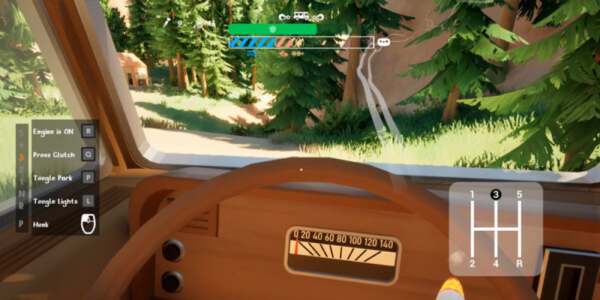
The interior contains mirrors, seats, storage, doors, windows, equipment, and domestic objects that create a convincing sense of place. Players can move around while someone else drives, which makes the vehicle feel like more than a camera attached to wheels. I enjoyed looking through windows, checking equipment, and watching the environment pass while another player controlled the route. The RV becomes a temporary home that the group gradually fills with damage and badly organized supplies.
Mirrors and interior rendering also create technical demands. The developers have adjusted how these elements are processed to improve performance, which shows how visually expensive a moving reflective interior can become. On lower settings, the space may lose some detail, but readability remains more important than perfect reflections. I mainly need to find tools quickly and understand whether the vehicle is still structurally usable.
The Sound Design Makes Mechanical Trouble Easy to Feel
The engine, tires, suspension, winch cable, loose objects, footsteps, animal sounds, and player voices create a dense audio environment. I can often hear that the RV is struggling before I understand the exact problem visually. A change in engine sound may indicate lost traction, while repeated impacts suggest that someone outside is making the situation worse. These cues make driving more physical and help players communicate without constantly describing every detail.
Proximity chat naturally becomes part of the soundscape. A friend’s voice may move from clear to distant as they leave the RV, creating a strong sense of physical location. This effect makes exploration more atmospheric and comedy more immediate. Hearing someone confidently announce a solution from far away, followed by sudden panic, is one of the game’s most reliable pleasures.
The Music Is Most Effective When the Group Creates Its Own Soundtrack
The game’s audio identity is strengthened by cassette music and the road-trip atmosphere surrounding the RV. Music can make an ordinary stretch of travel feel relaxed, then become absurd when the vehicle begins falling apart while the same song continues. I enjoy this contrast because the soundtrack does not need to react perfectly to every event. The group supplies the emotional interpretation through conversation.
Long sessions may lead players to use voice chat, jokes, and environmental sound as the real soundtrack. This is appropriate for a game built around social interaction. A perfectly cinematic score would compete with the spontaneous rhythm of the group. The existing approach leaves enough space for player-created moments.
Technical Stability Has Improved but Still Deserves Attention
The developers have released patches addressing crashes, voice communication, save issues, mirrors, connection errors, controller conflicts, graphics settings, and multiplayer reliability. This ongoing work has improved the overall experience, especially for longer sessions where earlier voice-chat problems could cause crashes. My general experience is playable, but physics-heavy multiplayer games can still produce jitter, unusual object states, and synchronization problems. A small network issue becomes visible when several players are interacting with one vehicle simultaneously.
Long journeys place particular pressure on stability because a crash can interrupt hours of shared progress. The save system reduces that risk, though I remain cautious about unusual situations involving destroyed vehicles, disconnected players, or objects held during a network problem. Performance depends on hardware and graphical settings, with mirrors and scene capture requiring additional resources. The game is technically modest in scale, but its interacting systems are more demanding than the simple visual style suggests.
Controller Support Works, Though Keyboard and Mouse Feel More Flexible
Driving and basic movement fit naturally on a controller because analog input helps with steering and movement speed. Managing the winch, interacting with small objects, and switching between interior tasks can feel less precise depending on the control layout. Keyboard and mouse provide faster camera movement and more direct access to certain actions. Rebindable keyboard controls improve comfort for players who prefer custom layouts.
I recommend testing both input methods before committing to a long journey. The best choice may also depend on role because a dedicated driver benefits from analog steering, while someone handling tools may prefer mouse precision. The game’s cooperative structure means different players can use different setups without creating a competitive imbalance. Comfort matters more than universal consistency.
The Game Does Not Need a Large Progression System
RV There Yet? focuses primarily on completing the journey rather than building a permanent character with extensive statistics or equipment levels. Achievements, hats, cosmetics, and map completion provide additional goals, but they do not replace the main cooperative experience. I appreciate this restraint because the physics and social stories remain central. The game does not require daily tasks or a battle pass to justify another session.
Limited progression also means replay value depends on the group and map variety. Once players understand every obstacle, there may be less reason to repeat the same route unless the social experience remains entertaining. For my group, different drivers and new plans created enough variation for several runs. Players seeking constant unlocks may find the structure comparatively light.
The Humor Works Best When the Game Does Not Explain It
The strongest comedy comes from players applying serious teamwork to an obviously terrible plan. A friend may speak like an engineer while attaching the winch to the wrong side of the RV, or someone may prepare food calmly while the vehicle slides toward a river. These moments work because the game allows the systems to produce the joke naturally. No character needs to announce that the situation is funny.
The written and item-based humor is more uneven. References to cigarettes, alcohol, frozen burgers, and irresponsible road-trip behavior establish the tone quickly, but repetition can make the joke feel limited. I prefer when these elements support the personalities players create rather than becoming the entire identity of the session. The game is funniest as a cooperative disaster simulator, not as a collection of substance-related interactions.
The Experience Depends Heavily on the People Beside Me
A cooperative game always depends on the group, but RV There Yet? makes that dependence unusually visible. Patient players can turn difficult terrain into a satisfying engineering puzzle, while impatient players may transform every section into uncontrolled chaos. Both styles can be entertaining if everyone expects the same experience. Conflict appears when one player wants careful progress and another wants to see whether the RV can jump across a ravine.
I recommend discussing the intended tone before beginning a long session. A serious completion run requires communication, organization, and willingness to stop before dangerous sections. A comedy-focused session can embrace failure, but the group should understand that progress may disappear. The game provides tools for both approaches without deciding which one is correct.
My Biggest Frustrations
Recovery can take too long after the RV becomes trapped in an especially bad position. Physics interactions occasionally behave inconsistently, while network synchronization may make another player’s movement or winch action difficult to read. Solo play involves too much repeated movement between roles, and public sessions remain vulnerable to disruptive players. The comedy survives many of these problems, but not every technical failure becomes a good story.
The content structure is also relatively narrow compared with larger cooperative adventures. Once I understand the available maps, survival items, and winch strategies, the sense of discovery declines. Substance-related jokes may become repetitive, and the lack of broader progression will not satisfy players motivated by constant upgrades. The game’s long-term future depends more on new routes and mechanical variety than on cosmetic rewards.
Who Should Play RV There Yet?
I recommend RV There Yet? to groups who enjoy cooperative physics games, proximity voice chat, road-trip humor, vehicle recovery, mechanical improvisation, and sessions where failure can be more entertaining than success. It works particularly well for three or four friends who are comfortable speaking constantly and assigning roles. Players who enjoyed games built around shared physical tasks and social confusion will understand its appeal quickly. The low initial mechanical complexity also allows new players to contribute without learning a large ability system.
I would be more cautious recommending it to solo-only players, groups that become genuinely angry after mistakes, or anyone who dislikes loose physics and repeated recovery work. The humor includes smoking, alcohol, and deliberately irresponsible behavior, so the tone will not suit every audience. Players expecting a detailed driving simulator or broad open-world road game may also be disappointed. This is a cooperative problem-solving comedy built around one difficult vehicle, not a realistic recreation of recreational travel.
My Final Verdict
RV There Yet? succeeds because it understands that the vehicle does not need to handle perfectly. Its awkward movement creates the communication, planning, panic, and blame that make the journey memorable. The winch is mechanically satisfying, the RV feels physically present, and proximity voice chat turns every recovery attempt into a social performance. When four players work together successfully, crossing one difficult hill can feel more rewarding than completing an entire mission in a more conventional cooperative game.
The experience is limited by technical inconsistencies, uneven solo play, potentially disruptive public sessions, repetitive humor, and a content structure that needs additional maps to remain surprising. Even with those flaws, I found the game’s identity unusually clear. I rate RV There Yet? 8.5/10. I rarely felt like I was controlling a recreational vehicle efficiently, but I consistently felt like I was trapped on the worst road trip imaginable with exactly the right people.
Pros:
- Robust gameplay mechanics that balance structure and freedom.
- A dynamic open-world design that rewards exploration and curiosity.
- Realistic weather and time-of-day effects that add challenging gameplay dimensions.
- Extensive mod and cheat support that extends replayability.
- Intuitive controls and customizable interfaces enhance player accessibility.
- Offers a rich visual experience that blends retro charm with modern aesthetics.
Cons:
- The detailed simulation may feel excessively slow-paced for some players.
- Additional content or in-game purchases might not appeal to every user.
- Occasional performance issues on lower-end or older hardware.









Recent Reviews

Minecraft

Grand Theft Auto V

Toca Boca World

Roblox

Leave a comment
Your comment is awaiting moderation. We save your draft here
0 Comments